
Ask any parent raising kids today whether it feels like more children are struggling with something, allergies, ADHD, anxiety, sensory issues, stomach troubles, and most will say yes without hesitating. The numbers back that up. By some estimates, roughly one in five children in the United States now has a special healthcare need, and more than 40 percent of school age kids live with some kind of chronic health condition. Genetics alone cannot explain a shift that fast. Neither can better diagnosis alone, or a single toxin, or any one thing parents did or did not do. We call the real explanation the Perfect Storm.
What the Perfect Storm Actually Means
The Perfect Storm describes a sequence of stressors that build on each other over time rather than any single cause. On its own, one piece of the pattern might not be enough to overwhelm a child's developing nervous system. Stacked together, prenatal stress, birth stress, and early life stressors can add up to more than a nervous system is ready to absorb. We teach this concept regularly because we see it in case history after case history, and you can read more about how we walk families through it on our Perfect Storm page, or join our free webinar where we cover it in depth.
Stage One: Prenatal Stress
The pattern often begins before birth. Chronic stress during pregnancy, whether physical, chemical, or emotional, can influence how a baby's developing nervous system forms. That does not mean a mother caused her child's later struggles. It means the nervous system is taking shape during a period when stress hormones and outside stressors can leave a lasting imprint on how that system develops and regulates itself.
Stage Two: Birth Stress
Birth itself is often the single biggest source of physical stress a child's nervous system experiences early on. Interventions like forceps, vacuum extraction, induction, and cesarean delivery can all place real pulling and twisting force on a newborn's upper neck, brainstem, and spine, and even straightforward vaginal births involve significant physical force. That stress can create what we call subluxation, a pattern of misalignment and restricted motion in the spine that interferes with communication between the brain and body. One analysis found that roughly 80 percent of babies born by cesarean went on to develop some form of sensory processing difficulty, which gives a sense of how much that early physical stress can carry forward.
It is worth pausing on why fertility itself belongs in this picture. Fertility challenges and interventions like IVF are increasingly linked to a higher likelihood of developmental struggles later in a child's life, and the reason likely traces back to the same place as everything else in this pattern: how the autonomic nervous system and vagus nerve take shape during the earliest, most sensitive window of a baby's development. Anything that disrupts that delicate process during the fertility and prenatal window can leave a lasting mark.
Stage Three: Early Life Stressors
After birth, the stack keeps building. Rounds of antibiotics following ear infections, a gut microbiome that never quite settles, environmental exposures, physical falls, and the ordinary accumulated stress of early childhood each add another layer of pressure onto a nervous system that may already be carrying tension from birth. None of these pieces has to be dramatic on its own. It is the accumulation across all three stages that tends to be what finally overwhelms a child's capacity to self regulate.
Why the Nervous System Is the Common Thread
Underneath a wide range of childhood struggles, there is very often the same underlying pattern:
- Colic, reflux, and constipation
- Repeated ear infections
- Delayed or missed developmental milestones
- Sensory processing differences
- ADHD and attention challenges
- Autism spectrum differences
- Anxiety and emotional regulation struggles
The common thread is an autonomic nervous system stuck leaning toward its sympathetic fight or flight setting rather than shifting easily into its parasympathetic rest and digest setting. That imbalance is called dysautonomia, and the vagus nerve, the body's primary driver of the parasympathetic side, sits right at the center of it. When the vagus nerve is not functioning the way it should, digestion, sleep, immune response, and emotional regulation all tend to struggle together rather than as isolated, unrelated problems.
The gut deserves its own mention here, since it sits so close to the center of this pattern. The combined effects of prenatal stress, birth stress, and antibiotic exposure can disrupt the gut microbiome in ways that ripple outward into immune function, allergies, and, through the well documented gut-brain connection, mood and behavior as well. A nervous system working overtime rarely stays contained to one system of the body for long.
How Our Doctors Approach This
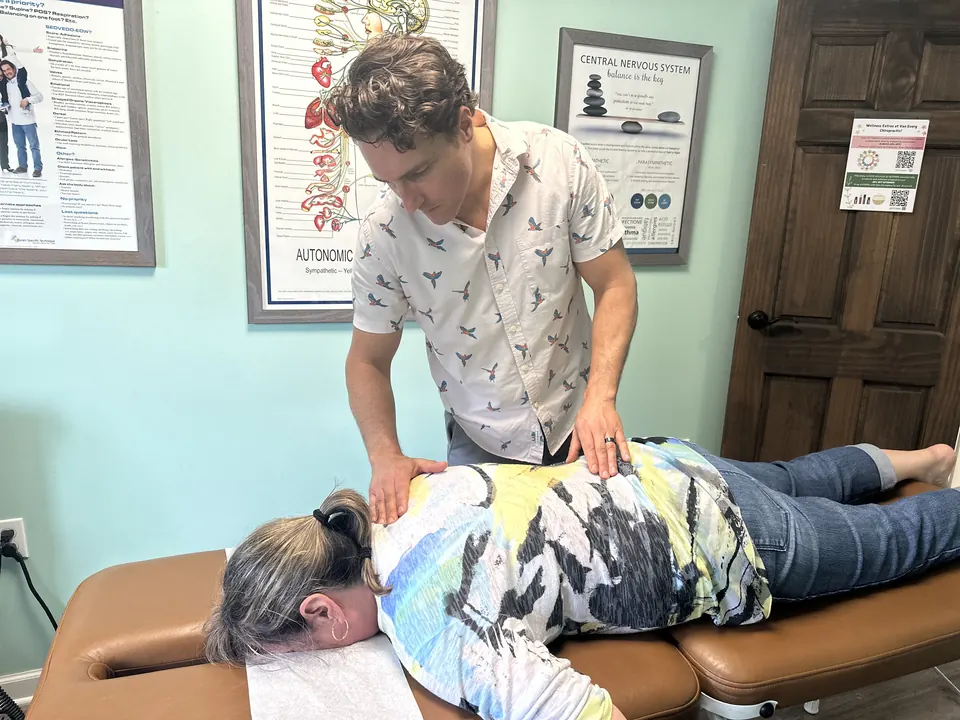
We start by listening closely to your child's full case history, fertility and pregnancy included, since that context often points directly to where a nervous system has been carrying stress. From there, INSiGHT neurological scanning, thermal, heart rate variability, and sEMG, gives us an objective look at where restriction and imbalance are sitting instead of guessing from the outside. Using Koren Specific Technique and Talsky Tonal Chiropractic, our doctors then work with light, specific, nervous system focused adjustments to release that stuck tension, most often concentrated in the upper neck and brainstem region, and give the vagus nerve room to do its job again.
Where to Go From Here
Understanding the Perfect Storm is the first step toward addressing it rather than managing each symptom on its own. If your family's story includes any piece of this pattern, fertility challenges, a stressful pregnancy, a difficult birth, or a string of early illnesses, it is worth having your child's nervous system looked at directly. Learn more about how we support nervous system health and whole family wellness, join our free webinar for a deeper walkthrough, or book online with our doctors in Royal Oak. You can also call us at (248) 616-0900.


