
Late Talking Toddlers: What Red Flags Mean and What Helps
One in five toddlers learns to talk later than their peers. For some it evens out on its own. For others, the gap is a sign worth understanding, not just waiting on.
Neurologically-Focused Chiropractic Support for Communication Development
When a child struggles to communicate, whether they are late to talk, hard to understand, or have trouble processing language, it touches nearly every part of their day. At Van Every Family Chiropractic Center, our doctors support children with speech and language delays by looking at the nervous system function that communication depends on in the first place, working alongside the speech therapy your child may already be receiving.
Speech and language require coordination between the brain, the cranial nerves, the muscles of the mouth and throat, and the sensory systems that feed into all of it. When there is interference in that system, especially around the upper cervical spine and brainstem where the relevant cranial nerves originate, the neurological foundation for speech can be affected before a single word is spoken.
Speech and language delays rarely look the same from one child to the next. Some children are not babbling by twelve months or speaking a single word by eighteen months. Others have plenty of words but struggle to string them into sentences, or have a hard time following directions and understanding what is said to them. Sounds may come out unclear or missing altogether, chewing and coordinating the mouth muscles can be a challenge, and back and forth conversation or picking up on social cues may not come easily. Every child's timeline looks a little different, which is exactly why this foundation is worth checking directly rather than waiting to see if a delay closes on its own, especially when a birth was difficult or a delivery involved instruments.
The cranial nerves that move the tongue, lips, jaw, and palate all originate in the brainstem, directly above the top of the neck.
The cranial nerves that control the tongue, lips, jaw, palate, and throat (nerves V, VII, IX, X, and XII) all originate in the brainstem, directly above the upper cervical spine, at C1 and C2. When that area is under tension, from a difficult birth, a fall, or the ordinary bumps of early childhood, the signaling those muscles depend on can be affected. The same tension can also keep a child's nervous system leaning toward fight or flight rather than the calm, regulated state where language learning actually happens, which is part of why some children who struggle to communicate also struggle to sit still and pay attention.
We start with a thorough evaluation, including INSiGHT neurological scanning (thermal, HRV, and sEMG) to objectively assess your child's nervous system function and find where stress patterns from birth, early development, or everyday life may be stuck, rather than guessing at what is behind the delay.
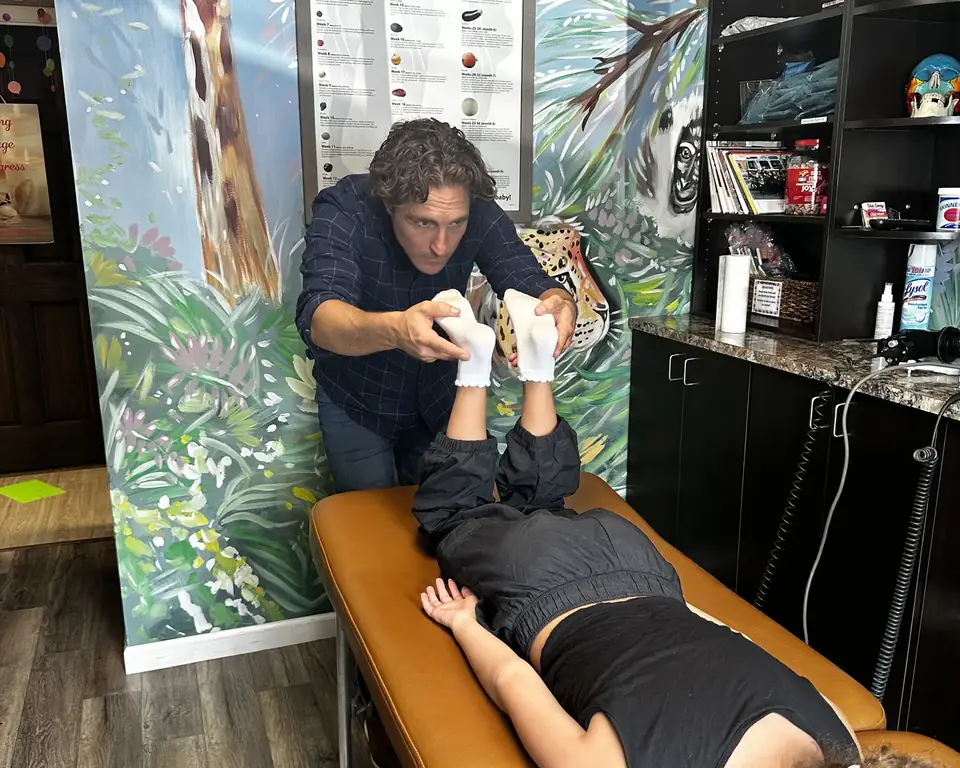
Using Koren Specific Technique (KST) and Talsky Tonal Chiropractic (TTC), our doctors correct upper cervical misalignments with light, nervous system focused contacts and no cracking or twisting, adjusted to each child's age and comfort level. Many kids tolerate the care well and come to look forward to their visits.
A speech-language pathologist teaches the specific skills and strategies your child needs, and we stay in touch with your child's therapist and pediatrician to keep everyone coordinated. Our part is the neurological foundation those skills build on. When that foundation is more settled, parents often tell us their child responds faster to therapy and gets more out of every session, so the two approaches end up reinforcing each other rather than working in isolation.
New words and sounds emerging, clearer speech, and better follow-through on directions are usually the first changes parents describe, sometimes within the first several visits.
Many also notice their child paying better attention during therapy sessions, chewing and coordinating their mouth muscles more easily, and showing more willingness to communicate and engage in social settings that used to feel harder for them.
Children of any age can benefit from this kind of evaluation, from babies not yet babbling to older kids working through articulation. The earlier interference is addressed, the more foundation there is to build on, though it is never too late to start.
Take the First Step Gentle care may help unlock your child's communication potential. Schedule an evaluation with our doctors in Royal Oak.
Book OnlineTeaching the specific sounds, words, and strategies your child needs is the role of a speech-language pathologist. What our doctors do is optimize the nervous system function that speech and language development depends on. Many parents tell us their child makes faster progress in speech therapy once that foundation is more settled.
The cranial nerves that control the tongue, lips, jaw, palate, and throat (nerves V, VII, IX, X, and XII) originate in the brainstem, directly above the upper cervical spine, at C1 and C2. Tension in that area can interfere with the nerve signaling those muscles depend on for speech production and language processing.
Yes. Our doctors use Koren Specific Technique (KST) and Talsky Tonal Chiropractic (TTC), both light, nervous system focused approaches with no cracking or forceful manipulation, adjusted to each child's age and comfort level. Children typically tolerate the care well, and many come to enjoy their visits.
Yes, the two work well together. Speech therapy provides the specific exercises and strategies for language development, while our care supports the neurological foundation that development is built on. Parents often see better results from combining the two than from either alone.
Every child is different. Some parents notice new sounds or words within the first several visits, while others see gradual changes over a few months as therapy and care work together. Our doctors track progress with regular re-evaluations and stay in touch with your child's therapist and pediatrician along the way.
Children of any age can benefit, from babies not yet babbling to older kids working through articulation. Our doctors see kids from newborns through teenagers, and the earlier interference is addressed, the more foundation there is to build on, though it is never too late to start.
One in five toddlers learns to talk later than their peers. For some it evens out on its own. For others, the gap is a sign worth understanding, not just waiting on.
Your child works hard in speech therapy, then progress flattens out. Here is why the missing piece is often further upstream than the mouth and tongue.
Your child clearly understands everything and clearly has something to say. The words just won't come out right, and speech therapy alone has only gotten you so far.
See what Royal Oak families say in our Google reviews and patient stories, or browse everything we offer.
Our doctors put together a full article on speech & language delays that explains what's really behind it and what lasting relief looks like. Get instant access below.

Van Every Family Chiropractic Center Royal Oak, Michigan
Free on-demand webinar for parents
Looking for answers for your child?
Focus struggles. Big emotions. Restless nights. Tummy troubles. Join our doctors for a free parent webinar exploring the nervous system connection and ways to support your child.
Explore the free webinarFree · About an hour · Watch anytime
