

Why Your Stomach Knows Exactly How Stressful Your Week Has Been
You can predict your worst gut days from your calendar alone. That connection is not in your head. It runs through a real, measurable pathway between your brain and your gut.
Why so many teens with IBS symptoms are dismissed, what the brain-gut-spine axis actually has to do with it, and why the school-morning stomach ache loop keeps cycling
Your teenager wakes up every school morning with a stomach ache. Or they spend the first hour of the day in the bathroom with cramps and urgency they cannot predict or control. The pediatrician ran labs. The GI doctor saw nothing structural. And someone along the way suggested it was anxiety.
Here is what most families are not told: the stomach aches are not imaginary, and they are not simply anxiety. The gut and the brain share a two-way communication highway, the vagus nerve, and in adolescents whose nervous systems are under sustained stress, the gut is often the first system to go offline. The school-morning pattern, the urgency, the bloating that seems to arrive with deadlines and social pressure, that is the brain-gut axis under load.
IBS in teenagers is real, underdiagnosed, and frequently dismissed. The current clinical framework (Rome IV) now classifies it formally as a disorder of gut-brain interaction, not a gut disease. What drives the pattern is the nervous system. That is also where meaningful support begins.
The vagus nerve controls motility, enzyme production, and the pain-sensitivity of the gut lining. In adolescents under chronic academic, social, or performance stress, the sympathetic system stays elevated and the parasympathetic rest-and-digest mode never fully engages. The cramping, urgency, and morning stomach ache are the gut responding to a nervous system stuck in overdrive.
One of the clearest patterns in adolescent gut-brain axis dysfunction: symptoms peak in the morning, when stress anticipation is highest, and often ease on weekends or breaks. The gut is responding to nervous system state, not a structural problem.
Urgency that cannot be predicted or controlled, arriving with stress, before tests, before social situations. Many teens begin mapping their routes around restroom access, which itself narrows their world.
Persistent bloating and cramping that does not follow a clear dietary pattern is often a motility issue driven by dysregulated enteric nervous system activity, not a specific food sensitivity.
When gut symptoms reliably improve during lower-stress periods and return as school resumes, families often interpret this as anxiety. It is the nervous system telling you exactly where the root is.
Teens who cannot predict their gut will often begin avoiding school, activities, restaurants, or friends' homes. What looks like anxiety or withdrawal is sometimes a very practical adaptation to unpredictable gut function.
Negative scopes, normal inflammatory markers, no celiac, no clear food triggers. When everything looks fine on paper but symptoms persist, the problem is regulatory, not structural, and a different approach is needed.
Many parents report that the school-morning routine shifts as the nervous system becomes less dominated by the stress response. The urgency and cramping that made mornings chaotic often become less intense and less frequent.
As the gut runs more consistently in its parasympathetic mode, the pain cycles many teens experience throughout the school day often become shorter and less frequent.
Better gut motility means less fermentation, less distension, and less of the visible bloating that many teens find embarrassing and difficult to manage at school.
Teens whose gut symptoms ease often re-engage with activities they had been avoiding. Restaurants, travel, sports, social situations that required bathroom proximity begin to feel manageable again. Many parents describe this as getting their kid back.
Our approach focuses on the vagal pathway and the autonomic balance that determines how well a teenager's gut-brain axis is functioning.
We begin with objective neurological assessment giving us data about how your teen's autonomic nervous system is functioning, specifically the sympathetic-parasympathetic balance and HRV patterns that directly reflect how much the gut-brain axis is being suppressed by chronic stress load.
We pay particular attention to the craniocervical junction (where the vagus nerve exits), the thoracic spine (where sympathetic outflow to the GI tract originates), and the overall tension pattern that tells us how deeply the nervous system is stuck in stress mode. Using Koren Specific Technique, Talsky Tonal Chiropractic, we work with the nervous system, not the abdomen directly.
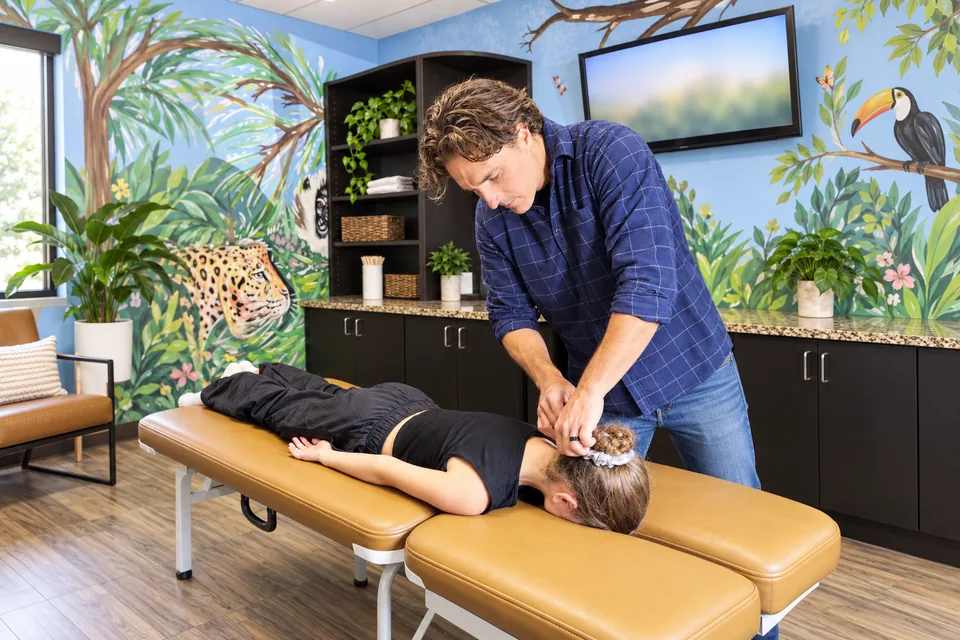
Our care is calibrated to the teenager's comfort, using precise, light-force input with no cracking, no twisting, and no discomfort. For teens who are already anxious or avoidant, the non-threatening nature of the care is itself meaningful. We explain every step and work at your teen's pace.
Families often tell us they notice changes in:
Want to Understand What's Behind Your Teen's Gut Symptoms? Learn how the brain-gut-spine axis drives adolescent IBS patterns, why the school-morning stomach ache loop keeps cycling, and why a nervous-system approach addresses what dietary changes and anxiety treatment often cannot.
Book OnlineYes. We work alongside your child's GI doctor and pediatrician, coordinating our care with theirs. We focus on the autonomic nervous system and vagal pathway that coordinates gut function. If your teen has not yet been evaluated by a GI specialist, we encourage that evaluation to continue.
The sympathetic nervous system (fight-or-flight) stays elevated in anticipation of a stressor even before the stressor arrives. Digestion is a parasympathetic function. When the stress side of the nervous system dominates, gut motility and pain sensitivity are directly affected. The morning peak and weekend improvement pattern is the nervous system showing you exactly where the root is.
Dietary changes reduce inputs that provoke symptoms. They cannot restore the vagal signal that tells the gut when to move, when to absorb, and when to settle. When the nervous system is stuck in sympathetic dominance, no amount of dietary precision will shift the brake pedal into gear. The signal has to change at the source.
Yes. Our care is the opposite of invasive. Both Koren Specific Technique and Talsky Tonal Chiropractic use light-force input with no cracking, no twisting, no discomfort. For teens who have been through scopes and uncomfortable medical tests, this is a genuinely different experience.
You can predict your worst gut days from your calendar alone. That connection is not in your head. It runs through a real, measurable pathway between your brain and your gut.
Every test comes back normal, and the pain is still real. When a child's gut has become hypersensitive, ordinary digestion can start to feel like an emergency, and there is a nervous system reason why.
See what Royal Oak families say in our Google reviews and patient stories, or browse everything we offer.
Our doctors put together a full article on tummy troubles & ibs in kids that explains what's really behind it and what lasting relief looks like. Get instant access below.

Van Every Family Chiropractic Center Royal Oak, Michigan
Free on-demand webinar for parents
Looking for answers for your child?
Focus struggles. Big emotions. Restless nights. Tummy troubles. Join our doctors for a free parent webinar exploring the nervous system connection and ways to support your child.
Explore the free webinarFree · About an hour · Watch anytime
