
Flat Head Shape in Babies: What Helps Beyond a Helmet
A flat spot on your baby's head is not just about head shape. It often comes with limited neck movement, and a helmet alone will not address why that tension is there.
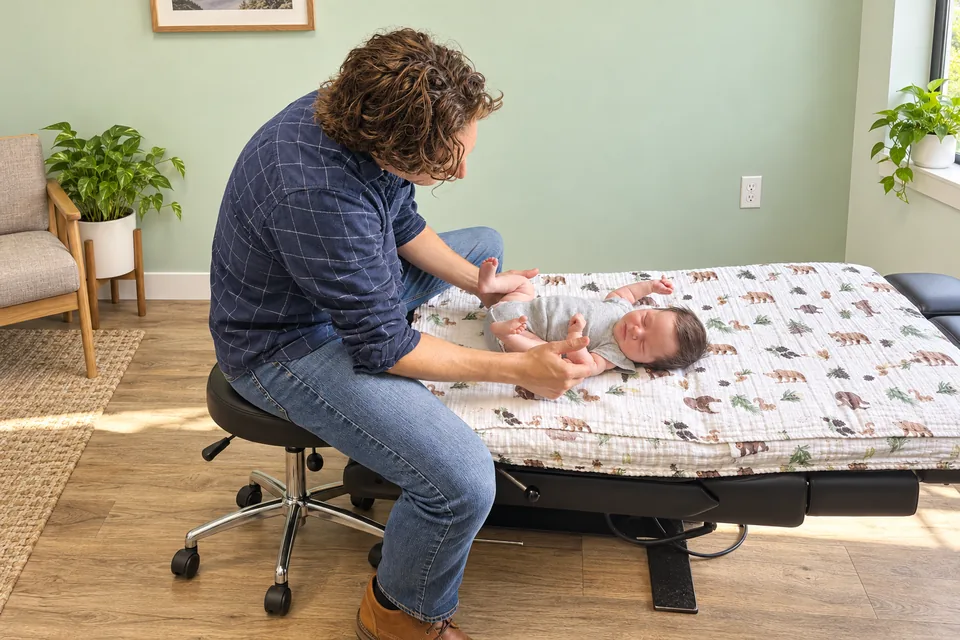
Gentle Chiropractic Support for Your Baby's Head Shape
If you have noticed a flat spot on your baby's head, you are not alone. Plagiocephaly, the medical term for an asymmetrical head shape, affects nearly half of infants to some degree, and it almost always has a mechanical reason behind it that is worth understanding rather than simply waiting out.
A baby develops a flat spot by consistently resting their head the same way, and that usually traces back to torticollis or an upper cervical restriction that makes turning one direction uncomfortable. Repositioning and tummy time work on the symptom. Freeing up the neck itself is what lets a baby choose either side on their own, which is why the two approaches work best together.
The most obvious sign is a flat area on the back or side of the head, but plagiocephaly rarely stops there. Parents often notice one ear sitting a little more forward than the other, or one side of the forehead looking more prominent, both of which trace back to the same underlying asymmetry. A baby with plagiocephaly usually has a clear favorite side to look toward and resists turning the other way, and that same one-sided preference tends to show up at the breast or bottle as a baby who nurses easily on one side but fights the other. Night after night of sleeping with the head turned the same direction is often what lets the flat spot progress in the first place.
A baby's skull is at its most moldable in the first four to six months of life, which is also the window where the fastest change is possible.
If a baby cannot comfortably turn toward one side, gravity does the rest: the same spot on the skull bears weight night after night, week after week. Helmets and repositioning devices work with that same soft, moldable bone, but they cannot fix why the head keeps returning to one position in the first place. That piece is almost always mechanical, and it usually traces back to how freely a baby can actually move their neck, whether from torticollis, tight positioning in the womb, or the mechanics of a difficult delivery.
Our doctors start with a thorough evaluation of head shape, neck mobility, muscle tone, and spinal alignment, including whether torticollis or birth positioning is part of the picture. INSiGHT scanning, which measures thermal, HRV, and sEMG readings when it is age-appropriate, helps us see objectively where the nervous system is under stress rather than guessing from the flat spot alone. In-utero crowding and a difficult delivery both come up often in that history.
Using Koren Specific Technique (KST) and Talsky Tonal Chiropractic (TTC), we correct the upper cervical restrictions that limit head rotation, with light, nervous system focused contacts and no cracking or popping. Once a baby can turn freely both ways, the skull has the chance to round out on its own.
We teach specific repositioning strategies and tummy time techniques tailored to your baby's age and comfort, along with simple exercises to build tolerance for the direction that has been harder. We coordinate directly with your pediatrician or a craniofacial specialist if helmet therapy becomes part of the plan, so nothing you are doing at home works against it, and everyone involved is working from the same information.
Improved rotation and a willingness to look both ways are usually the first changes parents notice, often within the first several visits, sometimes within four to eight visits total.
Head shape symmetry tends to follow from there, along with easier feeding on both sides, better sleep position variety, and a baby who seems more comfortable overall.
In moderate to severe cases, a craniofacial specialist may recommend a helmet alongside chiropractic care. The two approaches complement each other well: better neck mobility gives the helmet more symmetrical growth to work with, rather than fighting the same one-sided positioning that started the flat spot.
Take the First Step The earlier a flat spot is addressed, the faster it typically improves. Schedule your baby's evaluation in Royal Oak.
Book OnlineBabies can be evaluated within the first few weeks of life. The earlier we identify and address contributing factors like cervical restriction, the faster the head shape typically improves. Our doctors regularly see newborns just days old.
Yes. Our doctors use light, nervous system focused contacts specifically suited to infants, no more pressure than you would use to check a ripe tomato, with no cracking or twisting. Parents are with their baby the entire time, and many babies sleep right through their adjustments.
Many babies improve with chiropractic care, repositioning, and tummy time alone, especially when addressed early. In moderate to severe cases, helmet therapy may be recommended alongside chiropractic care. Our doctors give you an honest assessment and work directly with your pediatrician or craniofacial specialist.
Common causes include torticollis, prolonged time in one position such as car seats, swings, or cribs, birth trauma from a vacuum or forceps-assisted delivery, premature birth, and in-utero positioning. Multiple factors often contribute together.
Most babies show visible improvement within four to eight visits, especially when care starts early, though every baby is different. We determine the right pace after a thorough history, consultation, and INSiGHT scans when age-appropriate, then monitor progress at every visit and adjust from there.
Mild plagiocephaly is mostly cosmetic, but the underlying factors behind it, like cervical restriction and torticollis, can also affect feeding, motor development, and milestone progress. Addressing those factors supports your baby on more than just head shape.
A flat spot on your baby's head is not just about head shape. It often comes with limited neck movement, and a helmet alone will not address why that tension is there.
Your pediatrician calls it a preference and says to watch and wait. If your baby always tilts to one side, here is why the neck muscle is only part of the story.
See what Royal Oak families say in our Google reviews and patient stories, or browse everything we offer.
Our doctors put together a full article on plagiocephaly (flat head syndrome) that explains what's really behind it and what lasting relief looks like. Get instant access below.