

When a Childhood Hip Difference Shows Up as Adult Hip or Back Pain
A hip that was never quite square in infancy does not always announce itself again until decades later, as hip pain, groin pain, or low back pain that never quite made sense.
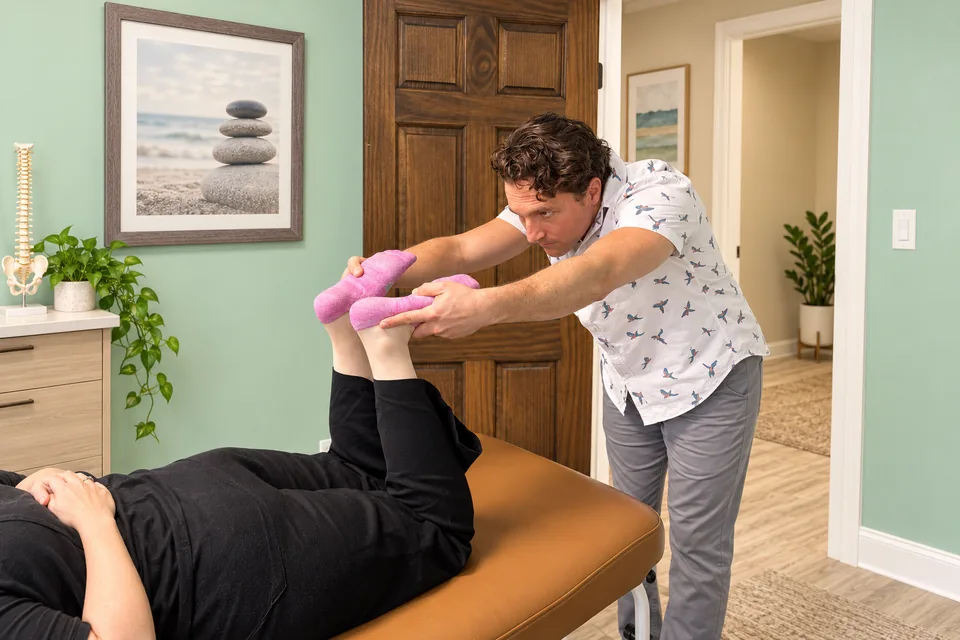
Most families first hear the words "hip dysplasia" at a newborn exam, not an adult checkup. Maybe there was a hip click. Maybe a provider noticed uneven thigh folds. Maybe your baby was breech and you were told to watch and wait. As a pediatric-focused practice, this is where we spend most of our time with hip dysplasia: infants and toddlers whose hips and pelvis are still settling out of the position they held in the womb.
Hip dysplasia does not always announce itself in infancy. Some people grow into adolescence or adulthood with a hip that was never quite square, and go on to develop hip, groin, or low back pain, or early hip arthritis. For these patients, care looks at how the pelvis, spine, and nervous system are coordinating around that longstanding difference.
In babies, hip dysplasia rarely announces itself loudly. What we watch for is a hip that clicks or feels loose on exam, thigh or gluteal folds that do not match from side to side, a head that is consistently turned one direction, or a leg that folds differently than the other. It often traces back to a breech position, a twin pregnancy, or simply a tight fit in the womb during the final months. In toddlers, the sign that usually brings families in is a limp, a waddling gait, or one leg working harder than the other while walking.
Hip dysplasia does not always get caught in infancy. Some people grow into adolescence or adulthood with a hip socket that never fully covered the ball of the joint, and go on to develop hip or groin pain, low back pain, or early hip arthritis, often without hearing the word "dysplasia" until an X-ray finally explains years of unevenness.
The same tucked position that shapes a hip in the womb often leaves its mark on the neck, the ribs, or how a baby prefers to turn, long before any of it shows up as a diagnosis.
The hip is built for stability more than free range of motion, and before birth the socket depends on the head of the femur sitting snugly inside it to finish shaping correctly. A breech position, a tight uterine fit from twins or a larger baby, or a family history of loose ligaments can all leave that socket shallower than it should be at birth. In older children and adults, that same shallow socket changes how weight travels through the hip, low back, and knees for years afterward, which is usually where the compensation pain actually starts.
For infants, we ask about pregnancy positioning, delivery, and any orthopedic findings so far. For teens and adults, we ask about prior diagnoses, imaging, and how the pain has changed over time, then run an INSiGHT scan, thermal, heart rate variability, and muscle (sEMG) readings, to see where the nervous system is under stress around the hip and pelvis.
Using Koren Specific Technique (KST) and Talsky Tonal Chiropractic (TTC), our doctors assess and adjust the whole pelvis and spine, not just the joint that is symptomatic, with gentle, nervous-system focused contact and no cracking or twisting, adjusted seated, standing, or in whatever position avoids provoking the hip.
For infants, we often see the pelvis and hips settle within the first several visits, working alongside any bracing or harness a pediatric orthopedist has already started. Toddlers are reassessed as their gait develops and their walking pattern changes over time. Teens and adults with a longstanding hip difference typically need more time, since the spine, opposite hip, and knees have been compensating for years, but it is rarely too late to start addressing the underlying pattern.
Contact is light enough that most babies sleep through an adjustment, and the same light, nervous-system focused approach works for a grandparent with decades of hip wear. We coordinate with your pediatric orthopedist, pediatrician, or adult orthopedic surgeon rather than working around their plan, supporting bracing, physical therapy, or post-surgical recovery already underway.
Babies often settle more evenly with less one-sided fussiness. Toddlers move with a steadier gait. Teens and adults notice less hip and groin discomfort during activity, along with less compensation pain in the low back, opposite hip, or knees.
Take the First Step Whether you are navigating a newborn hip check or years of adult hip pain, let us talk through what gentle care can look like. We see families on Saturdays in Royal Oak.
Book OnlineHip dysplasia, sometimes called developmental dysplasia of the hip, is when the hip socket does not fully cover the ball of the thigh bone. It ranges from a mildly shallow socket to a hip that is partially or fully out of place, and it can be present at birth or develop as a child grows.
Most often it is noticed at a newborn or well-baby exam: a hip that clicks or feels loose, thigh or gluteal folds that do not match, or a family history and breech position that prompt closer screening. Our doctors will ask about pregnancy positioning and delivery and note anything worth watching alongside your pediatrician.
Yes. Our doctors use light, nervous system focused contacts, no cracking, twisting, or forceful movement, and most babies sleep right through an adjustment. Care is adjusted to whatever position keeps your baby comfortable and supports the hip and pelvis rather than provoking them.
Absolutely. We coordinate with your pediatric orthopedist rather than working around their plan, and gentle chiropractic care can support a baby wearing a Pavlik harness or similar brace by easing tension in the spine and pelvis around it.
Not at all. Many adults carry a hip that was never quite square into their thirties, forties, and beyond, and go on to develop hip, groin, low back, or knee pain from years of compensation. Our doctors evaluate how your whole pelvis and spine have adapted around that longstanding difference and build care around what they find, whether or not the hip itself has ever been treated surgically.
No, and we would not want it to. We work alongside your pediatric orthopedist, pediatrician, or adult orthopedic surgeon, supporting bracing, physical therapy, or post-surgical recovery that is already underway rather than replacing it.
A hip that was never quite square in infancy does not always announce itself again until decades later, as hip pain, groin pain, or low back pain that never quite made sense.
See what Royal Oak families say in our Google reviews and patient stories, or browse everything we offer.
Our doctors put together a full article on hip dysplasia that explains what's really behind it and what lasting relief looks like. Get instant access below.