

What a Fever Is Actually Doing Inside Your Child's Body
A rising thermometer sends most parents into a bit of a panic. But a fever is your child's immune system doing exactly what it was built to do, not a malfunction to shut down.
Understanding What a Fever Is Actually Doing, and When to Call the Doctor
Fever is one of the most common reasons parents bring a child in to be seen, accounting for roughly three out of ten pediatric primary care visits. It is also one of the most misunderstood. Most parents are taught to see the number on the thermometer as the danger itself. In our practice we see it differently: a fever is usually a sign that your child's immune system is doing exactly what it was designed to do.
That does not mean every fever can be ignored, and this page includes a clear list of the signs that always warrant a call to your pediatrician or a trip to the ER. What it does mean is that most fevers are not the emergency parents fear at two in the morning. Our care never aims at the fever number. We support the nervous system coordinating the whole response, so your child has an easier time resting, settling, and recovering.
When a virus or bacteria shows up, your child's hypothalamus, the brain's internal thermostat, intentionally raises core body temperature. That is not a malfunction. It is a deliberate immune strategy. Normal body temperature sits around 98.6 degrees, but it naturally drifts by about a degree or more with activity, food and fluid intake, time of day, age, and, for older children, the menstrual cycle. A slightly warm reading after a nap in a heavy blanket is not the same thing as a true fever.
A fever is not the illness. It is usually your child's immune system doing exactly what it was designed to do.
For children, the generally accepted thresholds are an oral temperature of 99.5 degrees, a rectal temperature of 100.4 degrees, or an underarm reading of 99 degrees. Rectal readings are considered the most reliable for infants, which is part of why pediatricians ask for them specifically in the first few months of life. For adults, 100.4 degrees is the number most commonly used.
None of these numbers are a verdict on their own. They are simply the point where it makes sense to start paying closer attention to how your child looks and acts, not just to what the thermometer says.
A fever does real work in three main ways. Raising core temperature makes it harder for many bacteria and viruses to grow and multiply, since the proteins those pathogens depend on tend to be heat-sensitive. It also helps certain immune cells move and respond more effectively, part of what leads to a quicker recovery. And it signals the body to slow down and rest, exactly what the immune system needs while it does this work.
The vast majority of fevers in children trace back to an ordinary viral or bacterial illness, the everyday colds and flu-like bugs that move through daycares and classrooms. Less commonly, fever can follow a vaccination, show up mildly with teething, or come from an autoimmune or inflammatory condition, exposure to a toxin, heat stroke, or a medication side effect. A fever that lingers or behaves unusually is also one reason a physician looks closer, since rarer causes such as certain cancers or blood clots occasionally need to be ruled out. That is what your pediatrician is there for.
Some signs always mean it is time to call your pediatrician or go to the ER, and chiropractic care never replaces this list: any fever at all in a baby under three months old, 104 degrees or higher at any age, a fever climbing past 103 degrees and staying there, lasting more than 72 hours or recurring, trouble breathing, unusual lethargy or trouble waking, dehydration, a stiff neck, a rash that does not fade under pressure, a seizure, or hallucinations, repeated vomiting, or severe distress.
A few other situations always warrant a call too: an underlying immune problem, recent travel abroad, known exposure to a toxin, or a high fever right after an immunization. Our doctors ask about this list at every visit, and we always point a family back to their pediatrician or urgent care when any of these signs are present.
When the cause is ordinary and fluids are kept up, a fever itself is rarely the dangerous part. What makes an illness serious is usually the underlying cause, not the reading on the thermometer. Routinely knocking a typical fever back down can work against your child: the immune system does not fight at full strength while its temperature is artificially lowered, which can draw illness out longer. Frequent dosing carries its own downsides, and a child who feels temporarily better on medication can seem well enough to go back to school or daycare while still contagious, which is how illnesses keep circulating.
None of this is a directive. How and when to use a fever reducer for comfort is a decision between you and your pediatrician. We simply do not build our own care around chasing the number down, because the number was never what we work with.
There is plenty you can do to help your child feel better without working against what the fever is trying to do. Fluids matter most, since dehydration is the real risk, and rest helps more than most families expect. Warm herbal teas, bone broth, and homemade soup ease discomfort and keep a child nourished while appetite is low. Ask us about supportive supplements too, options that support your child's body without suppressing what it is doing.
Think of your child's nervous system as having a gas pedal and a brake. The sympathetic side is the gas pedal, the stress and immune-alert response that drives the fever itself. The parasympathetic side is the brake, responsible for rest, digestion, and recovery. Regulating a fever well means shifting smoothly between the two: revving up to fight the illness, then settling back down to rest and heal.
A nervous system already under chronic tension, whether from birth stress, an old injury, or ongoing strain, often has a harder time finding that brake, and a child can struggle to settle and stay uncomfortable longer than the fever itself would explain. This is why we believe every child's nervous system deserves regular checks, fever or not, so any interference is found and cleared before it limits how well the body can express its own healing capacity.
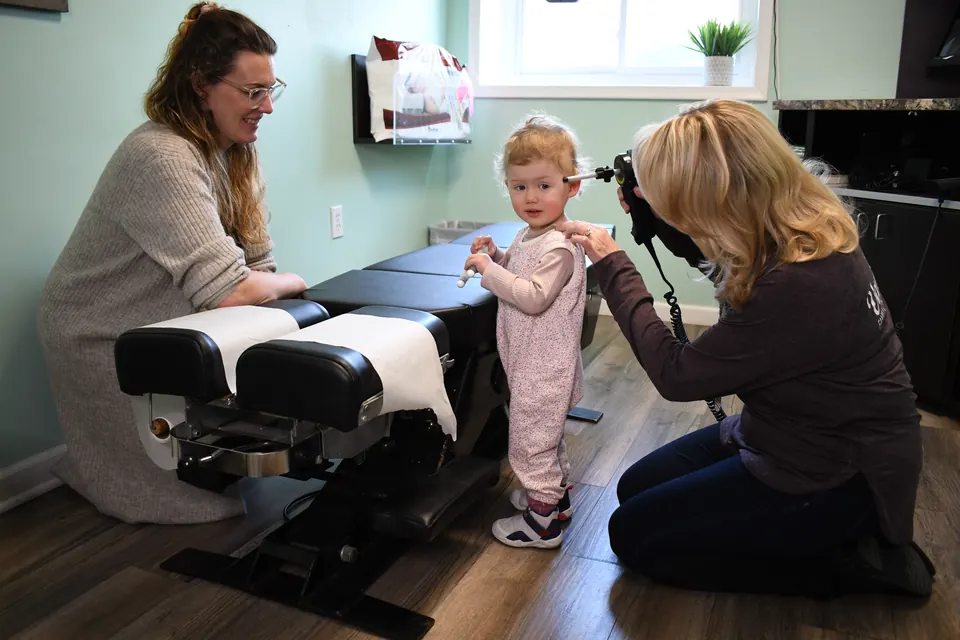
We start with a thorough history and, when appropriate for your child's age, INSiGHT neurological scanning, thermal, heart rate variability, and muscle scans, to get an objective look at nervous system function rather than guessing from symptoms alone. Using Koren Specific Technique (KST) and Talsky Tonal Chiropractic (TTC), our doctors use gentle, low-force input calibrated to your child's age, with no cracking, popping, or forceful movement. For infants, the contact is closer to the pressure you would use to check a piece of fruit for ripeness. Most children settle quickly, and many babies fall asleep during their visit.
Many parents notice their child settles and rests more easily during a fever, and some notice illnesses move through with less overall distress. We are not your child's pediatrician, and we do not want to be. Our care supports the nervous system so your child can regulate, rest, and recover, working alongside your pediatrician, never in place of them.
Take the First Step If fever season has your family exhausted and worried, come find out what gentle, nervous-system focused care looks like in Royal Oak.
Book OnlineNo, and that is not our goal. A fever is usually a normal, helpful part of your child's immune response, so we do not work to bring the number down. Our care supports the nervous system so your child can regulate, rest, and recover more comfortably while the immune system does its job.
For children, a fever is generally an oral temperature of 99.5 degrees, a rectal temperature of 100.4 degrees, or an underarm reading of 99 degrees. For adults, 100.4 degrees is the standard threshold. Normal temperature naturally shifts by about a degree with activity, food, time of day, and age, so one slightly warm reading is not automatically a fever.
That is a decision for you and your pediatrician, and there are times comfort matters most. What we would add is that routinely knocking down a typical fever is not always the most helpful move on its own: the immune system works less efficiently while temperature is artificially lowered, frequent dosing has its own downsides, and a child who feels better on medication can go back out while still contagious. We are glad to talk through supportive options that do not suppress what the fever is doing.
A fever that lasts more than 72 hours, keeps recurring, or keeps climbing past 103 degrees and stays there always warrants a call to your pediatrician. So does any fever of 104 degrees or higher at any age, and any fever at all in a baby under three months old. Chiropractic care never replaces that call.
We start by listening to your child's history and, when appropriate for their age, use INSiGHT neurological scanning to get an objective look at how the nervous system is functioning. From there, our doctors use gentle, age-appropriate adjustments with Koren Specific Technique (KST) and Talsky Tonal Chiropractic (TTC), with no cracking or popping. We never target the fever itself. We support the nervous system coordinating the whole response.
Always call your pediatrician or go to the ER for any fever in a baby under three months old, a temperature of 104 degrees or higher, a fever that keeps climbing past 103 degrees, a fever lasting more than 72 hours or recurring, trouble breathing, unusual lethargy or dehydration, a stiff neck, a rash that does not fade with pressure, a seizure, hallucinations or severe distress, an underlying immune problem, recent travel abroad, exposure to a toxin, or a high fever right after an immunization. We will always point you back to your child's doctor when any of these signs are present.
A rising thermometer sends most parents into a bit of a panic. But a fever is your child's immune system doing exactly what it was built to do, not a malfunction to shut down.
Your child hasn't gone in days, their belly feels warm, and now there's a fever too. Here is what that combination usually means, and when it means something more.
See what Royal Oak families say in our Google reviews and patient stories, or browse everything we offer.
Our doctors put together a full article on fever in children that explains what's really behind it and what lasting relief looks like. Get instant access below.
