Pain That Only Shows Up in Certain Positions

Pain That Only Shows Up in Certain Positions

Why It Only Hurts When You Do That

Person at a desk holding their neck in pain while working at a computer

You feel completely fine standing at the counter. Then you sit down at your desk, or get behind the wheel for a drive, and it starts right on schedule. Or maybe it only happens when you hold a golf club a certain way, lean into a guitar, reach for the mouse, or turn your head to check a blind spot. Everywhere else, nothing.

That pattern is easy to dismiss, by other people and sometimes by yourself. If it only happens sometimes, in one position, it must not be that serious. Maybe an exam even came back clean, because you were checked standing or lying flat, not in the position that actually bothers you. In our practice we see something different: pain that is specific to a posture is not vague or inconsistent. It is precise. And a precise pattern is usually easiest to find in the exact position where it lives.

How It Shows Up

Position-dependent pain takes a lot of different forms, and the common thread is that a specific posture or activity is the trigger, not general movement. Some people are fine standing but hurt within minutes of sitting, or on a long drive. Occupational research backs up just how common this is: professional drivers report low back pain at some of the highest rates of any occupation studied, driven largely by the posture and vibration of sitting behind the wheel for hours at a time. Others notice it only at the desk, holding a mouse at a certain angle or looking down at a phone for too long, and studies on heavy computer users show meaningfully higher rates of neck and shoulder pain tied to exactly that posture.

Musicians can feel it only while holding a guitar in playing position, and playing-related pain is remarkably common among musicians of every kind, usually centered in the neck. Golfers often feel it at one specific point in the swing rather than everywhere else on the course, and roughly one in three golfers has played through low back pain tied to that exact moment in their mechanics.

Turning the head a certain way, reaching overhead, or stooping into a cramped position can bring on pain that never shows up standing upright. For some people, the position that hurts today is the same position their body was in during an old car accident or a fall, a pattern that has quietly stuck around since the original injury.

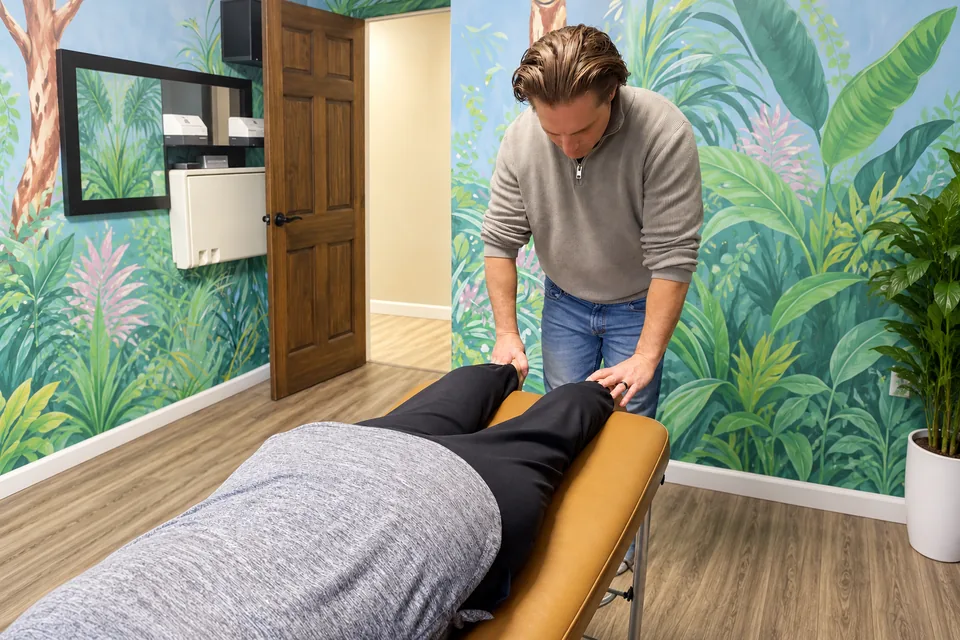
Pain that hides everywhere except one position is not inconsistent. It is specific, and specific patterns need to be checked where they live.

Why One Posture Hides What Another Reveals

A spine that looks balanced standing in an exam room can be measurably different once a person sits down, turns, or leans into a particular angle. That is not a contradiction. Research on positional imaging backs this up: studies comparing seated and standing spine films on the same person find real, measurable differences in curvature, and imaging patients in the position that reproduces their symptoms regularly turns up findings that routine imaging in a neutral position misses entirely.

That is why checking someone only standing, or only lying flat on a table, can miss a pattern that only reveals itself sitting, turned, or holding a particular object. The position is not a distraction from the real problem. It is often where the real problem is hiding.

The Posture of an Old Injury

Sometimes the position that triggers pain today traces directly back to how the body was positioned when it was first hurt. Someone injured while seated in a car accident often carries a different pattern than someone hurt falling down stairs or getting knocked over playing sports. A body thrown forward and to one side during a collision can end up holding a pattern specific to that exact direction and posture, one that keeps showing up whenever the body returns to something close to that position.

Research on whiplash mechanics supports this piece of the picture: the position of the head and body at the moment of impact affects the pattern and severity of what follows. The posture at the time of injury is not incidental. It often becomes the posture that needs to be checked later.

The Emotional Posture

Posture is not only physical. People sometimes notice tension or pain surfacing when they think about or relive a stressful event, a difficult conversation, or a hard period in their life. That is not imagined. Research on stress and muscle tension shows that recalling a stressful memory can measurably increase tension in the neck and shoulders, even without any physical trigger at all.

We approach this gently and without pressure. For some patients, being aware of that emotional state during care is simply part of understanding the whole pattern, not a separate treatment in itself.

How We Check and Adjust in the Position That Provokes It

Instead of relying only on how you look standing still or lying on a table, we start by asking you to show us. If it only hurts sitting, we check you sitting. If it only hurts turning your head or holding a golf club, guitar, or mouse in a certain position, we check you in that exact posture, because that is often the only place the pattern reveals itself.

Using Koren Specific Technique (KST) and Talsky Tonal Chiropractic (TTC), our doctors can analyze and correct you standing, seated, or holding whatever brings your pain out, not just on an adjusting table. Corrections are light and instrument-based, no cracking, popping, or twisting, and adjustments made in the position that actually provokes the pattern tend to hold longer between visits.

What Patients Report

Patients often tell us it is the first time an exam actually found something in the position that hurt, rather than clearing them because everything looked fine at rest. Many notice the specific trigger, sitting, driving, turning, holding an object, becomes far less of a problem as care continues. Old patterns tied to the posture of a past injury are often finally located and addressed rather than quietly staying put.

Relief frequently reaches further than the one triggering activity. Because a nervous system pattern rarely stays confined to a single position, releasing it in the place it was hiding often brings changes patients were not expecting.

Take the First Step

Ready to get checked in the position that actually hurts? Our doctors see patients on Saturdays in Royal Oak.

Book Your Consultation

Common Questions

Is this a real condition, or just something minor?
It is real. Pain that only shows up in one posture or activity is not vague or imagined. Research on positional imaging shows measurable differences in the spine between positions, which is consistent with pain that is specific to a posture rather than constant. The fact that it disappears when you stand up or lie down does not mean it is minor. It means the pattern needs to be checked in the position where it lives.
Why did my doctor not find anything?
Most exams and imaging happen with you standing, lying down, or sitting in a neutral position. If your pattern only shows up sitting, turned, or holding a specific object, a neutral-position exam can miss it entirely. That is why we ask you to show us the position that brings on your pain and check you there.
Can you really adjust me in an odd position, like holding a golf club?
Yes. Koren Specific Technique (KST) does not rely on an adjusting table, so you can be checked and corrected standing, seated, turned, or holding whatever object triggers your pain, whether that is a golf club, a guitar, or a computer mouse. The correction is light and instrument-based.
Can pain from an old car accident really still be tied to one position?
Often, yes. The position your body was in when it was first injured can leave a pattern that keeps showing up specifically in postures close to that original position, sometimes years later. Understanding the posture of the original injury is often a key part of finally addressing it.
Is the emotional or stress-related version of this common?
It is common enough that we take it seriously. Recalling a stressful memory or situation can measurably increase muscle tension in the neck and shoulders. If you notice tension or pain surfacing around certain thoughts or memories, that is worth mentioning during your visit, and we approach it gently.
How long before I notice a difference?
Every case is different, and it depends on how long the pattern has been present and how many positions it involves. Because we check you in the position that actually triggers your pain, many patients notice the specific trigger activity, sitting, driving, or turning, becoming less of a problem within the first several visits.

Related: Back Pain & Neck Pain · Sciatica · Posture & Tech Neck · Whiplash & Auto Injury · Carpal Tunnel Syndrome · Headaches & Migraines · Anxiety & Stress

Free Article

Why It Only Hurts When You Do That

Our doctors put together a full article on pain that only shows up in certain positions that explains what's really behind it and what lasting relief looks like. Get instant access below.