

When Your Child Cannot Face School Some Mornings
Stomachaches that appear every school morning and vanish on weekends. Meltdowns at drop-off. If mornings have become a battle, your child's nervous system may be sounding a real alarm.
You've tried the breathing exercises. The coping cards. The therapy. And your child is still the one who can't fall asleep because their mind won't stop, who melts down over a change in the schedule, whose stomach hurts every single school morning. If anxiety strategies keep bouncing off your child, it may be because the issue isn't mindset. It's a nervous system that never fully powered down out of fight-or-flight.
A child's nervous system is built to sound the alarm when it senses danger, then settle once the danger passes. For some kids, that alarm gets stuck in the "on" position, whether from a stressful birth, an illness, a fall, a family change, or simply a sensitive system that never learned it was safe to relax. Our doctors use gentle, hands-on assessment and Koren Specific Technique (KST) and Talsky Tonal Chiropractic (TTC) adjustments to help that nervous system find its way back to calm.
Anxious kids show it in different ways: racing worry that loops without settling, catastrophizing over small things, or the same worried question asked again and again. It often shows up in the body too, stomachaches before school, tension headaches, a racing heart with no medical explanation. Big reactions to small changes, trouble separating at drop-off, and worry that keeps sleep from settling are all common patterns.
Perfectionism often rides alongside the worry: avoiding a new activity rather than risk getting it wrong, or a meltdown over a small mistake that seems out of proportion to what happened. These patterns can look like a personality trait, but underneath, they are often a nervous system working overtime to feel safe.
The vagus nerve is the body's main calming pathway, and when tension in the upper neck interferes with it, breathing exercises alone cannot finish the job.
A child's nervous system is designed to sound an alarm when it senses danger, then power back down once the danger has passed. For some kids that alarm never fully resets. The vagus nerve, the body's main calming pathway, runs through the neck, and tension there can interfere with the signal that tells the body it is safe to shift out of fight-or-flight and into rest.
Gentle adjustments help a child's autonomic nervous system move out of sympathetic overdrive and toward the parasympathetic state where calm and clear thinking actually happen. Our INSiGHT neurological scans, thermal, HRV, and sEMG, measure how a child's nervous system is actually regulating stress, giving us real data instead of guesswork as we track progress. Nervous system care and talk therapy address anxiety from different angles, and the two together often work better than either alone.
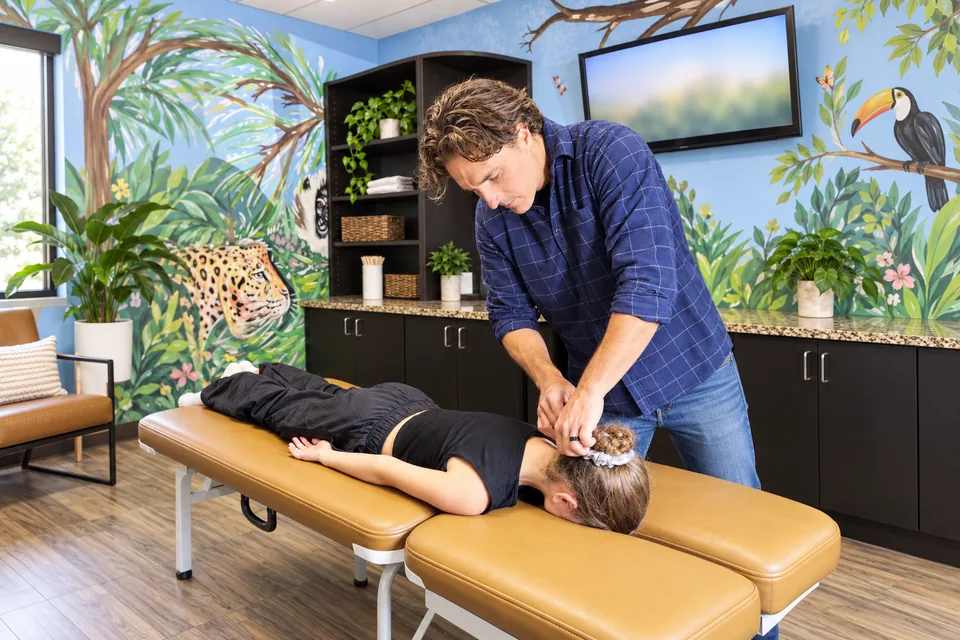
We start with your child's story: when the worry started, what makes it worse, what you have already tried. From there, our doctors use a gentle exam and INSiGHT neurological scanning, then Koren Specific Technique (KST) and Talsky Tonal Chiropractic (TTC), light, nervous-system focused adjustments with no cracking, popping, or twisting, delivered at whatever pace your child needs to feel comfortable.
Every child settles at a different pace, and our doctors build the plan around your child rather than rushing it. Some families notice small shifts within the first several visits, an easier bedtime, a calmer morning, while more entrenched patterns take longer and steadier care to unwind. Because the adjustments are gentle, there is no added stress layered on top of what your child is already carrying, and we track your child's nervous system regulation over time so you can see the progress rather than just hope for it.
Falling asleep more easily instead of lying awake worrying. Fewer stomachaches tied to school mornings. Shorter, less intense meltdowns when plans change, and an easier time separating at drop-off or bedtime.
Many parents also notice their child has more capacity to actually use the coping tools they are learning in therapy. A calmer nervous system makes those skills usable in the moment, not just on paper.
Take the First Step If worry has been running the show in your house, come talk with our doctors in Royal Oak about what gentle nervous system care could look like for your child.
Book OnlineChildhood anxiety often traces back to a nervous system stuck in fight-or-flight rather than a purely behavioral or emotional issue. A stressful birth, an illness, a fall, a family change, or simply a naturally sensitive nervous system can all leave that alarm response switched on, so the body keeps signaling danger even when your child is safe.
Therapy and coping skills work on the thinking side of anxiety, giving your child tools and language for what they feel. Nervous system care works on the physical side, helping the body itself shift out of sympathetic overdrive and toward a calmer state. When the nervous system is settled, kids typically have far more capacity to actually use the coping skills they are learning, so the two approaches complement each other well.
Yes. Our doctors use light, nervous-system focused contacts with no cracking, popping, or twisting, so care is comfortable even for kids who are anxious about being touched or examined. We move at whatever pace your child needs, and every visit is adapted to their comfort level.
Our INSiGHT neurological scans measure thermal, heart rate variability, and sEMG patterns, which gives us real data on how your child's nervous system is regulating stress rather than relying on guesswork. We track those scans over time alongside what you are noticing at home, so progress shows up in both the numbers and daily life.
Every child is different. Some families notice small shifts, an easier bedtime or a calmer morning, within the first several visits, while longer standing patterns take more time and consistent care to unwind. Our doctors build the plan around what your child's nervous system needs rather than a fixed timeline.
Often, yes. If therapy and coping strategies have not fully taken hold, it may be because the nervous system itself is still stuck in overdrive underneath the skills your child has learned. Addressing that physical piece alongside the work they have already done is frequently what finally lets those tools stick.
Stomachaches that appear every school morning and vanish on weekends. Meltdowns at drop-off. If mornings have become a battle, your child's nervous system may be sounding a real alarm.
Nearly one in four teens and one in twelve younger kids struggle with anxiety. Here is what is actually happening in the body, and what helps in the moment, not just afterward.
You added the herbal supplement everyone was talking about, and your child still has restless nights and hard mornings. Here is why ashwagandha helps some kids and barely touches it for others.
See what Royal Oak families say in our Google reviews and patient stories, or browse everything we offer.
Our doctors put together a full article on anxiety in children that explains what's really behind it and what lasting relief looks like. Get instant access below.

Van Every Family Chiropractic Center Royal Oak, Michigan
Free on-demand webinar for parents
Looking for answers for your child?
Focus struggles. Big emotions. Restless nights. Tummy troubles. Join our doctors for a free parent webinar exploring the nervous system connection and ways to support your child.
Explore the free webinarFree · About an hour · Watch anytime