

Hidden Signs of Birth Injury Parents Often Miss
Not every birth injury is obvious right away. Some show up weeks later as feeding trouble, stiffness, or a slow start hitting milestones. Here is what to watch for and how care can help.
Supporting Your Baby's Nervous System After a Difficult Birth
The birth was hard. Maybe there was a vacuum, maybe forceps, maybe a long and difficult final stretch. Now, in these first days home, your baby's arm just isn't moving the way the other one does. It hangs a little limp. It doesn't pull in or grab the way you'd expect. Someone may have already said the words Erb's palsy or brachial plexus injury, and handed you very little beyond wait and see.
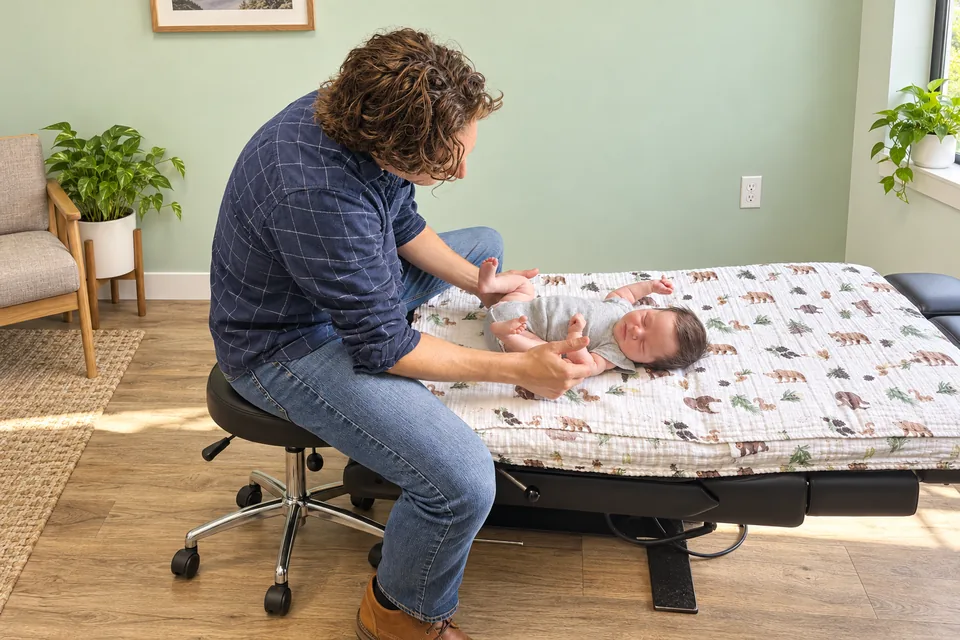
The same forces that stretch those nerves during a traumatic delivery also load an infant's upper neck heavily. Our doctors ease the tension a hard birth leaves behind in the upper neck and spine using gentle, nervous-system focused contacts, no cracking or twisting, light enough to compare to checking the ripeness of a tomato.
The most common thing parents notice is one arm that simply isn't moving like the other, resting limp and turned slightly inward while the other arm bends, reaches, and grips normally. A weaker grip or an asymmetric startle reflex on one side often shows up alongside it. Any difference like this belongs in front of your pediatrician right away.
Many of these babies also carry a strong head preference toward one side, a difficult or assisted delivery in their history, and a harder time settling overall. That combination points to the same traumatic forces landing on both the nerves of the arm and the upper cervical spine at once.
The injury to the arm and the tension left in the upper neck came from the same difficult delivery, which is why looking at both matters.
The brachial plexus is a bundle of nerves running from the lower neck to the shoulder, arm, and hand. When a difficult delivery stretches those nerve roots, most often from the same traction that resolves a stuck shoulder, the signal from the brain to the arm gets disrupted. The muscles themselves are usually fine. It's the wiring that's been interrupted, and the same forces that stretch those nerves load the entire upper cervical spine at the same time.
Our INSiGHT neurological scans, thermal, HRV, and sEMG, give us objective, non-invasive data about where stress and tension sit in your baby's nervous system after a traumatic birth, especially in the upper neck and upper back near the nerves of the arm. That gives us a clear baseline to track over time.
Our doctors use Koren Specific Technique (KST) and Talsky Tonal Chiropractic (TTC), light, nervous-system focused contacts with no cracking, popping, or twisting, easing the tension a hard birth leaves in the upper neck and spine and following your baby's cues at every visit.
Every baby recovers at a different pace, and nerve regeneration genuinely takes months. That doesn't mean nothing can happen in the meantime. As the upper-neck tension a traumatic birth leaves behind begins to ease, many families notice their baby settling more easily well before anyone can say anything definitive about the arm. We rescan over time to track how that tension is shifting.
Easier, calmer settling and a freer-moving neck that turns to both sides instead of locking toward one direction. Many parents also notice steadier feeding and sleep, since the same stressed nervous system reaches far beyond the arm.
Many families tell us that when nervous system support runs alongside physical or occupational therapy, the work their therapist is doing seems to take hold more readily. Every baby moves at a different pace, and we track progress honestly along the way.
Take the First Step If watch and wait has felt like the whole plan, come talk with our doctors in Royal Oak about what gentle nervous system support could look like for your baby.
Book OnlineThe brachial plexus is a bundle of nerves originating in the lower neck that travels down to control the shoulder, arm, and hand. When those nerves are stretched during a difficult birth, the signals from the brain to the arm are disrupted. The muscles themselves are usually fine. It's the nerve communication reaching them that has been interrupted.
The same forces that injure the brachial plexus also leave real tension in an infant's upper neck and upper back. The injury to the arm and the tension in the upper neck come from the same traumatic delivery, which is why looking at both matters.
Yes. Adjusting an infant looks nothing like what most people picture. There is no cracking, no twisting, no popping, and no force. Our doctors use light fingertip pressure, no more than you'd use to check the ripeness of a tomato, and follow your baby's cues at every moment.
No. Diagnosis, surgery, and therapy decisions stay with your child's neurology team, orthopedic surgeons, and physical or occupational therapists. Our doctors add gentle nervous system support alongside that care, easing the upper neck and spine tension a hard birth leaves behind. Most families keep their whole care team looped in as they go, and we're glad to share what we see.
The early weeks and months are when an infant's nervous system is developing most rapidly and is most responsive to input. That's why this window is worth acting on thoughtfully and early.
Not every birth injury is obvious right away. Some show up weeks later as feeding trouble, stiffness, or a slow start hitting milestones. Here is what to watch for and how care can help.
See what Royal Oak families say in our Google reviews and patient stories, or browse everything we offer.
Our doctors put together a full article on erb's palsy & birth injury that explains what's really behind it and what lasting relief looks like. Get instant access below.