

Why Handwriting Is Such a Fight for Some Kids
Homework time turns into a battle every single night over handwriting. If your child avoids writing, grips the pencil too tight, or tires out fast, there is often more going on than effort.
Supporting the Brain-Body Signal Behind Clumsiness and Motor Struggles
Your child wants to catch the ball, write their name the way everyone else does, get dressed without it turning into a battle. You can see how much they want to. And somewhere between the wanting and the doing, something gets lost, again and again, no matter how much they practice.
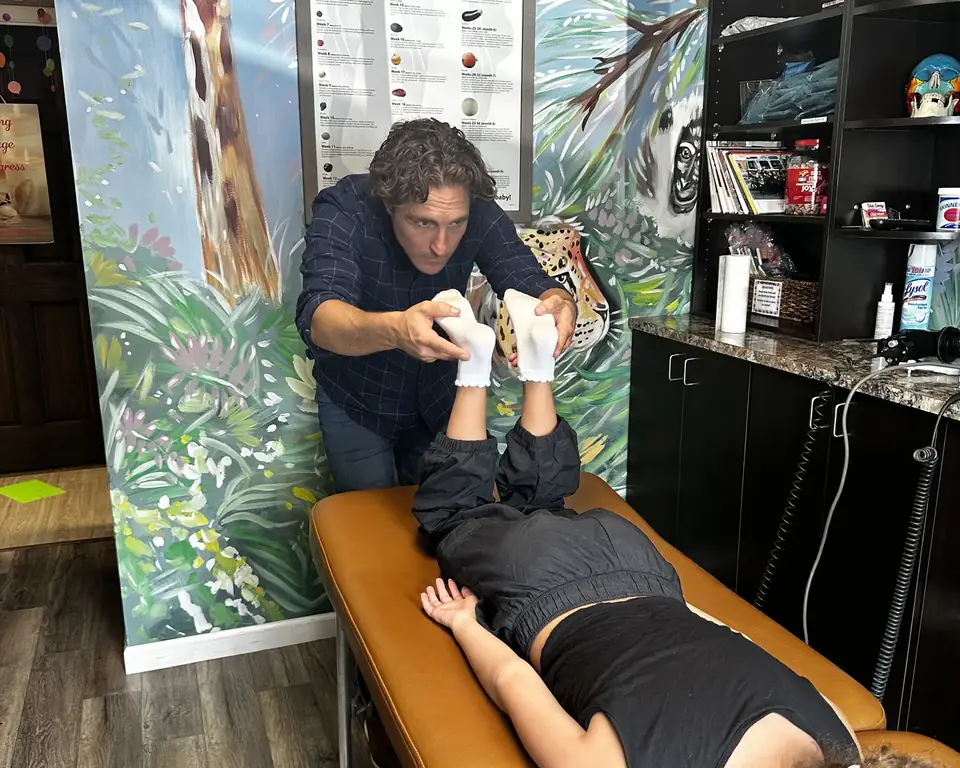
What we see in our Royal Oak office is that many of these kids have a brain that knows exactly what it wants their body to do, and a coordination loop that isn't carrying the signal cleanly. The intention is perfect. The connection carrying it needs support. Our doctors use gentle, hands-on assessment along with Koren Specific Technique (KST) and Talsky Tonal Chiropractic (TTC) to help that signal come through clearer.
Frequent tripping, bumping into furniture, falling more than other kids their age, a child who seems not to quite know where their body is in space. Many parents notice their child was late to sit up, crawl, or walk, or that they still struggle with riding a bike, climbing, or jumping years after their peers picked it up.
It often shows up in fine motor tasks too: shaky, uneven handwriting, trouble with buttons, zippers, shoelaces, or utensils. Some kids seem wiped out after ordinary activities that don't tire other kids, or start avoiding sports, the playground, or art projects rather than risk their coordination on display. Frustration and big reactions to physical tasks are common, and a child may start calling themselves clumsy or slow.
A child with dyspraxia has the intelligence, the desire, and the muscles to move well. What's missing is clean communication between the brain that plans the movement and the body that carries it out.
Motor coordination depends on a loop: the brain plans a movement, sends the signal down, and the body executes it while sending feedback back up. In a child with dyspraxia or developmental coordination disorder, that loop isn't carrying information cleanly, so even simple, well-intentioned movements come out mistimed or clumsy.
When a child's nervous system is stuck in a wound-up, guarded state, the brain has less bandwidth left over to fine-tune motor output, and the cerebellum, the part of the brain most responsible for coordinating movement and timing, doesn't get the calm input it needs to do that job well. Our INSiGHT neurological scans, thermal, HRV, and sEMG, give us objective data about how a child's nervous system is regulating that signal, rather than guessing from the clumsiness alone.
We start with your child's story: when the struggles started, what you have already tried, what a typical day looks like for them. From there, our doctors use a gentle exam and INSiGHT neurological scanning, then Koren Specific Technique (KST) and Talsky Tonal Chiropractic (TTC), light, nervous-system focused contacts with no cracking, popping, or twisting, delivered at whatever pace your child needs.
We are not a replacement for occupational or physical therapy, and we encourage every family to keep going with both. Our role is to support the nervous system signal underneath the skills a therapist is already teaching, so that practice has a better-prepared system to land in.
Every child settles into progress at a different pace, and our doctors build the plan around your child rather than rushing it. Some families notice small shifts within the first several weeks, a little more ease in movement, less frustration around physical tasks, while more entrenched patterns take longer and steadier care to unwind. Because the adjustments are gentle, there is no added stress layered on top of what your child is already managing, and we rescan over time so you can see the progress rather than just hope for it.
Smoother, more coordinated movement, tripping less, and handling everyday physical tasks with less struggle. Families already in occupational or physical therapy often notice progress speeding up, as if the skills their therapist is teaching finally have a better-prepared system to land in.
Many parents also say the frustration and meltdowns tied to physical tasks ease up, and their child seems calmer and more willing to try. It's common for coaches, teachers, or therapists to notice the shift in coordination before the family fully registers it at home.
Take the First Step If practice alone hasn't closed the gap for your child, come talk with our doctors in Royal Oak about what gentle nervous system care could look like alongside the therapy they're already doing.
Book OnlineDyspraxia and developmental coordination disorder (DCD) refer to overlapping, often interchangeable presentations of difficulty with motor planning and coordination. The core issue in both is that the brain-body coordination loop isn't carrying the signal cleanly, so movement comes out clumsy or mistimed despite normal intelligence and a genuine desire to move well.
Practice has real value, and many families see partial progress from it. But if the coordination loop is still carrying a distorted signal, a child can keep running into the same ceiling, because the wiring underneath the skill hasn't changed. That's what we aim to support: helping the signal come through clearer so the practice your child is already doing can finally land.
We work alongside occupational and physical therapy, not instead of it. Many families find that once the nervous system is supported, the skills their therapist is teaching seem to take hold more readily. We encourage you to keep every therapy appointment. Our role is to support the nervous system foundation that therapy builds on.
Yes. Our doctors use light, nervous-system focused contacts with no cracking, popping, or twisting, so care stays comfortable even for kids who are sensitive about touch or being examined. We move at whatever pace your child needs, and every visit adapts to their comfort level.
Our INSiGHT neurological scans measure thermal, heart rate variability, and sEMG patterns, giving us real data on how your child's nervous system is regulating over time rather than relying on guesswork. We track those scans alongside what you're noticing at home and what your therapist is seeing, so progress shows up in both the numbers and daily life.
Our doctors work with children at every age, from infants through teenagers. A young nervous system is still developing, which is part of why early support can be so responsive. The sooner the coordination loop can carry a cleaner signal, the more that growing system has to build on.
Homework time turns into a battle every single night over handwriting. If your child avoids writing, grips the pencil too tight, or tires out fast, there is often more going on than effort.
You've been called clumsy, disorganized, or too hard on yourself for decades. If everyday coordination and organizing your day have always felt like extra work, the pattern may run deeper than a personality trait.
Tying shoes, riding a bike, using scissors. Tasks that seem to click for other kids stay frustratingly hard for yours. Here is what may be going on underneath, and how nervous system care supports coordination.
See what Royal Oak families say in our Google reviews and patient stories, or browse everything we offer.
Our doctors put together a full article on dyspraxia & dcd that explains what's really behind it and what lasting relief looks like. Get instant access below.

Van Every Family Chiropractic Center Royal Oak, Michigan
Free on-demand webinar for parents
Looking for answers for your child?
Focus struggles. Big emotions. Restless nights. Tummy troubles. Join our doctors for a free parent webinar exploring the nervous system connection and ways to support your child.
Explore the free webinarFree · About an hour · Watch anytime

