

What to Track When Your Child Will Not Bounce Back After a Tick Bite
When labs come back negative but your child still is not themselves, a simple log of what you are noticing can matter more than any single test.
Why Some Kids Keep Struggling After a Tick Bite and Treatment, and the Nervous System Layer That Often Gets Missed
Maybe you found the tick. Maybe you never did. Either way, something shifted in your child, and you can feel it even if no one has fully named it yet. The signs are easy to wave off one at a time: unusual fatigue, joint aches that move from place to place, a shift in mood, a drop in focus at school.
Lyme disease is underdiagnosed in children, and in the early weeks standard labs can come back negative even when the infection is present. Trust the pattern, not any single symptom, and keep advocating for your child. Wherever you are in that process, there is one through-line worth understanding: the nervous system. Our doctors use Koren Specific Technique (KST) and Talsky Tonal Chiropractic (TTC) to support the autonomic nervous system layer that Lyme can disrupt in a growing child.
Our focus is the autonomic nervous system layer that Lyme and post-treatment symptoms can disrupt in a growing child, the piece behind the fatigue, brain fog, and mood shifts that often linger.
When a child sleeps long hours and still wakes exhausted, the nervous system is often stuck in a stress response that limits access to genuine recovery.
Parents often describe a strong student who now struggles to focus or retrieve information. This tracks with the neural efficiency Lyme can disrupt.
Irritability, worry, or a child who seems flat and disconnected are common reports. The autonomic nervous system plays a direct role in emotional regulation.
Pain that shifts from joint to joint without a clear structural cause is a recognized pattern. A dysregulated nervous system can amplify how that pain is experienced.
Children can be clearly tired and still unable to get deep, restorative sleep when the nervous system cannot fully shift into its rest state.
When parents say their child was fine before and has not been the same since, they are often describing a lingering nervous system pattern the infection set in motion.
Many parents report energy beginning to stabilize as the nervous system gains better regulation, instead of the crash-and-rally pattern that followed the illness.
As brain-body communication improves, parents frequently notice their child seems more mentally present, and teachers often comment first.
As the autonomic nervous system shifts out of chronic stress mode, the mood swings that followed the illness often begin to ease.
Many parents report their child seems more resilient overall once the nervous system is receiving direct support.
Our care is explicitly gentle and scan-guided. Your child's nervous system sets the pace.
We begin with objective assessment of how your child's autonomic nervous system is functioning, and where it is carrying the most tension.
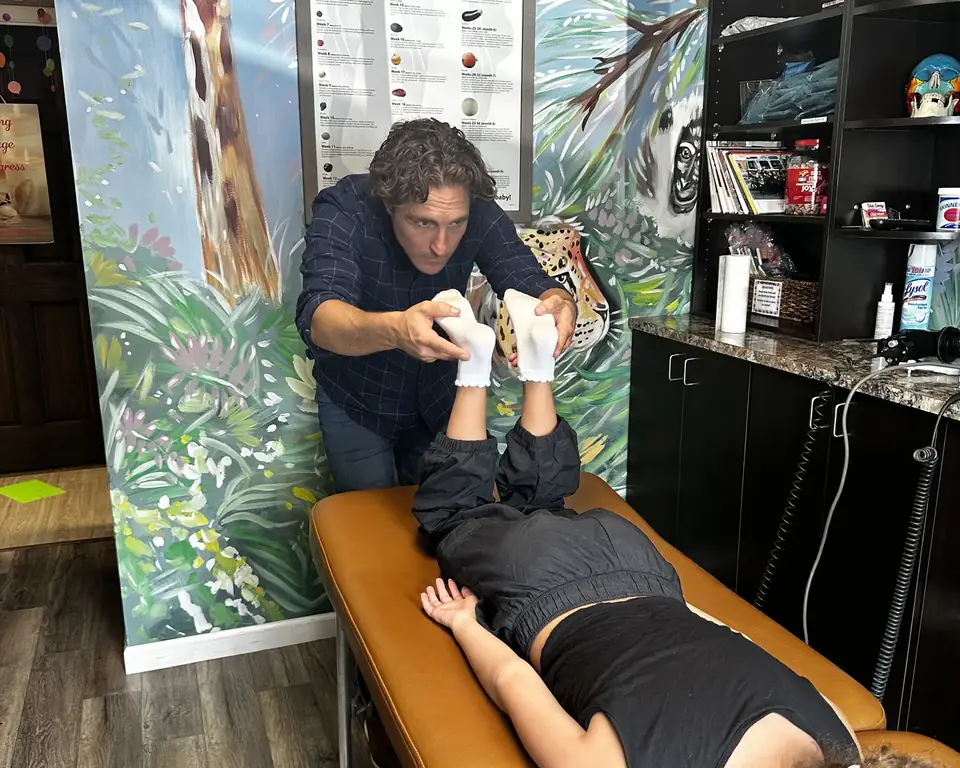
Using Koren Specific Technique (KST) and Talsky Tonal Chiropractic (TTC), our care is completely gentle, with no cracking or twisting, and we follow your child's cues carefully.
We rescan over time so we can see how your child's nervous system is responding as recovery continues.
Families often tell us they notice changes in:
Want to Understand the Nervous System Piece of Your Child's Recovery? Learn how Lyme disease can affect a child's developing nervous system, and what supportive nervous system care can look like.
Book OnlineNot necessarily. Lingering symptoms after Lyme treatment are often a nervous system pattern the infection set in motion rather than the infection itself still being present. The bacteria behind Lyme has a documented affinity for nerve tissue, and even after the infection is addressed, that nervous system pattern can keep running.
Antibiotics address the infection. They are not aimed at the autonomic nervous system pattern the infection can leave behind. When that system is locked in a stress response, the rest and recovery a growing child's body and brain need cannot happen the way they should. That functional layer is what we focus on.
Yes. Children recovering from Lyme are often sensitive, and our care is calibrated accordingly. Koren Specific Technique (KST) and Talsky Tonal Chiropractic (TTC) use light-force input with no cracking or twisting, and we adapt to where your child is on any given visit.
Yes. Most families keep their pediatrician or Lyme-literate physician in the picture the whole way through, and we are glad to share what our assessment finds.
Timelines vary a great deal from child to child. Most children's Lyme symptoms do eventually resolve, and supporting the nervous system is one piece of what can shape how that recovery feels along the way. We rescan over time to track how your child's nervous system is responding.
When labs come back negative but your child still is not themselves, a simple log of what you are noticing can matter more than any single test.
See what Royal Oak families say in our Google reviews and patient stories, or browse everything we offer.
Our doctors put together a full article on lyme disease in kids that explains what's really behind it and what lasting relief looks like. Get instant access below.