Vertigo & Dizziness

Vertigo & Dizziness

Find Your Balance Again with Chiropractic Care

Woman holding her head, feeling dizzy and off balance

Vertigo and dizziness can be disabling, making it hard to work, drive, or even walk safely. If an ENT or neurologist told you nothing was wrong, or medication has not helped, you have not run out of options. Many cases have a cervical component that responds well to chiropractic care.

Balance relies on three systems working together: what your eyes see, your inner ear's vestibular organs, and proprioceptors, position sensors concentrated more heavily in the upper neck than almost anywhere else in the body. A misalignment there sends the brain conflicting signals about where your body actually is, and dizziness is often the result.

How Vertigo and Dizziness Show Up

Not all dizziness feels the same, and telling the patterns apart helps us know where to start. True vertigo is a spinning sensation, as if the room itself is rotating. Lightheadedness feels more like faintness or wooziness, while disequilibrium shows up as general unsteadiness on your feet. Some patients describe disorientation instead, a spatial confusion about where their body actually is in the room. Cervicogenic vertigo comes specifically from neck misalignments disrupting those position signals, and others experience vestibular migraine, dizziness tied to migraine episodes. Each pattern points us toward a different starting point for care.

Most vertigo workups check the inner ear and stop there, leaving the neck, where more position sensors live than almost anywhere else in the body, unexamined.

Our Approach

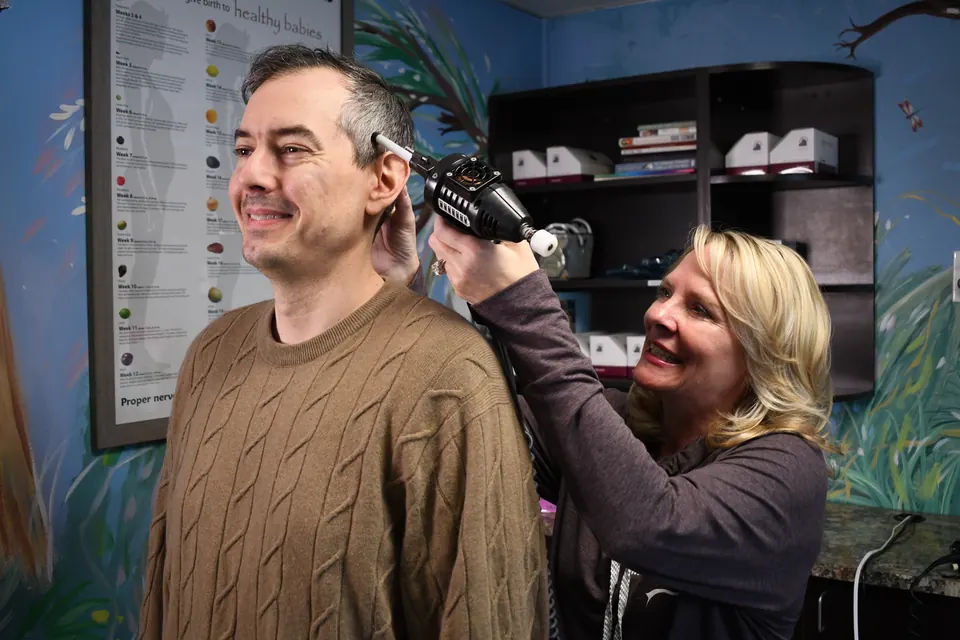
We assess your cervical spine, balance, and proprioceptive function through a detailed exam, including INSiGHT scanning to objectively measure how your nervous system is functioning, along with screening for BPPV and other vestibular conditions, so we understand which of the three balance systems is actually misfiring.

Using Koren Specific Technique (KST) and Talsky Tonal Chiropractic (TTC), our doctors correct upper cervical misalignments with light, nervous system focused contacts, no cracking, popping, or sudden movement, which matters for patients who are already sensitive to any change in position. We coordinate with your ENT or neurologist as needed for complete care.

BPPV Gets Extra Attention

When benign paroxysmal positional vertigo (BPPV) is part of the picture, we perform the Epley maneuver and other repositioning techniques to move displaced crystals in the inner ear back where they belong, usually paired with cervical correction for more complete relief.

What Patients Notice

Patients often notice steadier footing and fewer dizzy spells within the first several weeks, along with more confidence driving and moving through the world without bracing for the next episode. Neck pain and stiffness tend to ease right alongside the vertigo, and many are able to lean less on anti-vertigo medication as care progresses.

Take the First Step

If your workup found nothing but the dizziness is still there, let us look at your neck. Our doctors see patients on Saturdays in Royal Oak.

Book Your Consultation

Common Questions

How can chiropractic help with vertigo?
The upper cervical spine holds more position sensors than almost anywhere else in your body. When there is a misalignment in this area, your brain receives conflicting signals about body position, and dizziness or vertigo can follow. By correcting the misalignment, our doctors help restore accurate signaling and resolve the balance confusion at its source.
How do I know if my vertigo is cervicogenic, meaning neck related?
Signs that your vertigo may have a cervical component include dizziness triggered by neck movement, neck pain or stiffness along with the vertigo, a history of neck injury or whiplash, an ENT or neurologist who found nothing wrong, medication that has not helped, symptoms that vary with neck position, or symptoms that worsen after looking at screens for a while.
Will the adjustment make me more dizzy?
Our doctors use light, nervous system focused contacts built for exactly this kind of sensitivity, no cracking, popping, or sudden movement. Most patients feel improvement quickly, sometimes the same day. A few notice a brief, mild increase in symptoms as the body adjusts to the correction, and this typically settles within a day or two.
Can you help with BPPV?
Yes. For benign paroxysmal positional vertigo, we perform the Epley maneuver and other repositioning techniques to move displaced crystals in the inner ear back where they belong. We usually pair this with cervical correction for more complete and lasting relief.
How many visits will I need?
We do not quote a specific number of visits until we have completed a thorough history, consultation, and INSiGHT scans. That evaluation helps our doctors understand what is actually contributing to your dizziness and build a plan around your case specifically. Long standing cases may take more time, and we reassess regularly to track your progress.
Should I see an ENT first?
It is wise to get a medical evaluation to rule out anything serious. But if your ENT or neurologist already found nothing wrong, or medication has not helped, it is very likely there is a cervical component we can address. Our doctors are glad to work alongside your medical team for complete care.

Related: Headaches & Migraines · Back & Neck Pain · TMJ & Jaw Pain · Posture & Tech Neck

Free Article

Your Vertigo Might Have Nothing to Do With Your Ears

Our doctors put together a full article on vertigo & dizziness that explains what's really behind it and what lasting relief looks like. Get instant access below.