
Clicking, popping, or pain when you open your mouth are the usual first signs of TMJ dysfunction. A healthy jaw should open smoothly, track straight, and let you fit three fingers between your teeth without pain. When any of that changes, something in the joint or its surrounding structures has shifted, and it can turn something as ordinary as eating or talking into a source of real discomfort.
TMJ problems rarely stay isolated to the jaw. The joint shares nerve supply through the trigeminal nerve and muscle connections with your neck and shoulders, and neck muscles attach directly into jaw structures, which is why treating the jaw alone often leaves something unresolved.
How TMJ Shows Up
TMJ dysfunction rarely announces itself the same way twice. Some people notice a distinct clicking or popping every time they open or close their mouth, while others feel more of a grinding sensation deep in the joint. The jaw can ache steadily around the ear and face, or lock briefly in an open or closed position before releasing. Headaches that concentrate at the temples are common and often get mistaken for ordinary tension headaches, and some patients notice fullness or ringing in the ears that has nothing to do with their hearing. Grinding or clenching at night, pain when chewing anything tough, and a stiff, sore neck that flares up right alongside the jaw round out the picture for most patients.
What Causes TMJ Pain
TMJ pain shows up for different reasons: waking up sore without knowing why, discomfort after eating something tough like pizza crust or steak, an old injury or bump to the head, a whiplash injury, or extended dental work that held your mouth open for an hour or more. Teeth grinding, chronic stress, and a forward head posture all add up the same way. When we evaluate a jaw problem, we look at the temporal and mandibular bones together with the neck and shoulders, since they rarely act independently. When the cervical spine is under tension, it changes head position, and a shifted head position changes how your jaw comes together, creating muscle imbalance and joint stress on top of whatever started the problem.
Our Approach
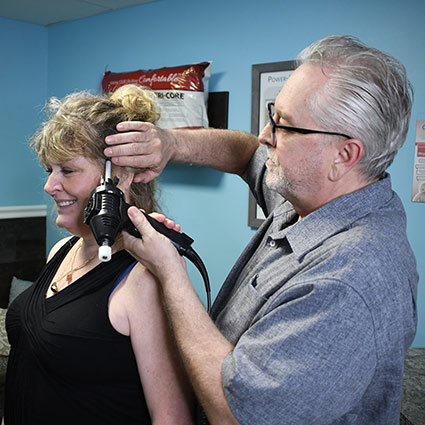
We start with a comprehensive evaluation that includes INSiGHT neurological scanning (thermal, HRV, sEMG) to objectively assess your nervous system and identify where tension has been sitting from old injuries, clenching habits, or built up stress. We also evaluate the TMJ joint directly, your cervical alignment, and your head posture. Some of our work happens right at the joint: while your jaw is clenched, we adjust to help the muscles relax, then check your tracking as you open to make sure you can move evenly side to side. We can also make an adjustment through the roof of the mouth to reach the joint from the inside.
Using Koren Specific Technique (KST) and Talsky Tonal Chiropractic (TTC), our doctors gently adjust the cranial bones and the cervical spine as well, using light, nervous system focused contacts with no cracking or twisting, since a jaw that is always tight on one side often tracks back to a neck or shoulder that is tight on the same side.
Working With Your Dentist
If you grind your teeth at night, seeing your dentist about a bite guard is a good first step, since a jaw that never gets a break stays sore no matter what else you do. A night guard addresses the grinding itself, while our care corrects the underlying spinal and structural factors contributing to your TMJ dysfunction. We are glad to coordinate directly with your dentist so the two approaches support each other instead of working at cross purposes.
What Patients Notice
Patients typically notice less clicking and popping first, followed by an easier time opening the mouth fully, less pain when chewing, and fewer headaches that trace back to jaw tension. Many also notice their neck loosens up and their sleep improves alongside the jaw, since the two were connected the whole time.
Take the First Step
If jaw pain has been hard to shake, let us look at the whole picture. Our doctors see patients on Saturdays in Royal Oak.
Common Questions
Why do our doctors look at my neck for jaw pain?
How quickly will I see results?
Is the treatment painful?
Should I still see my dentist for TMJ?
What causes TMJ problems?
Can TMJ pain really be connected to my neck if I have never had a neck injury?
Related: Headaches & Migraines · Back & Neck Pain · Posture & Tech Neck · Vertigo & Dizziness