
Fall Sports Soreness: A Kids Sports Chiropractor in Royal Oak
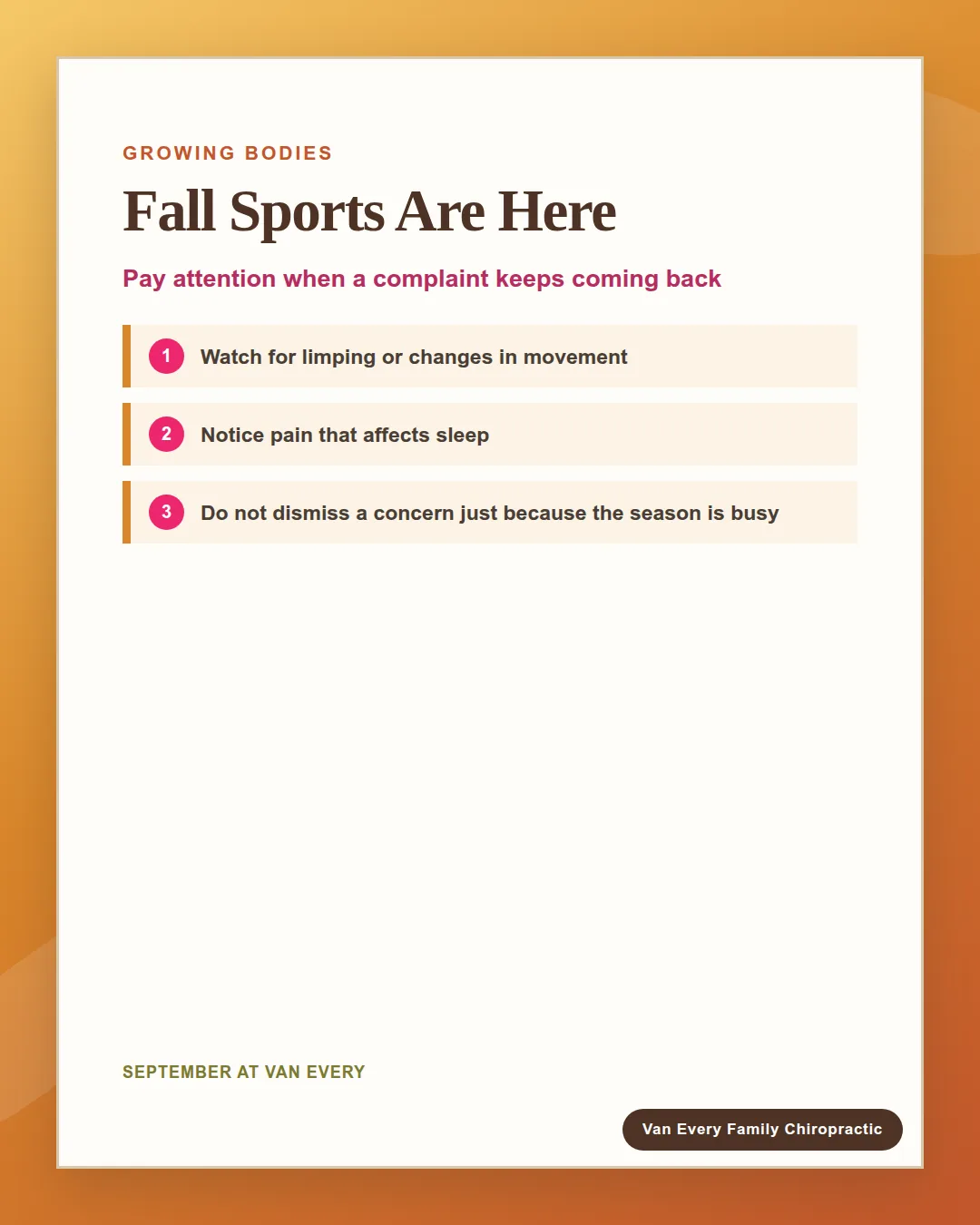
Fall sports can take kids from a relaxed summer to hours of repetitive activity almost overnight. Here is what we told Royal Oak families to watch for.
How Nervous System Function Shapes a Young Athlete's Coordination, Reaction Time, and Recovery During the Growing Years
Your athlete is on the field three or four times a week between practices, games, and maybe a travel team on top of school sports. You are already managing the schedule, the gear, and the occasional ice pack. You have started to wonder if there is a way to help them stay healthy through a heavy season, not just keep up with it.
Here is something most sports parents never hear: a young athlete's muscles do not fire on their own. The nervous system tells them when to fire, how hard, and how fast. Reaction time, coordination, balance, and recovery between practices are all nervous system functions, and during the growth years that system is working overtime. Our doctors use Koren Specific Technique (KST) and Talsky Tonal Chiropractic (TTC), gentle care aimed at that nervous system layer, to support young athletes through demanding seasons.
Reaction time, coordination, and recovery are all coordinated by the nervous system. When it is functioning well, the signals reaching a young athlete's muscles are cleaner and better timed. The goal is not pushing harder. It is letting the system that runs everything do its job without interference.
During rapid growth, limbs lengthen faster than the nervous system updates its map of the body. A normally graceful kid can suddenly seem a step behind.
Reaction time depends on how cleanly nerve signals reach the muscles. Interference in that pathway can leave a young athlete a half-step late even when they are working hard.
Recovery between practices depends on the nervous system's ability to shift into rest mode. When that shift is sluggish, soreness and fatigue can linger longer than expected.
Aches that keep returning to one area can point to an uneven motor-control pattern shifting load onto the same tissues again and again.
When effort is there but a skill just is not clicking, the limiting factor is often how the nervous system is coordinating the movement, not how hard the athlete is trying.
A packed schedule can keep a nervous system stuck in go mode. When it cannot downshift, sleep and recovery both slow down.
When nervous system interference is reduced, many parents notice their young athlete moving more smoothly, especially through an awkward growth stretch.
As the nervous system shifts more easily into recovery mode, families often report their child bouncing back more readily through a long season.
Motor learning runs on nervous system function. Many parents notice new skills coming together more readily once that system is running cleaner.
When movement is coordinated more evenly, the lopsided loading patterns behind recurring aches tend to ease.
Our approach centers on the nervous system that coordinates movement, recovery, and skill development, tracked alongside the training calendar.
INSiGHT neurological scans give us objective data on your child's nervous system, separate from fitness level or skill.
Using Koren Specific Technique (KST) and Talsky Tonal Chiropractic (TTC), care is calibrated to your child's age, size, and comfort, with no cracking or twisting.
We rescan over time and mind the training calendar, offering more support through heavy blocks and a recovery-minded approach when the schedule eases.
We coordinate visits around practices and competitions rather than asking your family to work around us.
Families often tell us they notice changes in:
Want to Understand How to Support Your Young Athlete? Learn how the nervous system shapes coordination, reaction time, and recovery in growing athletes, and how gentle, scan-guided chiropractic care fits into a demanding season.
Book OnlineNo. Most young athletes we see are not injured. The goal is to support the nervous system that coordinates movement, recovery, and skill development during the growing years, before problems develop rather than after.
We work with young athletes of all ages. Care is calibrated to the child's age and size, and the techniques we use are comfortable at every stage of development.
Physical therapy and massage address muscles and soft tissue directly. Our focus is the nervous system that coordinates those muscles. When the signal is cleaner, the motor output tends to follow, and many families use these approaches together.
We use Koren Specific Technique (KST) and Talsky Tonal Chiropractic (TTC). Both are gentle and low-force, with no cracking, no twisting, and no discomfort. Many young athletes find the sessions calming.
No. We work around the training calendar and stay mindful of competition timing, with more support scheduled during heavy training blocks.
Fall sports can take kids from a relaxed summer to hours of repetitive activity almost overnight. Here is what we told Royal Oak families to watch for.
Rolling, crawling, climbing stairs, catching a ball. Here is a plain checklist of what gross motor skills usually look like at each age, and what is worth a closer look.
Extra conditioning and more reps can only take a young athlete so far. Reaction time, coordination, and recovery all start with the nervous system underneath the muscles.
See what Royal Oak families say in our Google reviews and patient stories, or browse everything we offer.
Our doctors put together a full article on youth sports performance that explains what's really behind it and what lasting relief looks like. Get instant access below.

