
You noticed it in a school photo, maybe, or when your daughter was trying on a swimsuit and one shoulder blade stuck out further than the other. Or maybe it's your own back, the one that has ached through your thirties and forties in a way that never quite matches what the imaging shows. Either way, the conversation that followed probably went one of two ways: watch it, or start talking about surgery.
Not much gets said about what happens in between. You have been handed a Cobb angle number and told to come back in six months, while your child stands unevenly at the dinner table or gets tired faster than her friends on a hike. Or you have been managing your own curve for years, doing the stretches that help for a day before the stiffness settles right back in.
What explains that gap is worth understanding. Two people can have nearly identical curves on an X-ray and live two very different lives with them. One moves easily, sleeps fine, and rarely thinks about her spine. The other is stiff every morning, tired by mid-afternoon, and can't sit through a full movie without shifting. The X-ray does not explain that gap. Something else does.
What Scoliosis Actually Is
Scoliosis is a sideways curve of the spine, usually with some rotation, that most often shows up during the growth spurt just before puberty. Most cases, roughly 80 percent by our doctors' count, are idiopathic, meaning there is no single identifiable cause. Conditions like cerebral palsy or muscular dystrophy account for some of the rest, and adults can also develop a degenerative curve later in life as discs and joints change with age.
It rarely announces itself with pain, especially early on. What families usually notice first is visual: one shoulder or shoulder blade sitting higher than the other, an uneven waistline, or a hip that looks more prominent than its partner. Bending forward can reveal a rib hump on one side, the rotational part of the curve showing up as an uneven ribcage. Some people also deal with back pain, get tired faster from the extra effort of holding an unbalanced posture upright, or notice their head does not sit centered over their pelvis when they check a mirror.
The Nervous System Piece That Rarely Gets Mentioned
Your nervous system controls the muscles on both sides of the spine. In scoliosis, that balance gets thrown off. Picture it as one side of the spine having the gas pedal stuck partway down: the muscles on the concave side of the curve stay chronically contracted, pulling tighter than they should, while the other side can never quite compensate enough to even things out. The nervous system tends to read that asymmetry as a threat and responds by increasing muscle tone to guard it, which only deepens the imbalance. Tension creates more tension.
There is research behind this. A 2025 study published in the journal Bone and Joint found that roughly 30 percent of adolescents with idiopathic scoliosis have measurable deficits in trunk proprioception, meaning the body's own sense of where the spine sits in space is compromised, and those with the largest deficits tended to have more severe curves. That points to a regulation problem layered on top of the structural one, and regulation is something that can shift.
Why Watch and Wait, or a Brace Alone, Only Goes So Far
Bracing tries to physically contain a curve. Monitoring watches to see whether it crosses a surgical threshold. Both have a real place, and we are not suggesting anyone skip them. But neither addresses the muscle tension pattern that is actually driving the day-to-day experience: the morning stiffness, the afternoon fatigue, the ache that shows up after a long day of sitting. A brace can hold the structure without changing how the body has organized around it, which is why the stiffness often comes right back once the brace comes off.
Gentle Nervous System-Focused Care at Van Every
In our office, we start with a full history and a gentle INSiGHT scan, thermal imaging, heart rate variability, and muscle (sEMG) readings along the spine, to get an objective picture of how the nervous system is managing the curve, not just what it looks like from the outside. That gives us a report of findings before we ever touch you.
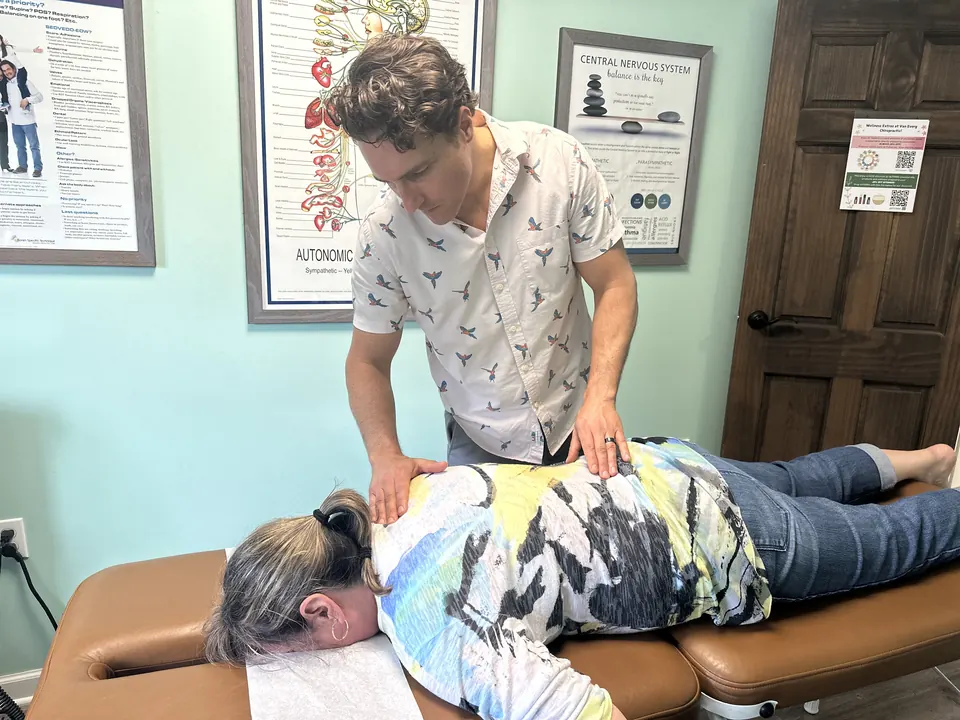
From there, our doctors use Koren Specific Technique (KST) and Talsky Tonal Chiropractic (TTC), gentle, nervous system-focused care with no cracking or twisting. We are not trying to force a curved spine straight. We are working with the tension pattern surrounding it, so the nervous system has an opportunity to manage the curve with less compensatory guarding. This approach is appropriate for growing spines and for adults managing years of degenerative change, and we coordinate with pediatricians and orthopedic specialists as needed.
What Parents and Patients Often Notice
Every case is different, and we cannot promise a specific outcome. That said, many parents tell us their teenager seems more comfortable during school and sports, with less guardedness in how they move. Adults often report less stiffness in the morning and more ease sitting or standing for long stretches. Mobility and range of motion tend to improve as the asymmetric holding pattern softens, particularly after periods of prolonged sitting. Some families also notice improvements beyond the spine itself, like steadier sleep or an easier time managing stress, since the same nervous system regulates all of it.
Living With a Curve, Day to Day
A few habits can support the care your child or you are already receiving:
- Have the spine checked yearly through the growth years, since scoliosis is most likely to progress while bones are still growing.
- Keep an eye on backpack or bag weight, and encourage using both straps rather than slinging one shoulder.
- Notice how posture changes after long stretches at a desk or on a device, and build in movement breaks.
- Track visible changes over time with a photo every few months rather than relying on memory alone.
- Pay closer attention during growth spurts, since that is when the nervous system tends to be under the most load and a curve is most likely to shift.
Where to Go From Here
If any of this sounds like your family, or like your own back, our scoliosis care page walks through how our doctors evaluate a curve and build a care plan around it. You can also download our free guide on nervous system function and scoliosis to read more before your first visit. When you are ready, you can book online, or call us at (248) 616-0900 and one of our doctors will walk you through what to expect. A curve without a known cause does not mean a curve without options.
