Maybe it was a school screening, or maybe you noticed it yourself while helping with a shirt, one shoulder blade sitting a little higher than the other, a waistline that does not quite match side to side. Your child does not seem to be in pain, which makes it more confusing, not less. If a curve gets confirmed, it is natural to want a clear answer for why it happened, and the honest answer is more interesting, and more useful, than most parents expect.
What Scoliosis Actually Is
Scoliosis means the spine curves sideways instead of running straight, and doctors measure how much using what is called the Cobb angle on an X-ray. Curves are generally described as mild, moderate, or more significant depending on that measurement. It affects a meaningful share of the population, with well over one hundred thousand children diagnosed each year in the United States, and it tends to show up most often, and progress most, during the growth years between about ten and eighteen, more frequently in girls.
The large majority of childhood cases fall under idiopathic scoliosis, meaning no single clear cause shows up on standard testing. That does not mean there is no explanation. It means the explanation lives somewhere standard imaging does not typically look.
What We Know, and What Scoliosis Is Not
Genetics play a real role. A meaningful share of teens diagnosed with this type of scoliosis have a parent, sibling, or other close relative who had it too, though identical twins do not always develop matching curves, which tells us genetics alone is not the whole story. Growth spurts during puberty are consistently the period of fastest progression, especially for girls in the early teen years, since a curve has more room to change shape while the spine is actively growing. It is worth saying clearly what scoliosis is not caused by, since these get blamed often: it is not caused by poor posture, a heavy backpack, or playing sports.
The Piece Most Families Never Hear About
Your child's sense of where their body is in space, called proprioception, is managed by the nervous system and plays a significant role in keeping the spine balanced and aligned as it grows. A growing body of research, including a systematic review in the Global Spine Journal, has found that kids with adolescent idiopathic scoliosis consistently show measurable proprioceptive differences compared to kids without scoliosis. When that feedback loop is not working precisely, muscles on either side of the spine can develop uneven tension over time, which may contribute to a curve developing or progressing.
The upper neck carries an unusually dense concentration of the nerve receptors responsible for this kind of body awareness. Birth stress and early life physical stressors can create tension patterns in that region well before a curve is ever visible, which is part of why our doctors look at nervous system function as part of the full picture, not as a replacement for standard orthopedic monitoring.
How We Assess This
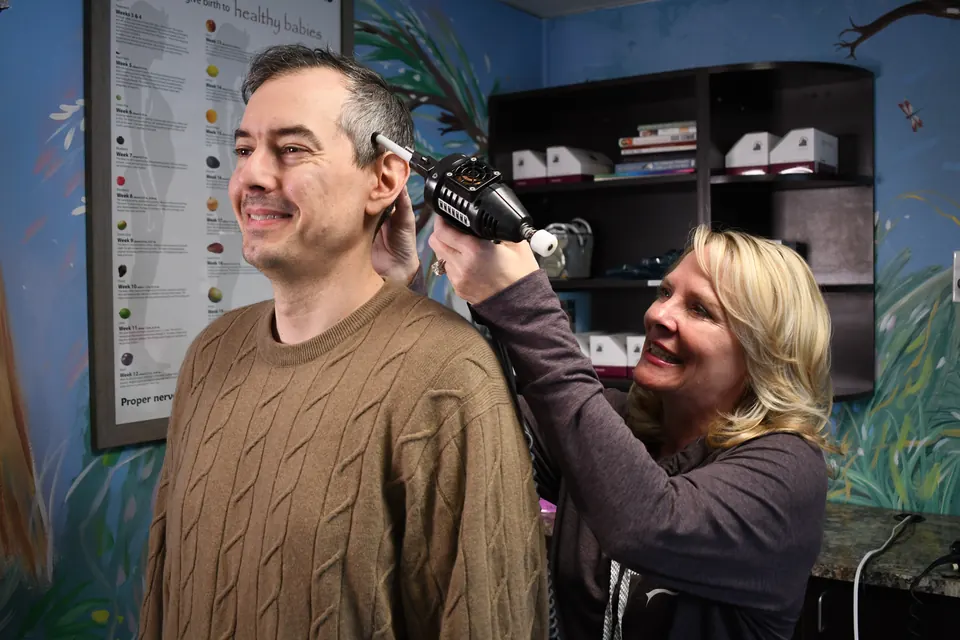
Alongside your child's ongoing X-rays and bracing plan with their orthopedic team, our doctors use INSiGHT neurological scanning to look at the nervous system side of the picture. Surface EMG measures electrical activity in the muscles along the spine and can reveal asymmetry. Thermal scanning picks up on autonomic nervous system patterns along the spine, and heart rate variability gives us a read on overall sympathetic and parasympathetic balance. Together, this gives us objective information about how your child's nervous system is coordinating the muscles that support their spine.
What Care Looks Like
Using Koren Specific Technique and Talsky Tonal Chiropractic, our doctors use light, nervous system focused contacts aimed at supporting proprioceptive function and reducing asymmetric muscle tension, always alongside, never instead of, your child's conventional monitoring and orthopedic care. Families often notice easier posture, less visible muscular guarding, and better overall coordination as care continues, though the pace and extent of change varies by child and by how established the curve already is.
Signs Parents Should Watch For
- Uneven shoulders or a shoulder blade that sits higher on one side
- A waistline or hip height that does not match side to side
- One arm hanging noticeably longer than the other
- A rib hump or visible curve that shows up when your child leans forward
Pain is fairly uncommon in kids with scoliosis, which is part of why a curve can go unnoticed for a while. A simple bend forward test, checking for a rib hump or asymmetry while your child leans forward with arms hanging loose, is an easy first screen you can do at home between checkups, though a proper evaluation from your child's care team is the right next step if something looks off.
Working Alongside Your Child's Orthopedic Team
Nervous system focused care is never meant to replace X-rays, orthopedic monitoring, or bracing when it has been recommended. It is meant to sit alongside that conventional care, addressing a piece of the picture, proprioceptive feedback and muscular balance, that standard imaging was never designed to measure. Our doctors coordinate with your child's orthopedic team so everyone has the full picture and nothing falls through the cracks between appointments.
Why Earlier Attention Tends to Help
Because growth spurts are consistently the period of fastest curve progression, the window before and during early puberty tends to be when nervous system focused support can make the most difference, simply because there is more active growth for the body to work with. That does not mean it is too late to start once a curve is already more established. It means that for families catching early signs before a formal diagnosis, there may be real value in addressing the nervous system piece sooner rather than waiting to see how things develop on their own.
Where to Go From Here
If your child has a confirmed curve, or you are noticing early signs and want a closer look at the nervous system side of the picture, our doctors in Royal Oak can help. Learn more about our approach to scoliosis, or get our free guide on the nervous system connection. You can book online, or call us at (248) 616-0900.