The shooting pain again. Down through the buttock, into the leg, sometimes all the way to your foot, right when you thought you'd finally shaken it. You've stretched. You've iced it. Maybe you've had an injection or two, or gone through a round of physical therapy that helped for a few weeks before the pain found its way back.
You're starting to wonder if this is just how it's going to be, something you manage instead of something that actually gets better. That frustration is fair. Sciatica has a way of circling back right when you've let your guard down, and most of the usual advice addresses the leg, when the leg usually isn't where the real problem started.
What's Actually Happening With Sciatica
The sciatic nerve is the longest nerve in your body, running from your lower back through your hips and buttocks and down each leg. Sciatica refers to pain that travels along that nerve, and it rarely looks the same twice. Some people feel a sharp, electric jolt. Others notice burning, numbness, pins and needles into the foot, or a leg that suddenly feels too weak for the stairs. For a lot of people, sitting for any length of time is exactly what sets it off.
A herniated or bulging disc pressing on the nerve is the most common cause, but spinal stenosis, a spinal misalignment irritating the nerve roots, or the piriformis muscle in the buttock spasming against the nerve can all produce the same shooting pain. Research suggests sciatica affects roughly 40 percent of people at some point in their lives, and a large share of those who improve see it return when the underlying pattern is never addressed. The nerve itself doesn't usually get pinched down in the leg. The trouble almost always starts back where the nerve exits your spine.
Why the Nervous System Is Part of the Story
Two people can have the exact same disc finding on an MRI, and one of them develops debilitating sciatica while the other has no symptoms at all. The disc alone doesn't explain that difference. What often does is the state of the nervous system around it.
Think of your nervous system as running on a gas pedal and a brake pedal. The gas pedal handles alertness and muscle guarding, and the brake pedal allows tissue to settle and release. When the gas pedal gets stuck on in the lower back, the muscles around those nerve roots stay locked in a guarding pattern, keeping pressure on the nerve even after the initial trigger has passed. The pain isn't a sign that something is getting worse. It's your nervous system continuing to guard an area it perceives as under threat.
Why Stretching and Injections Only Go So Far
Stretching, icing, and injections all work on the output, the tight muscle or the inflamed nerve, and that can genuinely bring relief for a while. What those approaches don't reach is the guarding signal itself. As long as the nervous system keeps telling the muscles around your lumbar spine to hold tension, the compression tends to rebuild, which is a big part of why the same shooting pain so often returns.
How We Approach Sciatica at Van Every
We start with a detailed exam, orthopedic and neurological testing, and an assessment of your spinal alignment and nerve function, alongside a gentle INSiGHT scan that gives us an objective picture of where stress and tension are concentrated in your nervous system, rather than guessing from the pain pattern alone.
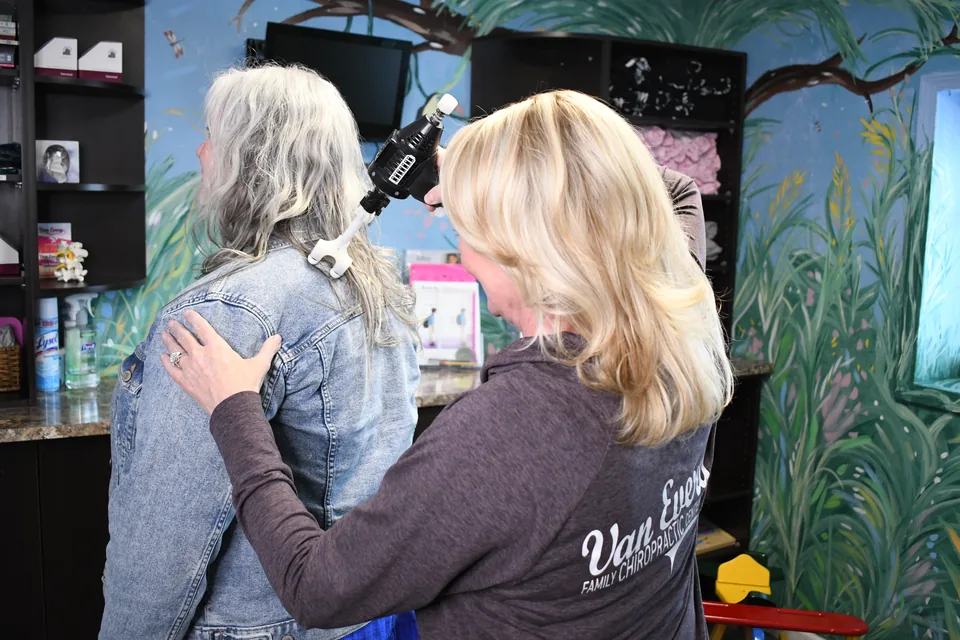
Using Koren Specific Technique (KST) and Talsky Tonal Chiropractic (TTC), our doctors make precise, gentle corrections to the lower spine and pelvis, no cracking, popping, or forceful manipulation, and we can adjust you in whatever position actually triggers your pain. Because the input is gentle, care doesn't add discomfort on top of what you're already dealing with.
What Patients Often Notice
Many patients notice they can sit comfortably again before the leg pain is fully gone, which makes sense given that the work is happening at the spine first. Numbness and tingling along the leg often ease as the guarding pattern releases, and walking and exercise tend to become possible again without the shooting pain cutting things short. Some patients also mention sleeping better and feeling less on edge generally, since the same nervous system shift that eases sciatica tends to affect more than one thing at a time.
What to Expect From Care
Many patients feel some improvement after their first visit, and most cases respond well within four to eight weeks of care. Because our approach is gentle, there's no additional discomfort layered on top of what you're already managing. Long standing cases, sciatica that's been part of your life for years rather than weeks, can take longer to shift, but that doesn't mean the underlying pattern is out of reach. We track your progress at each visit, so you're never guessing whether things are actually moving in the right direction.
Conservative care like this is generally worth trying before considering surgery, and a number of our patients came to us after being told surgery was their only option. Some cases genuinely do call for a surgical consultation, and when that's the right step, we'll say so and help you get there. But it's rarely the first step, and it's worth ruling out a nervous system pattern before assuming your only path forward runs through an operating room.
A Few Things That Help Alongside Care
- Change position often rather than sitting or standing in one spot for long stretches
- Notice which positions ease your pain and which make it worse, and mention both at your visits
- Keep moving within a comfortable range rather than staying completely still during a flare
- Support your lower back with a firm mattress or a small pillow when sitting for long periods
Next Steps
You don't have to accept sciatic pain as a way of life, and it's rarely too late to address the pattern underneath it, whether your sciatica started last week or years ago. Learn more on our sciatica page, or get our free guide for a deeper look at why sciatica keeps coming back. When you're ready, book online with our doctors, or call us at (248) 616-0900 to talk through what you've been dealing with.