
The pain starts low in your back and shoots down one leg like a switch flipped, sometimes reaching all the way to your ankle. Rolling over in bed makes you gasp. Standing up from the couch takes a plan. You mention it at your next appointment and hear that it is a normal part of pregnancy, that it should ease up after delivery, maybe try a heating pad or an over the counter pain reliever in the meantime. So you manage it as best you can and wonder why some of your pregnant friends never deal with anything like this at all.
What Sciatica Actually Is
The sciatic nerve is the biggest nerve running through your body, about as wide as a thumb. It forms where several roots low in the back join together, then travels through the pelvis, down through the back of your leg, ending at the foot. It is what lets you walk, bend your knee, and feel sensation in your leg. When something irritates or compresses it during pregnancy, the result can be sharp shooting pain, burning or tingling down the leg, numbness in the foot, or a jolt of pain when you cough or sneeze. It usually shows up on one side, and it tends to get worse as the day goes on. Some mornings you wake up fine and by evening you can barely get comfortable. Doctors formally diagnose sciatica in only a small share of pregnant women, but a much larger group experiences these same symptoms without ever getting that specific label. It often just gets filed under normal pregnancy back pain, something to grit your teeth through until delivery.
The Usual Explanation, and Where It Falls Short
The standard explanation is straightforward. Relaxin, a hormone that rises early in pregnancy and stays elevated, loosens the ligaments around the spine and pelvis to prepare the body for birth. As the baby grows, added weight and a shifting center of gravity change how the lower back curves and how hard the surrounding muscles have to work, which can put pressure on the nerve. All of that is real and worth understanding.
What it does not explain is why every pregnant woman goes through those same hormonal and postural changes, yet only some end up with sciatic pain. It does not explain why some women feel it as early as the first trimester, before mechanical pressure from a growing belly would be much of a factor. And it does not explain why, for some women, the pain lingers well after delivery, long after relaxin levels have dropped and the baby is no longer pressing on anything.
A Nervous System Piece Worth Considering
Picture the nervous system as having a gas pedal and a brake, the sympathetic and parasympathetic systems working together to keep the body regulated. When that system is working the way it should, the body can absorb the normal stresses of pregnancy, including the added pressure and shifting posture, without overreacting. When the gas pedal has been pressed down for a while, from years of stress, old injuries, or tension that built up gradually long before pregnancy, the nervous system can become more sensitive than it should be. A pressure that would normally feel unremarkable can start to feel sharp and unbearable.
This is one reason two women can have very similar bodies, similar relaxin levels, and similar posture changes during pregnancy, yet only one develops sciatica. The difference may have less to do with the pregnancy itself and more to do with how regulated the nervous system already was heading into it.
Why Stretching and Heat Only Go So Far
Physical therapy, prenatal yoga, support belts, and heat can genuinely ease discomfort in the moment, and there is nothing wrong with using them. What they tend not to reach is the underlying tension pattern in the lower back and pelvis that is keeping the nervous system on edge in the first place. That is often why the relief from these approaches feels partial or temporary, helpful for an afternoon but not lasting.
How Our Doctors Approach Pregnancy Sciatica
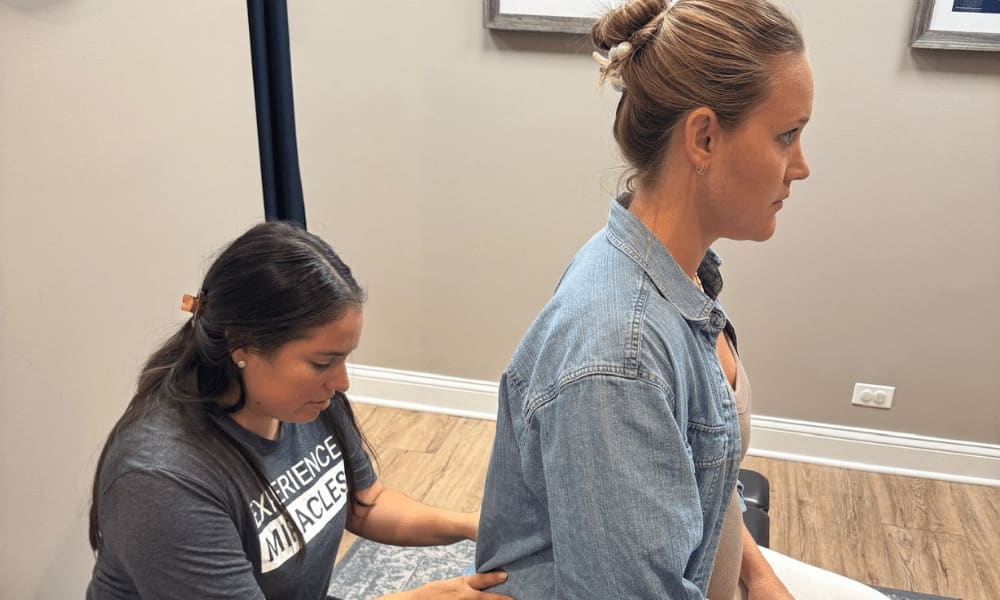
We start by hearing about your pregnancy so far, when the pain started, and what has helped or not helped. From there, a gentle exam and INSiGHT neurological scanning, looking at heart rate variability, muscle tension patterns, and thermal symmetry along the spine, gives us real information about how your nervous system is regulating rather than relying on guesswork. Using Koren Specific Technique and Talsky Tonal Chiropractic, our doctors use light, nervous system focused contacts, safe throughout pregnancy, to ease tension patterns in the lower back, pelvis, and sacrum where the sciatic nerve travels. There is no twisting or forceful movement involved.
Things That Can Help Between Visits
- Change positions often rather than sitting or standing for long stretches
- Sleep on your side with a pillow between your knees to keep your pelvis level
- Move gently and regularly, since staying completely still tends to increase stiffness
- Notice what time of day symptoms are worse and mention it at your next visit, since patterns are useful information
- Keep your OB in the loop about your symptoms and any care you are receiving
What This Can Mean Beyond the Leg Pain
Sciatica rarely shows up as the only complaint. Many of the same women dealing with shooting leg pain also mention trouble sleeping, constipation, or a harder time feeling settled overall as pregnancy goes on. That overlap makes sense once you think of it as one nervous system under load rather than a list of separate problems. Easing tension in the lower back and pelvis does not just target the sciatic nerve directly, it can support the broader system that governs digestion, sleep, and how well your body adapts to the physical demands of carrying a baby. That is part of why some women notice more than one thing improving once care is underway, even though sciatica was the reason they first came in.
Where to Go From Here
Many women find that once nervous system tension eases, sciatic pain settles too, sometimes along with other pregnancy discomforts like constipation or poor sleep that were part of the same underlying pattern. You can read more about how we support pregnancy back pain, including how it relates to sciatica, or get our free guide for a deeper look at what is going on. When you are ready, you can book online with our doctors in Royal Oak, or call us at (248) 616-0900.
