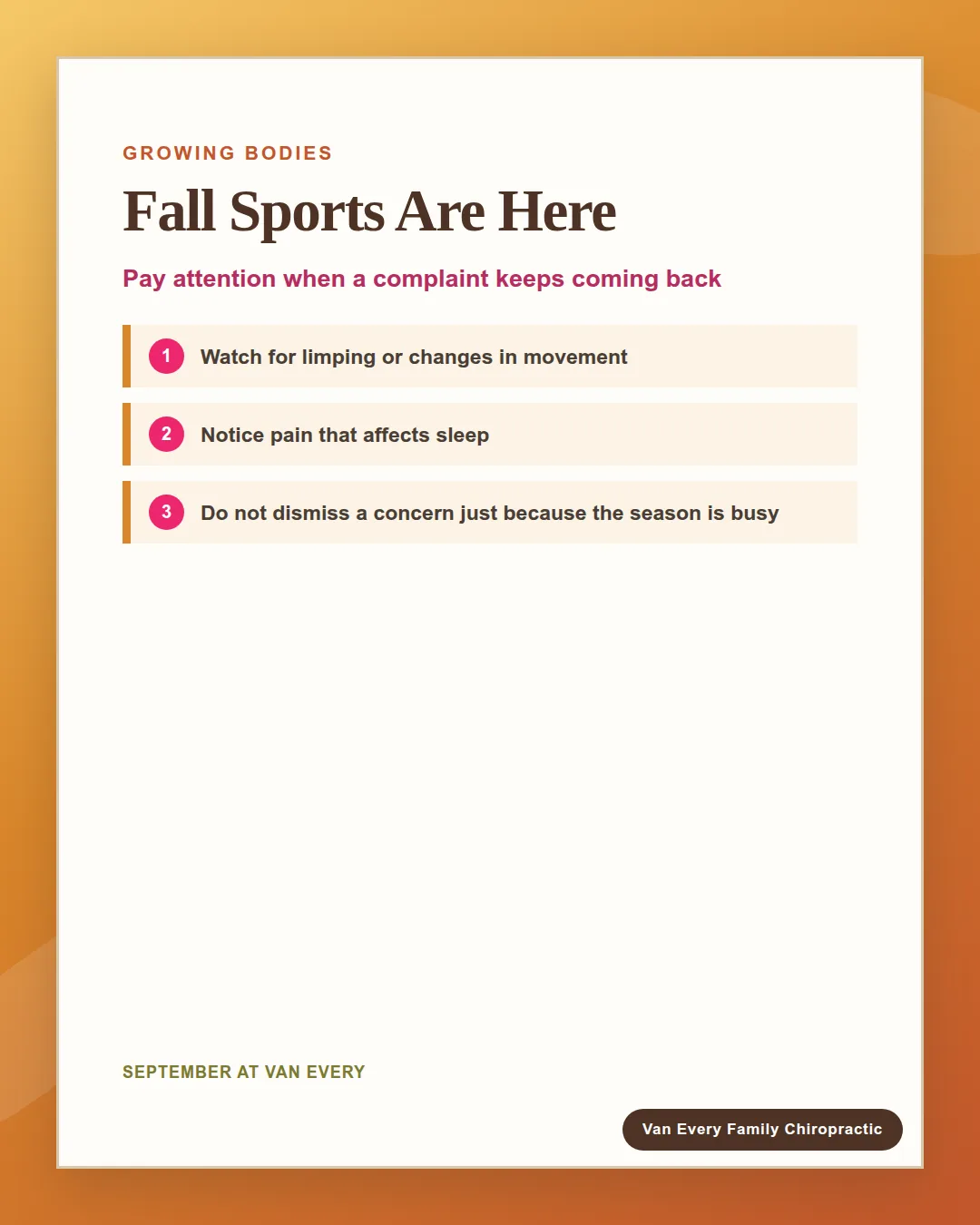
Your young athlete puts in the work. Extra practice, another season of club, a private coach for the off season. Some of it pays off. Then a growth spurt hits, or a nagging ankle just will not fully settle down, or your normally sharp kid suddenly looks a half step slow on the field, and none of the usual answers, more conditioning, more reps, more rest, seem to move the needle the way you would expect. That gap between effort and performance is worth a closer look, because a lot of what shapes how a young athlete moves has less to do with muscle and more to do with the nervous system running underneath it.
Performance Starts Before the Muscles Do
Every sprint, cut, catch, and landing your child makes starts as a signal from the brain, travels down the spinal cord, and reaches the muscles that carry out the movement. Strength and conditioning matter, but they are downstream of that signal. If the communication between brain and body is running cleanly, muscles fire at the right moment with the right amount of force. If that communication is carrying extra static, reaction time slows, coordination gets a little less precise, and muscles tire faster than they should for the effort being asked of them.
How Nervous System Tension Builds in Young Athletes
Repetitive training, awkward falls, collisions, the emotional pressure of competition, and simple growth all place real stress on a young athlete's spine and nervous system. Over time, that accumulated tension, especially around the spine and core, can interfere with how cleanly the nervous system communicates with the muscles it controls. The result is not usually a dramatic injury. It is more often a gradual dulling: reactions that used to be instinctive start requiring conscious effort, recovery between practices takes longer, and small tweaks and strains become more frequent even though nothing about the training load has changed.
What We Look At
Rather than guessing which muscles are tight or which drills to add, we use INSiGHT neurological scanning to get an objective picture of how your child's nervous system is functioning. Surface EMG scanning shows how well signals are traveling from the brain down through the muscles that support the spine and core, which can reveal tension patterns or imbalances that are quietly limiting performance even when nothing looks obviously wrong. Heart rate variability scanning gives us a window into how well your child's nervous system shifts between effort and recovery. A young athlete who cannot downshift out of competition mode between sessions is working with less recovery capacity than one whose nervous system resets efficiently, which matters for both performance and injury risk.
What Care Looks Like
We start with your athlete's sport, training schedule, injury history, and what you and their coaches have noticed. From there, a gentle exam and INSiGHT scanning show us where nervous system tension is being held. Using Koren Specific Technique and Talsky Tonal Chiropractic, our doctors use light, nervous system focused contacts to reduce that interference, most often along the spine and through the core, so the signal between brain and muscle can run more cleanly again. This is not about chasing an injury after it happens. It is ongoing support that keeps a young athlete's nervous system able to keep up with the demands being placed on it.
What Parents Often Notice
Families tend to see changes show up gradually rather than overnight:
- Reaction time and coordination that feel a little sharper during practice and games
- Faster bounce back after hard sessions, with less next day soreness or stiffness
- Fewer of the small nagging strains that used to sideline your athlete for a few days at a time
- More consistent energy and focus across a long season rather than a steady fade
- Better sleep, which matters as much for performance as any drill on the field
Why This Matters Beyond the Season
A nervous system that regulates well under stress is not only an athletic advantage. The same parasympathetic capacity that helps your child recover between sprints also supports sleep, emotional steadiness, and immune function during a demanding season of school and travel schedules. Supporting the nervous system directly, rather than only adding more physical training, tends to pay off in more areas than the scoreboard.
It is also worth thinking about the long game. Young athletes who train hard for years, sometimes across multiple sports at once, are asking a lot of a body that is also busy growing. A nervous system carrying unaddressed tension from an old fall, a collision, or simply the accumulated load of repetitive motion does not always announce itself with pain. More often it shows up quietly, as a plateau that is hard to explain, or as the same minor strain that keeps coming back no matter how much the training plan changes. Checking in on nervous system function periodically, the same way a young athlete might get a physical each year, gives you a way to catch that kind of quiet tension before it becomes a bigger setback.
Parents sometimes ask whether this kind of care is only for athletes who are already dealing with an injury. It is not. Some of the families we see are managing a specific issue, a lingering ankle, a shoulder that never fully settled after a fall. Just as many are simply trying to help a young athlete's body keep up with a demanding schedule before something goes wrong, the same way you would think about nutrition or sleep as part of an overall training plan rather than something you only address after an injury.
Where to Go From Here
If your young athlete has plateaued, gets hurt more often than teammates, or just does not look like themselves out there, it may be worth a look beyond the training plan. You can learn more about how we support young athletes, or read about our gentle techniques. When you are ready, book online with our doctors in Royal Oak, or call us at (248) 616-0900.