
If you've been living with Lyme disease, we don't need to describe what a bad week feels like. Brain fog thick enough that simple tasks take twice as long. Fatigue that a full night of sleep doesn't touch. Joint pain that moves from your knee to your shoulder to your wrist without warning. Heart palpitations. Days where every system in your body seems to be struggling at once.
You've probably done the antibiotics, more than one round. The herbal protocols. Low dose naltrexone. Supplements by the handful. Maybe IV therapy or a heavy metal detox. Some of it helped for a while. Some of it helped and then quietly stopped holding. And somewhere along the way you may have been told your labs looked fine, that this was in your head, or that you should just be patient. You know better, and you've kept going anyway.
There's a layer underneath the infection itself that most Lyme protocols never touch: the autonomic nervous system. Lyme and its common co-infections have a documented pull toward nerve tissue, and the disruption that creates can keep going even while the infection itself is being actively addressed. We don't treat Lyme disease and we never claim to. What our doctors focus on is that nervous system layer, working alongside your Lyme-literate doctor rather than in place of them.
What Lyme Often Brings With It
The CDC estimates around 476,000 people in the US are diagnosed with Lyme disease each year, and Lyme along with co-infections like Bartonella, Babesia, and Ehrlichia can bring brain fog, migratory joint and muscle pain, heart palpitations, blood pressure irregularities, headaches, dizziness, and nerve pain that burns or tingles. Temperature swings, chills and sweats that don't line up with the room, and disrupted sleep round things out. On the hardest days it can genuinely feel like there's nowhere in your body that isn't affected.
The Nervous System Layer Most Protocols Miss
Borrelia burgdorferi, the bacteria behind Lyme, along with common co-infections, has a well documented affinity for nerve tissue. It can cross the blood brain barrier and inflame both the central and peripheral nervous systems, and the vagus nerve tends to take a particularly direct hit. As the body's main parasympathetic nerve, the vagus governs your inflammatory response, your digestion, your heart rate, and your ability to shift into recovery mode. When Lyme-driven inflammation reduces vagal tone, your body loses much of its natural anti-inflammatory brake, and that allows inflammation to climb further, which in turn affects the vagus nerve again. It's a loop that can keep the nervous system locked in a stress response long after the initial infection is under active treatment. Some researchers describe the nervous system in terms of a gas pedal and a brake pedal, and in a body fighting Lyme, the gas pedal often stays pressed down around the clock.
Why Protocols Plateau
None of what you've tried was the wrong move. Antibiotics, herbal protocols, LDN, and supplements are each aimed at the infection or its downstream effects. What they're generally not aimed at is the autonomic nervous system dysfunction Lyme itself creates. When the vagus nerve is inflamed and vagal tone is low, your body's capacity to coordinate healing, regulate inflammation, and tolerate treatment is limited no matter how well designed the protocol is. That's often why symptoms plateau or shift instead of steadily improving, and why a treatment that worked well for a stretch can suddenly feel like it's not doing much anymore.
Working Alongside Your Medical Team
We see our role as one piece of a larger care team. Our doctors are glad to communicate directly with your Lyme-literate physician, work within the plan you've already built together, and time our care around whatever phase you're in, active treatment, a Herxheimer reaction, rebuilding during recovery, or managing post-Lyme symptoms long after the initial course of treatment. Our focus stays on the nervous system layer underneath your treatment.
What Care Looks Like at Van Every
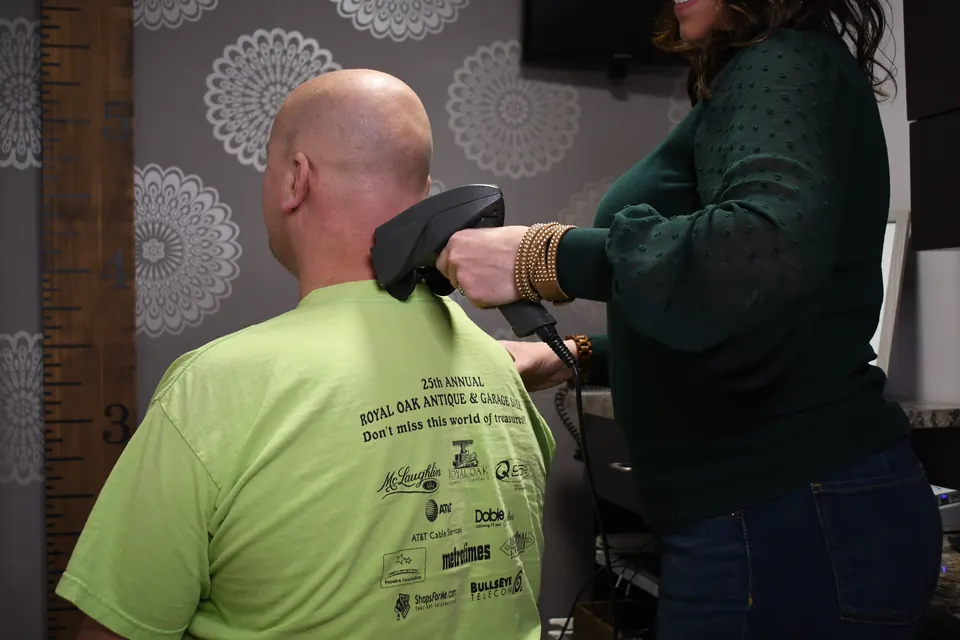
Using the INSiGHT scans, thermal, heart rate variability, and sEMG, we get an objective picture of where your nervous system is under stress, tension patterns from chronic infection, inflammation, or the demands of treatment your body hasn't released yet. That data guides our approach instead of relying on your symptom list alone. Using Koren Specific Technique (KST) and Talsky Tonal Chiropractic (TTC), adjustments stay ultra gentle, seated, standing, or lying down, whichever position feels best that day, with no cracking or twisting. We pace care to your treatment cycles rather than a fixed schedule and adjust intensity based on how sensitive your system is feeling at each visit.
What Patients Often Notice
Patients often mention reduced joint and muscle pain, clearer thinking, and more stable energy, alongside steadier heart rate and fewer headaches. Sleep tends to deepen as the nervous system settles, and many people also find they tolerate their treatment protocols better once this layer gets direct support. Progress with Lyme rarely moves in a straight line, so we track your INSiGHT scans over time rather than promising a fixed timeline.
A Few Ways to Support the Process Between Visits
- Keep a simple log of your Herx patterns and share it with both your Lyme-literate doctor and our doctors.
- Rest without guilt on flare days rather than pushing through on principle.
- Stay as consistent as your body allows with hydration, since it supports the systems doing the heaviest lifting.
- Note which days treatment protocols feel hardest to tolerate. That pattern often tells us something useful.
- Bring your observations to every visit. Lyme recovery rarely follows a script, and what you're noticing matters as much as our scans.
Where to Go From Here
If Lyme has your nervous system working overtime, our doctors in Royal Oak would like to be part of your care team. You can read more about our approach to Lyme disease support, or get our free guide on the nervous system layer underneath Lyme recovery. When you're ready, you can book online, or call us at (248) 616-0900.
