
Most parents have said some version of the same sentence more times than they can count: sit up straight, put the phone down, quit slouching over your homework. It works for about ninety seconds. Then the shoulders roll forward again, the chin drops toward the screen, and the reminder starts over. If that loop sounds familiar, the problem was probably never the reminder. It was everything your teen sits in, carries, and looks at for six or more hours a day.
A teenager's cervical spine is still maturing, and the nervous system that governs muscle tone and posture is still calibrating during these years. Sustained mechanical load from a backpack, a desk chair, or a laptop screen at the wrong height does not get corrected by willpower, because willpower was never the thing holding the posture up in the first place.
How the Load Actually Adds Up
Looking down at a phone or laptop at a 45 to 60 degree angle can place roughly 49 to 60 pounds of effective pressure on the cervical spine, compared to about 10 to 12 pounds in a neutral position. Multiply that across a school day of hunched note taking, a study session on the bed with a laptop propped on crossed legs, and a backpack loaded with textbooks worn low on one shoulder, and the neck is absorbing a genuinely heavy mechanical load for years during exactly the window when its bones, discs, and supporting tissue are still developing. Posture reminders address the moment. They do nothing about the hours of setup driving the moment in the first place.
The Backpack Question Most Families Skip
A backpack worn on one shoulder, slung low near the hips, or loaded heavier than a teen can carry with easy posture forces the spine into a compensating curve to keep from tipping over. That compensation does not stay confined to the shoulder carrying the weight. It travels up into the neck as the head shifts to counterbalance the load, and it travels down into the low back as the pelvis tilts to offset it. A backpack worn correctly, both straps, positioned high and snug against the back, is one of the simplest changes a family can make, and it is one most teens quietly stop doing sometime around middle school because it is not what their friends do.
The Desk Setup Question
A laptop sitting flat on a desk forces the neck into a forward, downward angle no matter how good a teen's intentions are about posture. Raising the screen to eye level, even with a stack of books, changes the geometry entirely, though it usually means adding an external keyboard so the hands are not reaching up awkwardly to compensate. A desk chair without support for the low back tends to collapse a teen's posture into a slouch within the first twenty minutes of homework, regardless of how straight they started out sitting.
Why This Is a Nervous System Question, Not Just a Furniture Question
When a body holds a bad position long enough, the nervous system stops treating it as temporary and starts treating it as the default. Muscles that were only supposed to brace occasionally begin bracing constantly, and that bracing pattern can persist even after the backpack gets lighter or the desk gets rearranged, because the nervous system learned to hold that tension and has not yet gotten the signal that it is safe to let go. This is why some teens correct their setup and still deal with chronic tightness, headaches, or stiffness that lingers well beyond what the furniture alone would explain. The furniture change is necessary. It is just not always sufficient on its own, especially once a holding pattern has had months or years to settle in as the default.
How Care Fits Into This
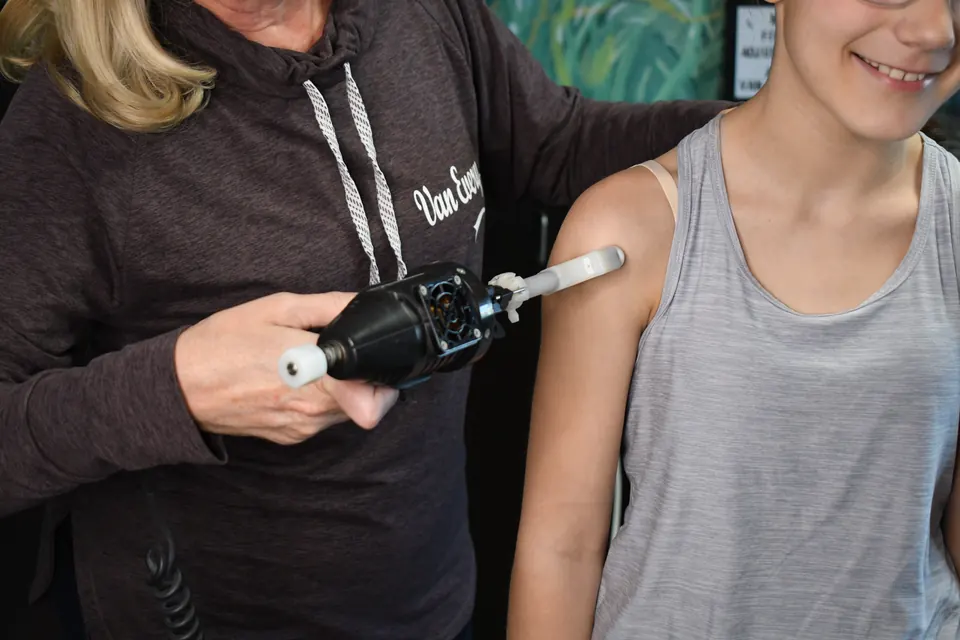
Our approach starts with an objective look at what a teen's nervous system is actually doing, not just where the pain is. Using Koren Specific Technique (KST) and Talsky Tonal Chiropractic (TTC), our doctors work with light, nervous system focused contacts, no cracking or twisting, calibrated to a teen's comfort level, paying particular attention to the upper cervical region and thoracic spine where postural load tends to concentrate. We also talk through the practical side, backpack habits, desk setup, screen time patterns, and sleep, because addressing the nervous system pattern works best alongside changes to what is actually loading it every day.
A Few Changes Worth Making This Week
- Raise laptop and phone screens closer to eye level rather than looking down at them for long stretches
- Switch to both backpack straps, worn snug and high, and keep the load as light as the school day allows
- Choose a desk chair with low back support, or add a cushion if the current one does not have it
- Build in short breaks during long homework or gaming sessions to change position
- Notice whether stiffness is worse after a specific activity, a sport, an instrument, hours at a desk, since that pattern is useful information for a visit
Where to Go From Here
If posture reminders have stopped working, or never really did, the setup behind the posture is worth a closer look, along with the nervous system pattern that has built up underneath it. Learn more on our teen neck pain page. When you are ready, book online with our doctors in Royal Oak, or call us at (248) 616-0900 with any questions first.
