
Most people notice a dowager's hump the same way, catching a glimpse of themselves from the side in a photo or a store window and realizing there is a mound at the base of their neck that was not there a few years ago. The conversation that follows is almost always about appearance. What almost nobody mentions in that first moment is breathing, and yet breathing is often the piece most quietly affected by the exact same pattern.
How a Rounded Upper Back Limits a Breath
A full, easy breath depends on your rib cage being able to expand freely, front, back, and to the sides. The upper thoracic hump, the more common version of this pattern, develops when vertebrae at the base of the neck gradually shift forward and the ribs attached to them follow, creating that rounded mound. As those upper ribs lose their normal range of motion, the whole rib cage loses some of its ability to expand, and breathing quietly becomes shallower, often so gradually that a person does not notice the change happening in real time.
The Sign Most People Miss
Two signs surprise patients most when they finally connect the dots. The first is tenderness at the front of the chest, right where the upper ribs attach to the breastbone, a common companion of a long standing hump that most people never think to mention to anyone. The second is exactly this breathing pattern, breaths that have quietly become shallow because a rounded upper back limits how freely the rib cage can move. Neither shows up on a posture check in the mirror, which is part of why both go unnoticed for so long.
Why This Matters Beyond Posture
The upper spine also relates neurologically to the heart, lungs, and thyroid, which is part of why a pronounced hump deserves attention as a health matter and not only a cosmetic one. A rib cage that cannot expand fully affects far more than how deep a breath feels in the moment. Over years, restricted breathing mechanics can contribute to lower energy, poorer stress tolerance, and a body working harder than it should just to move air in and out through an ordinary day. None of that shows up in a mirror the way the visible rounding does, which is exactly why it tends to go unaddressed for so long.
Why the Pattern Involves More Than One Spot
A hump rarely releases when only the most visible spot gets attention. The typical pattern includes several upper back vertebrae, the ribs attached to them, and often segments further down the spine that have been compensating for years. Until each piece of that pattern is found and addressed, the rib cage keeps rebuilding the same restricted shape, and the breath keeps rebuilding the same shallow pattern along with it. That is a large part of why posture reminders and generic stretching so often disappoint. They work at the surface of the pattern while the segments actually restricting the rib cage stay stuck underneath.
Our Approach
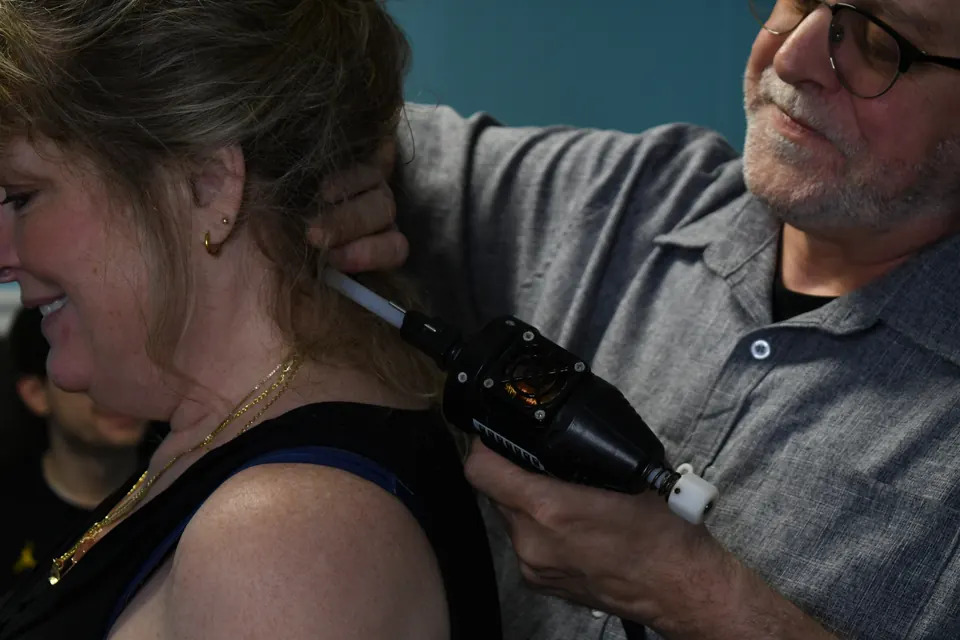
We begin with INSiGHT scans and a thorough history so your care plan reflects what is actually happening in your spine and rib cage, not a guess based on how the hump looks from the outside. From there, our doctors use Koren Specific Technique and Talsky Tonal Chiropractic to address each part of the pattern, upper back vertebrae, ribs, and related segments, with light, nervous system focused contacts, no cracking, popping, or twisting. Because each correction is specific to what the scans actually show, adjustments tend to hold, and rib mobility tends to build visit over visit rather than resetting back to where it started.
What Patients Notice
Everyone responds at their own pace, but a few changes come up often enough in conversation to be worth listing:
- A deeper breath that arrives without consciously trying to take one
- Less tenderness at the front of the chest near the breastbone
- Steadier energy through the day, once breathing mechanics improve
- Posture that starts to hold itself rather than requiring constant correction
- A calmer overall feeling, which many patients connect to breathing more freely
What This Means Going Forward
Where the hump follows compression fractures later in life, the visible shape may never fully reverse, and people in that situation do not have to settle for restricted breathing or discomfort as a result. When the surrounding pattern, upper back, ribs, and related segments, is addressed together, rib cage mobility and breathing mechanics often improve meaningfully even when the shape itself changes only modestly. That improvement in how a person breathes and feels day to day is frequently the more significant outcome, even though the visible rounding is what brought them in the door in the first place.
If you have noticed the rounding and never connected it to how you breathe, our doctors in Royal Oak would like to take a careful look at both. Learn more about our approach to dowager's hump care, or get our free guide on the hump pattern and what drives it. You can book online, or call us at (248) 616-0900 with any questions first.
