
You stand up straight for the exam, and everything checks out. Full range of motion, no obvious tenderness, nothing that jumps out on a scan. Then you get back in the car, or sit down at your desk, or turn your head to check a blind spot, and the same pain shows up exactly where it always does. It is tempting to wonder if you imagined the whole thing, especially when someone with a clipboard just told you nothing is wrong.
Nothing was wrong in the position they checked. That is a different statement than nothing being wrong at all, and the difference matters more than it gets credit for.
How This Shows Up
Position dependent pain takes a lot of different shapes, and the thread running through all of them is a specific posture or activity acting as the trigger, not general movement throughout the day. Some people feel completely fine standing at the counter and hurt within minutes of sitting down, particularly on a long drive. Others only notice it at a desk, holding a mouse at a certain angle or looking down at a phone too long. Musicians can feel it only while holding an instrument in playing position. Golfers often feel it at one specific point in the swing and nowhere else on the course. Reaching overhead, stooping into a cramped space, or turning the head a certain way can all bring on pain that never shows up while standing upright and still.
Why One Posture Hides What Another Reveals
A spine that looks balanced while you are standing in an exam room can be measurably different once you sit down, turn, or lean into a particular angle. That is not a contradiction. It reflects how joints, discs, and the surrounding soft tissue actually load and shift depending on position, something a neutral standing or lying down exam was never designed to capture. Checking someone only standing, or only flat on a table, can miss a pattern that only reveals itself sitting, turned, or holding a particular object. The position is not a distraction from the real problem. It is frequently where the real problem is hiding.
The Nervous System Angle Most Exams Skip
A joint or muscle does not fire pain signals for no reason. It fires because something along that nerve pathway is under load in that specific position, and the nervous system is doing its job by flagging it. When the trigger only appears in one posture, the nervous system is telling you something precise: this exact combination of angle, load, and duration is where the interference lives. A general exam performed in a neutral, low load position simply is not asking the nervous system the same question your daily life is asking it.
Sometimes the position that triggers pain today traces back to how the body was positioned when it was first hurt, whether that was an old fall, a sports collision, or a car accident. A body thrown forward and to one side during an impact can end up holding a pattern specific to that exact direction, one that keeps surfacing whenever the body returns to something close to that original position, sometimes years later.
Posture Is Not Only Physical
Pain and tension can also surface around stress, a difficult conversation, or a hard stretch of life, and that pattern is not imagined either. Muscle tension in the neck and shoulders tends to rise during stressful moments, whether the stress is physical or emotional, because the nervous system does not fully separate the two. We approach this gently and without pressure. For some patients, simply noticing that connection during care is part of understanding the whole pattern, not a separate step on its own. It does not mean the pain is any less real or any less worth addressing in the body. It usually means the nervous system has more than one thing to settle at once, and both deserve attention.
How We Check and Adjust in the Position That Provokes It
Instead of relying only on how you look standing still or lying on a table, we start by asking you to show us. If it only hurts sitting, we check you sitting. If it only hurts turning your head or holding an object in a particular way, we check you in that exact posture, because that is often the only place the pattern shows itself.
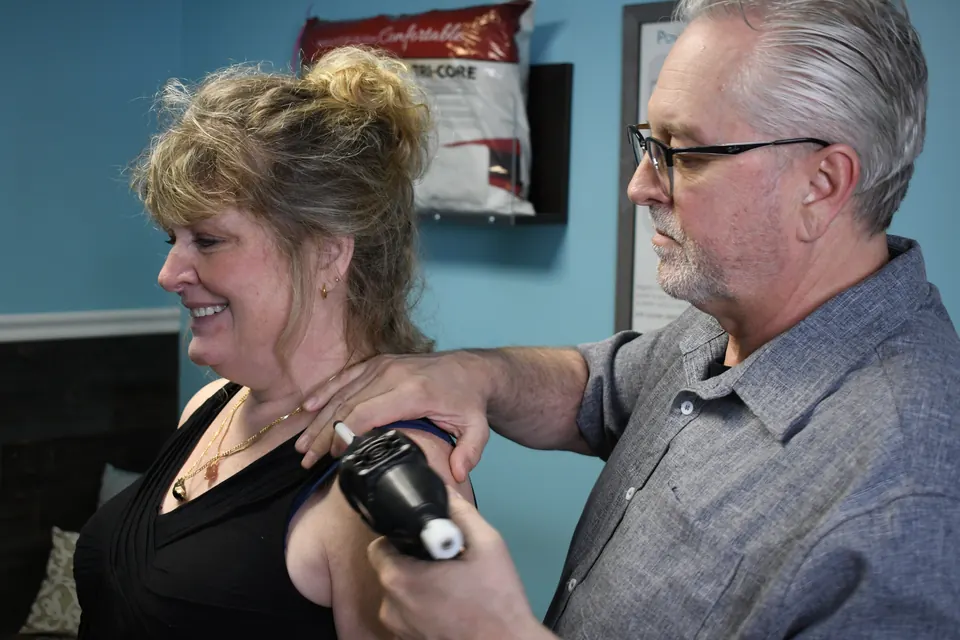
Using Koren Specific Technique (KST) and Talsky Tonal Chiropractic (TTC), our doctors can assess and correct you standing, seated, or holding whatever brings the pain out, not only on an adjusting table. Corrections are light and nervous system focused, no cracking, popping, or twisting, and work done in the position that actually provokes the pattern tends to hold longer between visits.
What Patients Report
- Being checked in the actual position that hurts, often for the first time, instead of being cleared because everything looked fine at rest
- The specific trigger activity, sitting, driving, turning, holding an object, becoming noticeably less of a problem as care continues
- Old patterns tied to a past injury finally being located instead of quietly staying in place
- Relief that reaches beyond the one triggering activity, since a nervous system pattern rarely stays confined to a single position
Where to Go From Here
If an exam has come back clean while the pain keeps showing up in the same position every time, that is worth a closer look, not a shrug. You can read more about how we approach this on our positional pain page. When you are ready, book online with our doctors in Royal Oak, or call us at (248) 616-0900 to talk through what you are noticing first.