
You found the tick, or maybe you never did. Either way, something about your child has felt different since, and it is hard to put a finger on exactly what. A kid who used to sleep hard now wakes up tired. A strong student who suddenly cannot hold focus through a homework session. Joint aches that show up in one knee, then a shoulder, then nowhere at all for a week. Individually, each of these could be explained away. Together, over weeks, they start to form a pattern.
Why a Single Test Rarely Settles the Question
Lyme disease is underdiagnosed in children, and in the early weeks after a bite, standard lab tests can come back negative even when the infection is genuinely present. That gap between what the labs show and what a parent is actually watching happen at home is one of the hardest parts of this whole process. It means the most useful tool a parent has is not a single test result but a written record of the pattern over time, because a pattern is much harder to dismiss than a single symptom mentioned in passing at an appointment.
What Is Worth Writing Down
Rather than trying to remember everything for a pediatrician visit weeks later, a simple running log kept on your phone or a notebook tends to be far more useful than memory alone. A few categories worth tracking:
- Energy: does your child wake up rested or already tired, and does that change through the week
- Focus: are there specific times of day, or specific types of tasks, where concentration seems to fall apart
- Mood: irritability, flatness, or swings that feel out of character, and whether they cluster around certain days
- Joint or muscle aches: where, how often, and whether the location moves around from one week to the next
- Sleep quality: not just how many hours, but whether your child wakes up feeling like the sleep actually did its job
Bring that log with you to appointments. Trust the pattern it shows over any single symptom taken in isolation, and keep advocating for your child even when one test alone does not tell the full story.
The Nervous System Layer Underneath the Symptoms
The tick bite is the trigger, but the pattern it sets in motion in a child's nervous system is often what keeps producing symptoms long after the initial infection has been addressed. The bacteria behind Lyme has a documented affinity for nerve tissue, and even once antibiotics have done their job, the autonomic nervous system, the part of the body that governs energy, focus, mood, and how deeply a child is able to rest, can be left running in a stress pattern it has not found its way out of.
That distinction matters, because it explains something a lot of families run into: labs look clear, the antibiotic course is fully finished, and the child still is not back to normal. Antibiotics are aimed squarely at the infection. They are not designed to address the autonomic nervous system pattern the infection can leave behind, and that functional layer is where symptoms like fatigue, brain fog, and mood shifts tend to keep running from.
How Our Doctors Support This
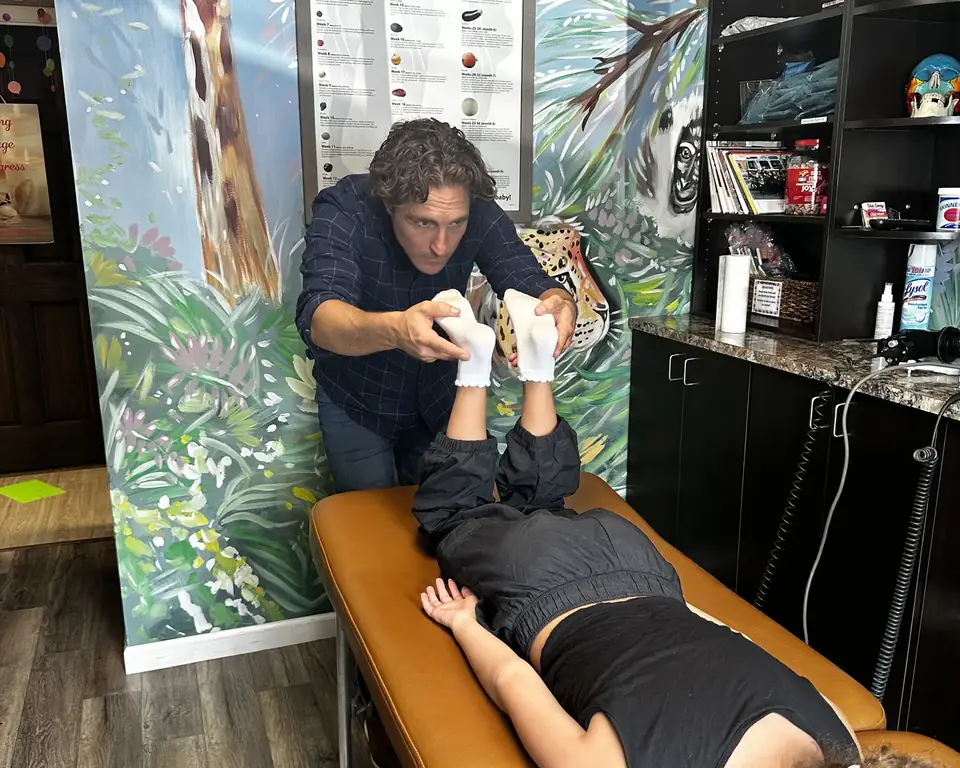
Our care starts with an objective look at how your child's autonomic nervous system is functioning and where it is carrying the most tension, rather than guessing based on symptoms alone. Using Koren Specific Technique (KST) and Talsky Tonal Chiropractic (TTC), care is completely gentle, with no cracking or twisting, and paced to your child's sensitivity on any given day. Many kids recovering from Lyme are understandably guarded around new forms of touch or care, and our approach is built with that in mind.
We rescan over time so both you and our doctors can see how your child's nervous system is responding as recovery continues, rather than relying only on how a given week felt. We are also glad to stay in communication with your pediatrician or Lyme-literate physician throughout the process, sharing what our assessment finds so everyone involved in your child's care is working from the same picture.
What Families Often Report
As the nervous system gains better regulation, many parents describe energy beginning to stabilize instead of the crash-and-rally pattern they had grown used to. Brain fog and school struggles often start to ease, sometimes noticed by a teacher before a parent connects the dots. Sleep tends to deepen as the nervous system gains more genuine access to rest, and mood swings that followed the illness often begin to settle as the autonomic system shifts out of chronic stress mode. Because energy, focus, mood, and joint aches frequently share the same nervous system root, families often notice improvement across more than one area at the same time rather than one symptom at a time.
If You Are Still in the Middle of This
There is no single timeline that fits every child, and comparing your child's pace to another family's story rarely helps. Timelines vary a great deal from child to child, and most children's Lyme symptoms do eventually resolve. Supporting the nervous system is one piece of what can shape how that recovery actually feels along the way, especially for a child whose paperwork says recovered but whose day to day says otherwise. If that sounds like where you are, our doctors would be glad to take a look. You can read more on our page for kids who were bitten and still are not back to normal. When you are ready, you can book online with our doctors in Royal Oak, or call us at (248) 616-0900 to talk through what you are seeing first.