You've watched it happen more than once. The same loud restaurant, the same chaotic family gathering, the same overlit big box store, and everyone around you seems to shrug it off while you're the one who needs to step outside, or go quiet, or leave early because your whole body is telling you it's had enough. If you've ever wondered why the world seems to hit you louder than it hits other people, that's not in your head, and it doesn't make you weak.
What Overstimulation Actually Is
Overstimulation happens when your brain takes in more sensory, emotional, or mental input than it can filter and settle in the moment. Sound, light, texture, smell, conversation, all of it arrives at once, and the usual background noise most people tune out without thinking suddenly feels impossible to ignore. You might notice every sound in a room at full volume, feel like the lights are too sharp, or find your own clothing unbearable against your skin.
It shows up in the body too: headaches, muscle tension, a racing heart, a tight stomach, exhaustion that hits out of nowhere. And it shows up in mood and focus, difficulty concentrating, irritability, a sudden need to escape the room. None of that is an overreaction. It's a nervous system that has already tipped past its threshold.
Why Your Threshold Sits Lower Than Someone Else's
Every brain has a filtering process that quietly screens out repetitive, harmless input, the hum of the fridge, the chatter at the next table, so you can focus on what actually matters. When that filter runs less efficiently, each signal lands with more intensity, and the point of too much arrives sooner. Some of that is simply temperament. Some people are wired to process sensory and emotional information more deeply from birth, noticing the flickering bulb or the second conversation across the room that most people never register.
But a lower threshold isn't only something you're born with. Early nervous system stress, whether from a difficult birth, a stretch of illness, or a rough early childhood, can leave a nervous system more reactive well into adulthood. That kind of early stress tends to stack, and the result is a system that starts each day already running a little hot, so it takes far less to push past the edge.
The Gas Pedal and the Brake
Underneath all of this is your autonomic nervous system, which runs on two settings. Picture them as pedals in a car. The sympathetic branch is the gas, your alert, fight-or-flight accelerator. The parasympathetic branch, powered mostly by the vagus nerve, works like the brake, the part responsible for rest, digestion, and settling back down. In a well-regulated system, you hit the gas when something actually calls for it, then ease off once it passes.
When that balance tips, the accelerator stays down and the brake can't fully catch, so your baseline is already loud before anything even happens. Chronic stress, poor sleep, and constant digital input pile on top of a system that's already running close to capacity, which is a big part of why overstimulation seems to get worse in adulthood rather than better. None of that means something is broken. It means the load has outpaced what your nervous system can currently regulate.
Getting Through the Moment
In the middle of overload, the goal is simple: lower the input and give your nervous system a reason to believe it's safe to stand down. A few things that genuinely help in the moment, without requiring anything special on hand:
- Step into a quieter, dimmer space, even a bathroom, your car, or outside, for a few minutes
- Try box breathing: in for four counts, hold for four, out for four, hold for four
- Ground through your body, feet pressed into the floor, something cool or textured in your hands
- Build in sensory buffers ahead of time, noise-dampening headphones, sunglasses, dimmable lights, and real breaks between demanding stretches of the day
These strategies genuinely work in the moment. What they don't do is change how quickly you reach overload in the first place. For that, the nervous system itself is the part worth addressing.
Where Nervous System Care Fits
Our doctors start by getting real information about how your nervous system is regulating, using INSiGHT scanning to look at heart rate variability, muscle tension patterns along the spine, and thermal regulation. That gives us an objective picture of where stress is being held in the spine and nervous system, rather than guessing from symptoms alone or waiting to see what happens next.
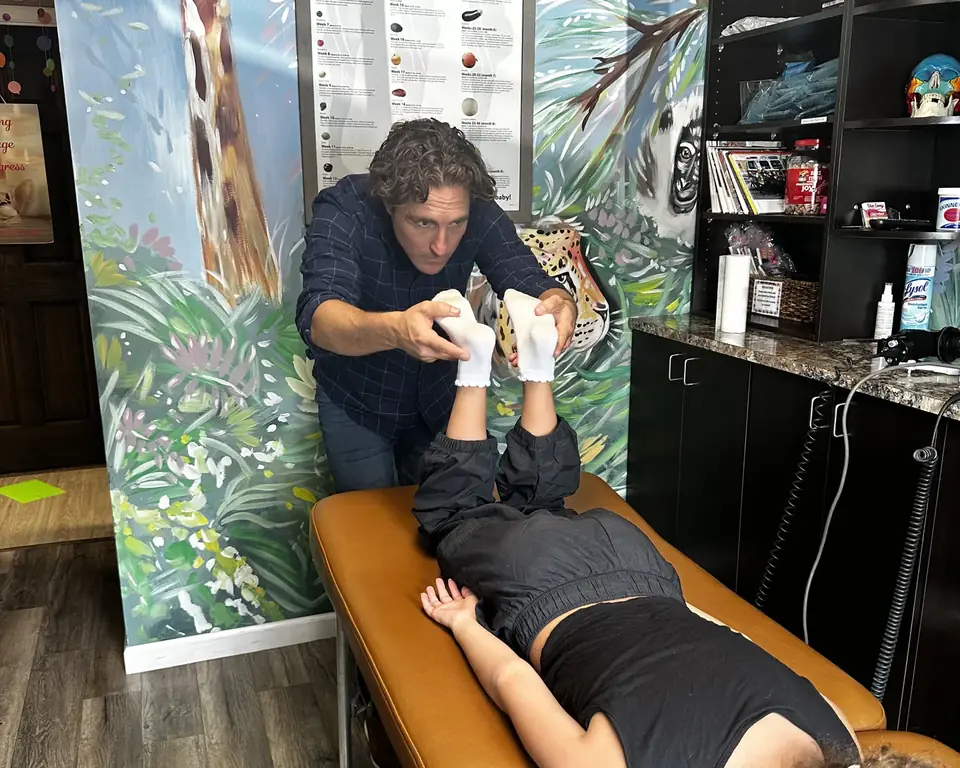
Using Koren Specific Technique and Talsky Tonal Chiropractic, light, nervous system focused contacts with no cracking or twisting, we work to ease stress patterns held in the spine and upper neck, the same region where sympathetic overdrive tends to get locked in and the vagus nerve's calming signal gets suppressed. The goal isn't to make the world quieter. It's to build enough capacity in your nervous system that the world stops feeling like an assault.
You Are Not Stuck Running Hot
Living with a nervous system that reaches overload faster than everyone around you is exhausting, and it's reasonable to want more than coping tools for the moment it happens. A nervous system that learned to stay on guard can also learn, with the right support and enough time, that it's allowed to power down. If the grocery store, the open office, or a loud room leaves you wrung out more than it should, our doctors in Royal Oak would be glad to take a look at what your nervous system is doing. Learn more about how we support sensory processing challenges, get our free guide, or book online. You can also call us at (248) 616-0900.