
If you have spinal stenosis, you have probably already discovered this trick without anyone teaching it to you. Leaning forward on the grocery cart. Sitting down on a bench and hunching slightly for a minute before standing back up. Walking uphill somehow feeling easier than walking on flat ground. None of that is a coincidence, and once you understand why forward leaning eases the symptoms, you can use it on purpose instead of stumbling into it by accident.
The Pattern Most Stenosis Patients Notice
The classic pattern with spinal stenosis is pain, heaviness, or weakness in the legs that builds while walking or standing and eases when you sit down or lean forward. A lot of patients notice they can walk much farther pushing a shopping cart than walking upright with nothing to lean on, or that a slightly stooped posture on a long walk buys them extra distance before the legs start to give out. Cycling on a stationary bike, where the body is naturally bent forward, is often far more comfortable than walking the same distance upright. This pattern, sometimes called neurogenic claudication, is one of the clearest signals doctors look for when diagnosing spinal stenosis in the first place.
Why Forward Flexion Actually Helps
Spinal stenosis is the narrowing of the spinal canal that crowds the spinal cord and the nerve roots branching off it. When you flex your spine forward, even slightly, the space inside that canal opens up a bit more than it does when you are standing fully upright or arching backward. That small increase in available space is often enough to relieve pressure on the nerves that were being compressed, which is exactly why a stooped posture or a hand on a cart can turn a short, painful walk into a longer, more comfortable one. Standing fully upright, and especially arching backward, tends to narrow that same space further, which is part of why some patients notice their symptoms are worse standing still than while actually walking in a slightly forward-leaning posture.
Why This Matters Beyond Just Comfort
Understanding this pattern is not just a curiosity. It gives you a practical tool for managing daily activity while you are working on a longer term plan. A patient who knows why leaning forward helps can use a cart deliberately at the grocery store, choose a walking route with a slight uphill grade instead of a flat one, or take short seated breaks proactively rather than waiting until pain forces a stop. That kind of practical pacing can meaningfully extend how far and how comfortably someone with stenosis is able to move through an ordinary day, even before other care has had a chance to make a bigger difference.
Why It Is Not the Whole Answer
Leaning forward manages the symptom in the moment. It does not change the surrounding tissue tension that is adding to the compression in the first place, and it is not something anyone wants to do full time, since a permanently stooped posture creates its own problems over the long run. Muscles and ligaments around a narrowed canal that stay chronically tense from a nervous system stuck in a heightened stress response take up space the nerves need, on top of the structural narrowing itself. That surrounding tension is something posture alone cannot fully address, which is why patients who rely only on forward leaning as a coping strategy often find their walking tolerance plateaus rather than continuing to improve.
Our Approach at Van Every
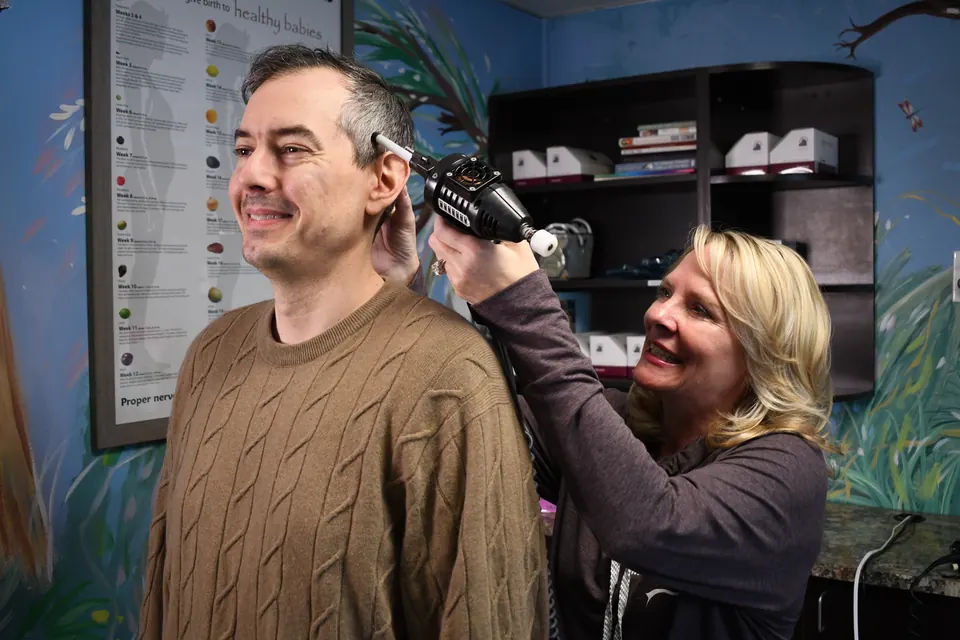
We start with a thorough evaluation of your spinal alignment, range of motion, neurological function, and walking ability, including an INSiGHT scan to objectively assess your nervous system and see where stress and tension are held from years of spinal changes and compensation. We also review any imaging you already have and coordinate with your medical team when additional studies are needed. Using Koren Specific Technique (KST) and Talsky Tonal Chiropractic (TTC), our doctors make light, nervous system focused corrections, no cracking, popping, or forceful manipulation, since forceful adjustments are not appropriate for a narrowed canal. The goal is to help your body use the space that is already there as well as it possibly can.
What Patients Often Notice
Walking farther before symptoms appear is usually the first thing people mention, sometimes going two blocks where they could barely manage one before. Patients often notice they need to lean on a cart or rail less than they used to, and that walking upright for longer stretches feels genuinely comfortable rather than something to brace for. Numbness, tingling, and leg weakness often ease as surrounding tension releases, and balance and confidence on uneven ground tend to improve alongside it. Since stenosis is a chronic condition, we build a long-term plan rather than a short course of care, and many patients settle into a maintenance schedule of just a visit or two per month once things stabilize.
Practical Ways to Use This Between Visits
- Use a cart or a stroller handle deliberately on longer errands rather than waiting until pain forces you to reach for support
- Choose routes with a gentle uphill grade when possible, since the forward lean built into that movement often extends comfortable walking distance
- Take a short seated break with a slight forward lean before pain builds, rather than waiting until you have to stop
- Track how far you can walk comfortably over time, since that number tends to move before pain fully resolves
- Mention which specific positions and activities help most at your next visit, since that information guides your care plan
Getting A Clearer Picture
You can learn more on our spinal stenosis page, or get the full picture in our free guide. When you are ready, book online with our doctors in Royal Oak, or call us at (248) 616-0900.