
Somewhere along the way, whatever originally caused your shoulder to lock up probably finished recovering. The fall, the clavicle strain, the months of repetitive overhead work, whatever started it. And yet the stiffness is still there, sometimes worse than it was months ago, even though by every reasonable measure the injury itself should be old news. That gap, between the healing that has already happened and the restriction that has not gone anywhere, is worth understanding.
Two Different Timelines
Tissue recovery and nervous system guarding do not run on the same clock. A strained muscle, a bruised joint, or an irritated nerve can settle down in a matter of weeks. The protective pattern your nervous system built around that injury, tightening the surrounding muscles and limiting movement to keep the area safe, can persist long after the original threat has passed. Your shoulder is not necessarily still injured. It may simply still be guarded, running on outdated information about how much danger that area is actually in.
Why the Nervous System Keeps Guarding
Think of the sympathetic and parasympathetic branches of your nervous system as a gas pedal and a brake. The gas pedal tightens muscle, keeps tissue on alert, and turns up protective tension when it senses a threat. The brake is what allows that guarding to stand down once the danger has passed. In a shoulder that has been protected for months, the gas pedal can stay partly engaged well past the point where it is still needed, holding tension the joint no longer requires. This is not a malfunction so much as a system that has not yet received a clear enough signal that it is safe to let go.
What Makes This Pattern Easy to Miss
Because the guarding shows up as physical stiffness, restricted motion, an ache that seems to live in the joint, it is easy to treat it as though the joint itself is still the problem. Rest, ice, and anti-inflammatory approaches all make sense from that framing, and they can genuinely bring some relief. What they rarely do is address the nervous system pattern underneath the stiffness, which is part of why so many people describe a loop: some improvement, a plateau, then stuck again, without ever fully breaking free of the restriction.
How This Connects to the Neck
There is another layer worth knowing about. The nerves that reach your shoulder branch out from the cervical spine first, which means the original injury sometimes started in the neck rather than the shoulder itself, even when the shoulder is where the stiffness eventually showed up. When that upstream piece never gets examined, treating the shoulder in isolation leaves part of the actual picture untouched, and that gap can be part of why guarding sticks around long after tissue recovery should have finished.
Our Approach to Breaking the Loop
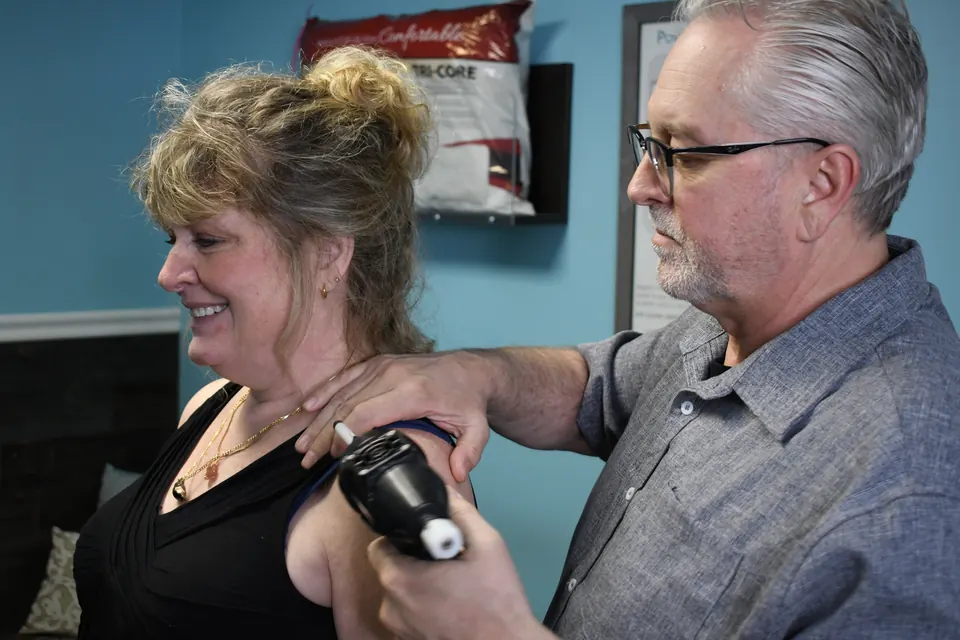
We start with INSiGHT scanning to get an objective read on how your nervous system is functioning, paired with orthopedic and neurological testing to find where the injury actually originated rather than only where it hurts now. From there, our doctors build a plan using Koren Specific Technique (KST) and Talsky Tonal Chiropractic (TTC), light, nervous system focused contacts with no cracking or twisting, aimed at giving your nervous system a clearer signal that the area is safe to release. We can adjust the shoulder while you actively move your arm, which tends to speed the process along, and massage therapy, targeted exercises, and lifestyle adjustments often round out the plan.
What Patients Notice
Motion is usually the first thing to shift, often before the ache has fully settled down. Reaching overhead, getting dressed, and sleeping on that side again tend to follow as guarding eases. A few other patterns we hear about regularly:
- A shoulder that finally feels like it belongs to the person again, rather than something to work around all day
- Less bracing in daily movements that had quietly become careful and limited
- Sleep that improves once the joint stops interrupting it through the night
- A sense that the stiffness has an actual explanation rather than being an unexplained mystery
How quickly things change depends on how long the shoulder has been locked up and what has actually been driving the guarding. A shoulder guarded for a couple of months tends to respond differently than one that has been locked up for a year or more, which is part of why we build the plan around your specific timeline rather than a fixed number of visits. Some patients notice a shift within the first several visits. Others, particularly with a longer standing restriction, need more time for the pattern to fully settle. Tracking motion at each visit gives us an objective way to see whether care is working rather than relying on guesswork.
A Few Things That Can Help Between Visits
- Gentle pendulum stretches within a pain free range, rather than pushing into sharp pain to try to force motion back
- A small pillow supporting the affected arm at night to reduce guarding while you sleep
- Noticing how much tension you are carrying in your neck and upper back, not only the shoulder itself
- Warm showers or heat before stretching, which can make gentle movement more comfortable
Where to Go From Here
You do not have to accept a shoulder that will not move as your new normal, and you do not have to keep guessing why the stiffness has outlasted the original injury. Our doctors in Royal Oak, including Saturday appointments, would be glad to take a look. You can read more on our frozen shoulder page, or grab our free guide. When you are ready, book online with our doctors, or call us at (248) 616-0900 with any questions first.