
You know the exact moment the pain started to change. It was not the dull ache you had gotten used to. It shot down your arm, or maybe your leg, sharp enough to stop you mid-sentence. Then came the tingling, or the numbness that made you drop your coffee cup, or a grip that suddenly could not quite hold onto anything.
You have probably already tried the usual sequence. Anti-inflammatories. Maybe a cortisone shot. Physical therapy, or a brace you wear at night. Some of it helped, at least for a while. But the symptoms crept back, and somewhere in the back of your mind is the question you have not said out loud yet: is this going to keep getting worse until surgery is the only option left?
What a Pinched Nerve Actually Is
A pinched nerve, sometimes called nerve compression or radiculopathy, happens when a vertebra, a disc, a muscle, or a ligament crowds a nerve and interrupts the signal it carries. It rarely looks the same in two people. Some feel a sudden shooting pain down an arm or leg. Others notice a burning sensation tracing the nerve's path, patchy numbness, or a weaker grip that makes opening a jar harder than it used to be. Pain right at the site of compression, in the neck or low back, is common too, and it often gets worse at night or with certain positions.
Here is the part that surprises a lot of people: a pinched nerve does not just carry pain. It also carries the signal that controls muscle strength, sensation, and coordination in whatever it supplies. That is why a nerve issue in your neck can show up as weakness in your hand, and why the response has to reach further than the spot where it hurts.
Why It Rarely Stays Where You Feel It
The nerve running to your hand starts at your neck. The one running to your foot starts at your lower back. Wherever the compression is actually happening, every signal running through that pathway gets disrupted, not only the ones carrying pain. This is part of why so many evaluations that stop at the symptom site, the wrist, the calf, the shoulder, end up missing the source entirely.
The Nervous System Piece Behind the Compression
Most people picture a pinched nerve as a purely mechanical problem: a bone spur, a bulging disc, something physically in the way. That is part of the picture, but it is rarely the whole story. The muscles around a compressed nerve are often held in a chronic, tight pattern because the nervous system is telling them to guard, the same reflex that keeps your shoulders up around your ears during a stressful week, just aimed at your spine instead. When that stress pattern does not let up, the guarding does not either, and the compression it is sustaining stays put no matter how many rounds of anti-inflammatories you take.
A hospital-based study of 162 patients with nerve compression found that 85 out of 100 who received chiropractic care reported resolution of their radicular symptoms. That number lines up with what many patients in our office describe, and it points at something important: when the nervous system tension driving the guarding pattern is addressed directly, the nerve often gets the room it needs to recover.
Why Rest and Injections Sometimes Only Help for a While
Anti-inflammatories reduce swelling around the nerve. Cortisone injections numb the area. Physical therapy strengthens nearby muscles. All of that can genuinely help, and none of it is wrong to try. But if the muscle guarding sustaining the compression is still active in the background, the pressure tends to build back up once the medication wears off. That is the frustrating cycle a lot of patients describe: temporary relief, then the same shooting pain a few weeks later. Addressing the guarding pattern itself, not just the swelling around it, is what tends to hold.
Our Approach at Van Every
We start with neurological testing, a range of motion assessment, and INSiGHT scanning, thermal imaging, heart rate variability, and surface EMG, to get an objective read on how your nervous system is functioning around the compressed nerve. That gives us a real picture of where and why the pressure is happening rather than a guess based on where you feel it.
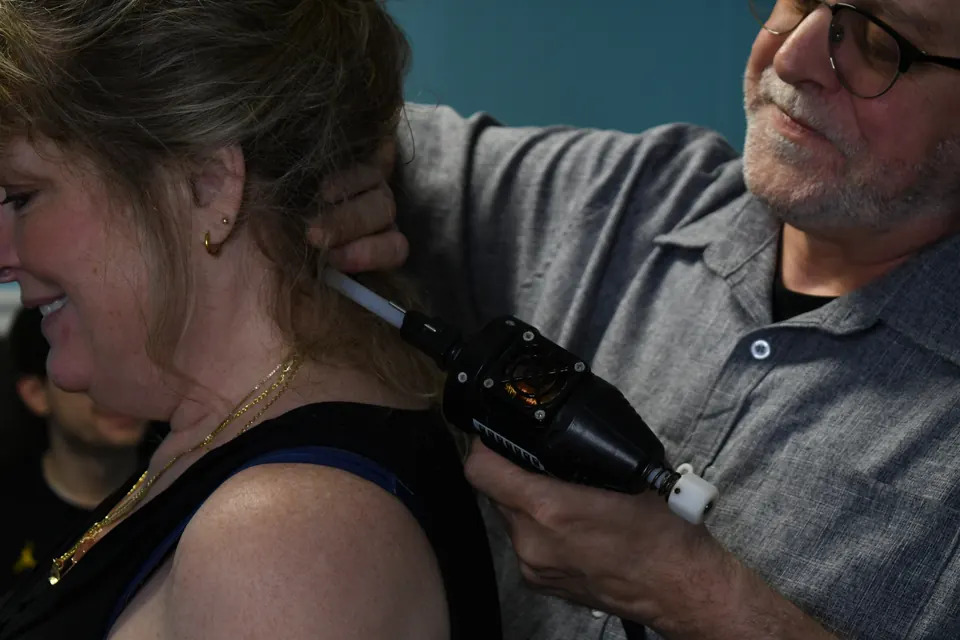
From there, our doctors use Koren Specific Technique (KST) and Talsky Tonal Chiropractic (TTC) to work at the spinal level where the nerve root is under pressure. These are light, nervous system focused contacts, no cracking, popping, or forceful manipulation, which matters a great deal when the area involved is already irritated. A forceful adjustment near a compressed nerve can aggravate it further, so we deliberately skip that approach. If your case calls for a surgical consultation, we will refer you to the right specialist.
What Patients Often Notice
Most patients notice the shooting pain and tingling ease first. Steadier grip strength and better range of motion tend to follow, along with sleep that is no longer interrupted by nighttime numbness. In a study of cervical radiculopathy patients, roughly 40 percent reported autonomic symptoms alongside their nerve pain, things like dizziness or a dysregulated stress response, which is a reminder that a compressed nerve pathway can affect more than the spot where it hurts. Many patients return to activity and work they had scaled back without ever needing a surgical consult.
Supporting Recovery Between Visits
A few habits often make a real difference alongside care:
- Change positions regularly rather than sitting or standing still for long stretches, since a compressed nerve tends to protest sustained postures
- Note which positions worsen your symptoms and which ease them, since that pattern helps pinpoint the affected spinal level
- Keep a simple log of when numbness or tingling shows up, especially at night, so you can track whether it is improving
- Avoid sleeping in a position that curls the affected limb underneath you
- Stay gently active rather than fully immobilizing the area, unless a doctor has told you otherwise
Next Steps
You can learn more about our approach on our pinched nerves page, where you can also request our free guide on what nerve compression means for your body's communication system. When you are ready, book online with our doctors, or call (248) 616-0900 if you would rather talk it through first. You can also read more about KST and Talsky Tonal Chiropractic before you come in.
