
Most people describe their neck pain the same way at every appointment: it hurts, it is stiff, some days are worse than others. What tends to get left out is when the pain shows up, and that detail carries more information than people realize. A neck that is worst the moment you wake up is telling a different story than a neck that only tightens up after eight hours at a desk, and both are different again from a neck that catches sharply with a specific movement.
Morning Stiffness That Loosens as the Day Goes On
If your neck feels its worst the moment you open your eyes and gradually eases over the first hour or two, that pattern often points toward how you are sleeping. A pillow that is too high, too flat, or simply wrong for your sleeping position can hold the cervical spine in an awkward angle for hours at a stretch, long enough for tension to settle in overnight. It can also point toward inflammation that has had all night to build without the movement that normally keeps it in check during the day. Either way, the fact that it improves with motion is a useful clue.
Tightness That Builds Through the Day
Pain that starts out mild and gets progressively worse as the day goes on usually has a different driver: sustained posture. Hours spent looking down at a screen, phone, or paperwork keep the neck muscles working overtime just to hold the head up against gravity, and that steady low-grade load adds up. This is the pattern people usually mean when they talk about tech neck, and it tends to respond well once the underlying tension pattern, not just the posture habit, gets addressed directly.
Pain That Catches With a Specific Movement
A sharp catch when turning to check a blind spot, or pain that spikes with one particular motion and stays quiet otherwise, often points toward a specific joint or segment rather than general muscle fatigue. This kind of pattern is common after an old whiplash injury that never fully resolved, where a segment of the cervical spine lost some of its normal motion and the surrounding tissue has been compensating ever since. It is also common with a disc that is bulging or irritated in a way that only becomes noticeable at certain angles.
Pain That Comes With Headaches or Arm Symptoms
When neck pain travels, headaches that seem to start at the base of the skull, tingling or numbness running down into the arm and hand, it is a sign the nerves running through the cervical spine are involved, not just the muscles around them. That is worth paying attention to, because the nerves exiting the neck connect to far more than the muscles right around them, which is part of why neck problems can produce symptoms that show up somewhere else entirely.
Why the Pattern Matters for Care
Knowing when your pain shows up and what makes it better or worse gives our doctors real information to work with instead of a general complaint. A detailed history, paired with range of motion testing and an INSiGHT scan, thermal, heart rate variability, and muscle readings, lets us see what your nervous system is actually doing before anyone touches your neck, and the timing pattern you describe often points us toward exactly where to look first.
Our Approach Once We Know the Pattern
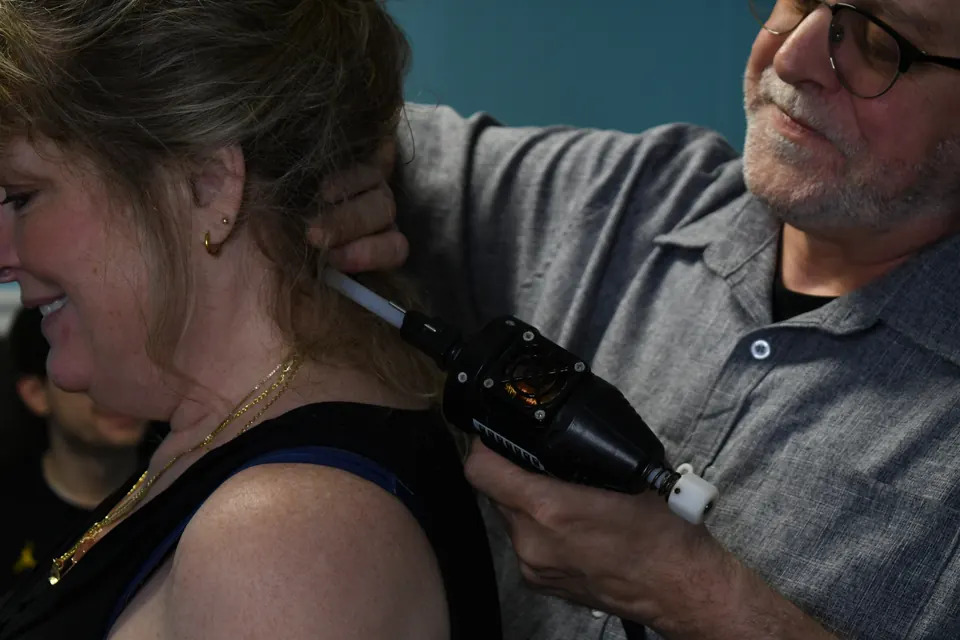
Using Koren Specific Technique (KST) and Talsky Tonal Chiropractic (TTC), our doctors deliver precise, gentle adjustments with no cracking, popping, or forceful manipulation, adjusted seated, standing, or in whatever position actually provokes your pain so we can address it directly rather than guessing. Even patients who feel nervous about chiropractic care in general tend to find these nervous system focused techniques calming rather than jarring.
What to Track Before Your Next Visit
- When during the day your neck feels its worst, and whether it improves or worsens with movement
- Whether a specific motion, turning to one side, looking up, reliably triggers the pain
- Whether headaches, arm tingling, or numbness ever accompany the neck pain
- What kind of pillow and sleeping position you use most nights
- How many hours a day you spend looking down at a screen or phone
What Patients Notice
Most patients notice better range of motion first, the ability to turn the head fully without a catch, followed by fewer flare-ups and less reliance on over-the-counter pain relievers. Patients who came in for a stiff neck also frequently mention sleeping better and having more energy, since restoring proper motion and communication in the cervical spine tends to change more than the original complaint. Posture often improves alongside it too, since a neck that moves freely is simply easier to hold upright. Many patients are surprised by how much a simple timing pattern, worst in the morning versus worst by evening, ends up mattering once they start paying attention to it, because it turns a vague complaint into something specific enough to actually work with.
Next Steps
A stiff, aching neck does not have to be something you plan your days around. If you can describe the pattern, when it shows up, what triggers it, what eases it, our doctors can use that information to look in the right place from the start. You can read more on our neck pain page. When you are ready, you can book online with our doctors in Royal Oak, or call us at (248) 616-0900 with any questions first.