
There is a specific, measurable number behind a lot of what people write off as simply getting older: heart rate variability, the moment-to-moment variation in the time between heartbeats. It sounds like a small, technical detail, but it reflects something fundamental, how well your nervous system can shift between an alert, active state and a settled, recovering one. And on average, that capacity declines significantly between age 25 and 60. That is a real number worth understanding, because it is not the same thing as saying decline is inevitable or unchangeable.
What This Number Is Actually Measuring
Your nervous system runs on two settings, often described as a gas pedal and a brake. The gas pedal, your sympathetic nervous system, gears you up for activity and stress. The brake, your parasympathetic nervous system, lets you rest, digest, and recover. Heart rate variability reflects how readily your body can move between these two states. A nervous system with strong variability shifts smoothly. One with reduced variability tends to get stuck, running hotter and settling less easily, even when nothing in particular is demanding that response.
Why This Declines With Age, and Why That Matters
After roughly age 55, vagal capacity, the strength of that brake pedal, measurably declines for most people. The practical result is a nervous system that runs a little hotter than it used to and takes longer to power down. This shows up as stiffness that seems to build every year regardless of activity level, balance that feels less automatic than it used to, sleep that does not restore the way it once did, and a general sense that recovery from a busy day or a hard workout takes longer than it used to.
Why This Is Not Purely About the Calendar
Here is the part that gets missed most often: a meaningful portion of that decline reflects accumulated interference in the nervous system, built up from decades of old injuries, repetitive strain, postural changes, and general wear, rather than age itself dictating the number. Your spine holds thousands of position sensors, proprioceptors, that function like an internal GPS, sending your brain constant information about where your body is in space and what adjustments are needed to stay upright and coordinated. When tension accumulates in that system over decades, the signal gets noisier. The brain receives less accurate information, reaction time slows, and an unexpected step off a curb that your body would have corrected instantly at forty becomes a real fall risk at seventy. That is not simply weakness or deconditioning. It is a nervous system carrying more interference than it needs to.
Why Balance Exercises and Stretching Alone Often Fall Short
Balance training, stretching, and physical therapy all have real value, and we encourage people to keep doing what is already working. What those approaches address is the output, the muscle strength, the flexibility, the practiced movement pattern. They do not directly reach the nervous system signal underneath, the noisy proprioceptive information that is part of what makes balance and coordination harder in the first place. That is why some people do all the right exercises and still feel like their balance has not caught up to their effort.
How Gentle Chiropractic Care Fits In
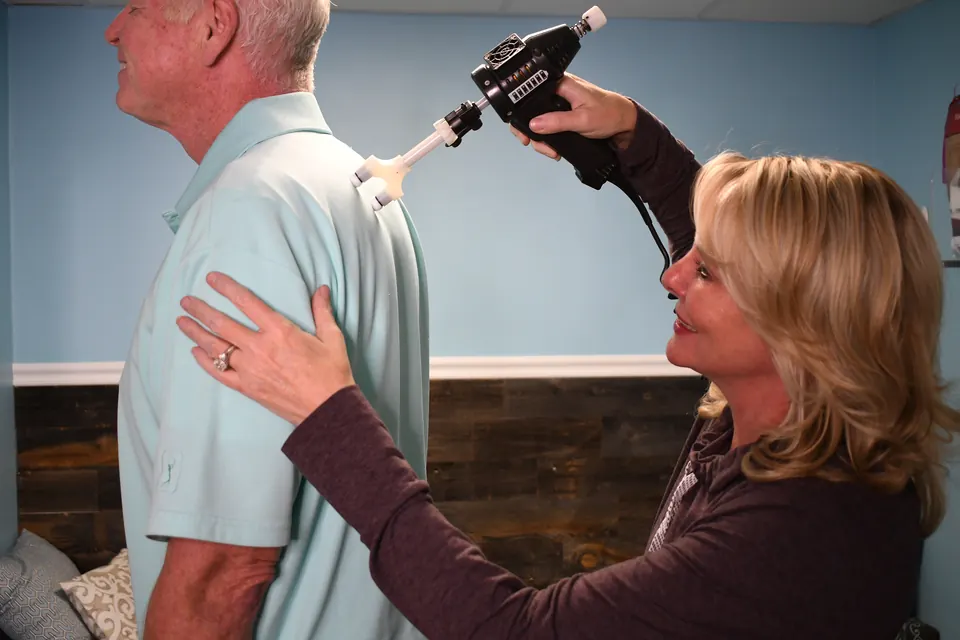
Using Koren Specific Technique (KST) and Talsky Tonal Chiropractic (TTC), our doctors work with controlled, gentle pressure and no rotation, twisting, or high-velocity manipulation, adjusting you in whatever position is most comfortable, sitting, standing, or lying down. This approach is safe alongside osteoporosis, arthritis, and joint replacements. A gentle INSiGHT scan, including heart rate variability readings, gives us an objective picture of how your nervous system is actually functioning, not just where you feel discomfort, and lets us track that number over time rather than guessing whether care is making a difference.
What Older Adults Often Notice
- Steadier balance and more confidence navigating stairs or uneven ground
- Range of motion that opens back up, particularly in the neck, shoulders, and low back
- Chronic joint pain that decreases as nervous system regulation improves
- Sleep that deepens as the nervous system regains more capacity to shift into rest
- A sense of engaging more fully with activities that had started to feel risky, gardening, driving, keeping up with grandchildren
For older adults, we often begin with shorter, more frequent visits to build nervous system capacity gradually, and we rescan periodically to track genuine progress rather than relying only on how a given day feels.
You Are Not Too Old to Start
A common thing we hear from older patients is that they assumed chiropractic care was not an option once osteoporosis, arthritis, or a joint replacement entered the picture. That assumption usually comes from picturing cracking and twisting, which is not what our care looks like. We regularly work with patients well into their eighties and beyond, and it is rarely too late to give your nervous system real support.
Where to Start
The gap between where you are and where you could be is often the nervous system, not the calendar. If stiffness, balance, or recovery have been quietly narrowing your days, our doctors would be glad to take a look. You can read more on our senior care page, or get our free guide to gentle chiropractic care for older adults. When you are ready, book online with our doctors in Royal Oak, or call us at (248) 616-0900 with any questions first.