
A nerve does not fire for no reason. If the base of your skull keeps producing sharp, burning, electric pain that comes back no matter what has already been tried, something is putting real pressure on that nerve, and the question worth asking is not how to quiet it one more time. The question is what is pulling on it in the first place.
A Structure Most People Have Never Heard Of
Your brain and spinal cord are wrapped in a tough, continuous membrane called the dura mater. Most people, if they picture it at all, picture something like a sleeve running down the spine. What often gets missed is what is happening right where that membrane meets the base of the skull. At that point, the dura is directly attached to the inside of the occiput, the bone that sits at the very back and base of your head, right where the occipital nerves exit on their way up into the scalp.
When that membrane is under sustained tension, it does not just sit there quietly. It pulls. And what it pulls on, because of how closely the two structures sit together, are the very nerves responsible for the pain you are feeling.
How the Tension Builds
This is not usually the result of one dramatic event. Sometimes there is a history of neck trauma, a car accident or a hard fall, that sets the pattern in motion. Just as often, there is no single injury at all. Years of accumulated stress, physical, chemical, or emotional, can create the same dural tension gradually, without ever announcing itself the way a car accident would. A nervous system that has been running in a stress response for a long time tends to keep the sympathetic branch active, the part of the nervous system built for alert rather than rest, and that ongoing activation tightens the dural system as part of a larger protective pattern. The muscles at the base of the skull add their own layer of tension on top, and the two reinforce each other.
Why the Usual Approaches Rarely Hold
A nerve block numbs the nerve, and for a while, that brings real relief. But the injection does nothing to the membrane pulling on the nerve from the inside, so once it wears off, the pain has every reason to return. Muscle relaxers ease the surrounding tightness without reaching the deeper tension underneath it. Physical therapy can genuinely help range of motion while still not addressing what is happening at the level of the dura itself. Each of these approaches works on the output, the nerve signal, the muscle spasm, the pain, rather than the structure generating it, and that is a large part of why relief so often fades rather than holds.
How Our Doctors Address It
We start with an INSiGHT neurological scan focused on the upper cervical region, where the occipital nerves, the dural attachments, and the base of the brainstem all converge, so we have an objective picture rather than a guess about where your nervous system is carrying the most stress. From there, our doctors look at the tension pattern itself, not only the nerve. Is the dura under sustained tension where it attaches to the occiput? Is a nervous system stuck in a stress response keeping that tension locked in place? Is there a cervical component adding to the load?
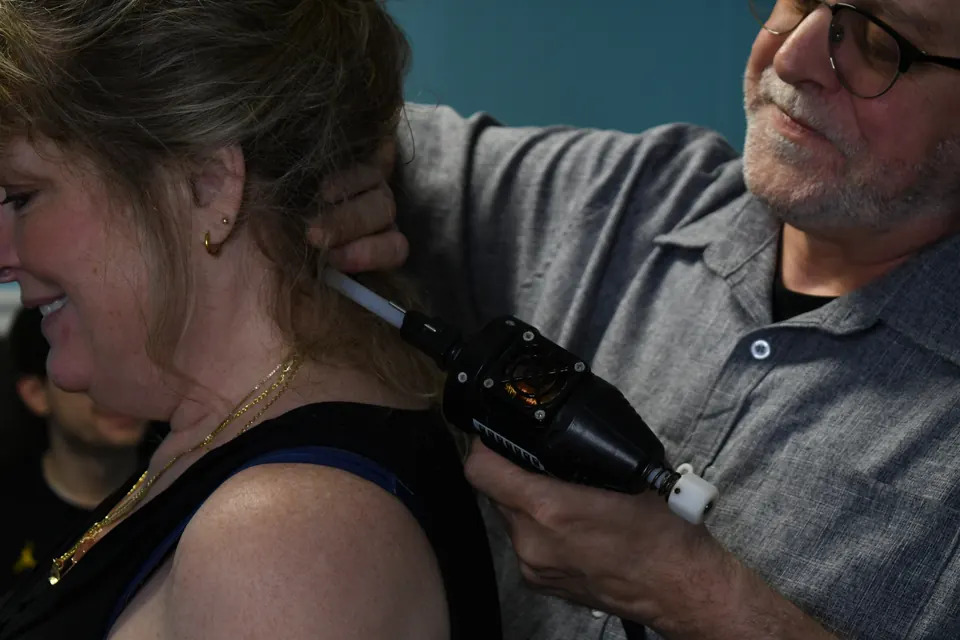
Using Talsky Tonal Chiropractic (TTC) and Koren Specific Technique (KST), care is applied gently and specifically to the upper cervical spine and the junction where the skull meets the neck. There is no cracking, no popping, and nothing that would aggravate a nerve pathway that is already inflamed. The intent is to communicate with your nervous system at the level where the tension is actually being held, so that as the dural tension at the occiput begins to release, the mechanical load on the nerve lifts along with it.
What Patients Often Notice
As this deeper tension pattern shifts, the changes tend to reach beyond the head itself. Some of what we hear most often:
- A meaningful drop in how often occipital flares happen, often within the first several weeks of care
- Neck movements that used to reliably trigger pain becoming easier and less guarded
- Better sleep, as the nervous system shifts out of its chronic stress response and the muscles at the base of the skull are finally able to relax
- Less of the constant background tightness at the base of the skull that had felt like a permanent fixture
- Improvements that show up outside the head entirely, including less jaw tension and more stable energy through the day
Because the dural system and the nervous system are so closely tied together, addressing the tension at its source tends to produce changes that reach further than the original complaint. Timelines vary depending on how long the pattern has been building. Someone with a recent flare-up may notice a shift quickly, while a longstanding pattern that developed over years of accumulated tension may take steadier, more gradual care to fully unwind.
Where to Go From Here
If you have already tried nerve blocks, muscle relaxers, or physical therapy and the pain keeps finding its way back, it may be worth having the actual source of the tension evaluated rather than treating the nerve signal one more time. You can read more on our occipital neuralgia page, or get our free guide that goes deeper into what is driving this pattern. When you are ready, you can book online with our doctors in Royal Oak, or call us at (248) 616-0900 with any questions first.