A birthday party, a cousin's visit, a moment at daycare pickup. Somewhere along the way you started quietly measuring your toddler's talking against everyone else's, and the comparison has been sitting with you ever since. Maybe a doctor already told you to give it time. Maybe you have not brought it up yet because you are not sure it is a real concern. Either way, that instinct is worth paying attention to. Speech is one of the most common developmental questions parents raise, and there is usually a real, traceable reason underneath it.
Two Different Things That Get Mixed Up
People often use speech delay and language delay to mean the same thing, though they are not quite the same. Speech is about the physical act of forming sounds clearly. A child can have plenty they want to say and still be hard to understand because the mechanics of production are lagging. Language is a separate skill built from two halves: what a child takes in and understands, and what they can put back out in words. A toddler who follows every instruction perfectly but barely talks is dealing with an expressive gap, not a comprehension one, and that distinction changes what is actually worth watching for.
A Rough Timeline to Compare Against
Every child has their own pace, so treat the following as a general shape rather than a strict schedule. Around the first birthday, most babies are experimenting with a mix of babbled sounds and using simple gestures such as pointing or waving to get a need across. Somewhere near a year and a half, a small stock of real words starts to appear, usually favored over gesturing alone. By the second birthday, vocabulary tends to expand quickly, two words start getting strung together into a mini phrase, and a child can typically manage a basic one step request. Around age three, short sentences and genuine questions show up, and strangers start understanding more of what is said. By four, full sentences and the ability to recount something that happened earlier in the day become typical.
Clarity itself follows its own separate curve, one fewer parents think to track. A parent or regular caregiver can usually make out only about half of a two year old's speech, climbing to roughly three quarters understood by age three. Strangers catching most of what a four year old says is a reasonable bar to expect.
When It Is Worth Picking Up the Phone
A handful of patterns deserve a call sooner rather than a wait it out approach:
- No pointing, waving, or similar gesture use by the first birthday
- Still relying only on gestures, with no attempts to copy sounds, by eighteen months
- No spontaneous words or short phrases showing up on their own by two years old
- Trouble carrying out a basic one step instruction at that same age
- A voice that sounds unusually hoarse or heavily nasal
- Skills that were present and then disappeared
- Speech that lags noticeably behind the clarity ranges above for their age
A baby who shows no response to sound at all warrants prompt attention rather than a wait and see window. As for the label late talker, it fits some kids accurately and gets stretched too far for others. When your gut says to look closer, that instinct is worth trusting. Getting an answer early costs almost nothing and can save a great deal of frustration down the road.
What a Standard Workup Checks, and What It Misses
A reasonable evaluation typically starts with a hearing test, since fluid lingering behind the eardrum from repeated ear infections can dull sound input during the exact stretch when a toddler is learning to match sounds with meaning. Checking the coordination of the lips, tongue, and jaw comes next, along with a look for a restrictive tongue tie. Speech lagging can also be an early flag for broader developmental differences, which a pediatrician or specialist is right to screen for. Each of those steps is worth doing. The trouble is that once hearing checks out fine and no structural issue turns up, plenty of families are simply told the cause is unclear and sent to therapy, with the actual why still left unanswered.
Why Talking Rarely Develops in Isolation
Physical development does not unfold along separate, independent paths. It builds in layers, and the order those layers stack in matters as much as how quickly any one of them arrives. Controlling the head and trunk comes before sitting. Sitting comes before crawling. The fine control needed for small, precise movements builds on that same foundation, and talking, which depends on dozens of tiny coordinated muscle movements in the mouth and throat, sits near the top of that stack. That sequencing is exactly why a lagging talker so often has quieter, easy to miss history alongside it: a toddler who skipped crawling, looser muscle tone than expected, or ongoing tummy trouble. Those threads usually are not separate coincidences. They tend to be one underlying pattern showing up in more than one place.
The Piece Underneath the Muscles
Producing clear speech depends on a tight relay between the brain, several nerves that exit near the base of the skull, and a whole network of small muscles working the jaw, tongue, lips, and throat in close coordination. That entire relay travels directly through the upper neck and the base of the skull, a spot that comes under genuine mechanical load during delivery for the overwhelming majority of babies, including deliveries that went smoothly by every conventional measure. When tightness settles into that area and lingers, it can garble the signal moving between brain and body well before anyone notices anything beyond a toddler who simply is not forming words yet.
How Our Doctors Approach It
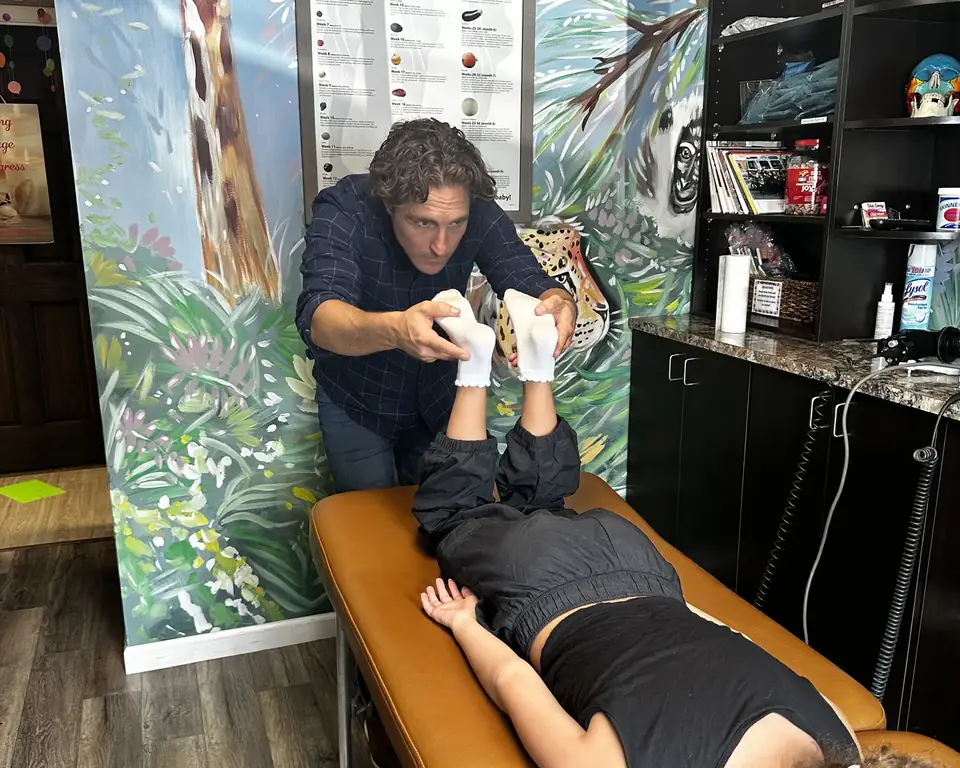
We begin with your child's complete story, the pregnancy, the delivery, and how development has unfolded since, along with anything already evaluated elsewhere. From there, a gentle hands on exam paired with INSiGHT neurological scanning gives us real, objective information about how your child's nervous system is regulating, rather than a guess based on symptoms alone. Using Koren Specific Technique and Talsky Tonal Chiropractic, our doctors apply light, nervous system focused adjustments around the upper neck and skull base, aiming to ease that signal so the muscles behind speech have a steadier foundation to draw from. Speech therapy trains the pattern of speaking itself, muscle by muscle, repetition by repetition, and it does that well. What it cannot touch is how clean the underlying nerve signal is once it reaches those same muscles, which is the piece this work is aimed at. Families whose progress in speech therapy has stalled often find this is the missing half.
Where to Go From Here
If you have quietly been keeping score of every word and wondering whether it means something, give that feeling some weight. Learn more about how we support speech and language delays, or get our free guide for a fuller look at causes and care. When you are ready, book online with our doctors in Royal Oak, or call us at (248) 616-0900 to talk through what you are noticing at home.