
You went to the ER right after it happened, and they told you nothing was broken. There was relief in that, for about a week, until an ache settled into your neck and wouldn't let go. Then came headaches that started behind your eyes and worked their way forward. You did what everyone tells you to do: ibuprofen, a heating pad, a handful of physical therapy sessions where someone stretched your neck and sent you home with a sheet of exercises.
Weeks later, the insurance adjuster started calling more often than your PT clinic did, and somewhere on your kitchen counter there's a folder with the words "case closed" written on it. Except your neck still catches when you check your blind spot. The headaches show up on days you didn't expect. Some mornings you wake up more tired than when you went to bed, and your thinking feels a step slower than it used to.
Nobody at the ER or the PT office did anything wrong, and the imaging really was clean. But clean imaging was never the whole story.
What Whiplash Actually Does to the Body
Whiplash happens when your head gets thrown forward and back, or side to side, faster than your neck muscles can brace for it. That sudden motion strains the ligaments, muscles, and joints of the cervical spine and irritates the nerves running through it, which is why the pain rarely stays in one tidy spot.
One detail catches almost everyone off guard: whiplash symptoms often don't show up for 24 to 72 hours after a crash, sometimes longer. Feeling fine when you climbed out of the car doesn't mean you walked away unscathed. Injuries have been documented at collision speeds as low as 5 mph, especially when your head was turned at the moment of impact, so a fender bender that barely dented your bumper can still leave a mark on your neck.
Once symptoms start, they rarely show up alone. Neck pain and stiffness are the obvious ones, but headaches that begin at the base of the skull, aching between the shoulder blades, tingling down an arm, dizziness, a jaw that suddenly clicks, sleep that won't settle, and a mental fog that makes work harder than it used to be all trace back to the same event.
Why the Symptoms Outlast the Injury
Months after a crash, a neck that's still tight and a head that still aches usually has less to do with torn tissue than with a nervous system that never got the message the danger had passed, a piece of the picture most people are never handed.
In the fraction of a second a collision takes, your head snaps forward and back, and your upper cervical spine, sitting right next to the brainstem, absorbs a shock that reaches well past the neck muscles. Picture your nervous system as a car with a gas pedal and a brake. The impact slams the gas pedal to the floor: stress hormones flood your system, muscles clamp down to guard the area, and your body locks into full alert. Normally the brake, the calming half of the nervous system, eases that back down within days. After a hard enough jolt, the brake can stay offline long after the tissue itself has finished healing, which is why the guarding never fully lets go.
Why Normal Imaging and a Few Weeks of PT Aren't Always Enough
Most people are told whiplash should clear up in six to eight weeks. For a lot of people that's just not what happens. More than 3 million whiplash injuries occur in the US every year, and researchers estimate up to half of those people are still dealing with symptoms six months later. Anti-inflammatories quiet the pain for a few hours. A handful of PT visits strengthen the muscles around the area. Both are worth doing, and neither one is the wrong call to make. But if the nervous system is still running the alarm it set off at impact, the guarding pattern underneath the pain doesn't change, and the symptoms keep resurfacing on their own schedule.
That also explains the imaging. A scan can look completely normal within weeks, long after the tension pattern your body is still holding in the neck and upper back has settled in for the long haul. The scan isn't wrong about what it measures. It's measuring bone and soft tissue, not whether your nervous system has finished processing what happened to it.
What Care Looks Like at Van Every
Our doctors, Dr. Saylor, Dr. Zach, and Dr. John, start with a full evaluation rather than pressing on the sore spots and calling it a day. We use INSiGHT neurological scans, thermal imaging, heart rate variability, and surface EMG, to get an objective picture of how your nervous system responded to the crash, alongside range of motion testing and a neurological exam. Then we sit down and walk you through what we found before any care begins.
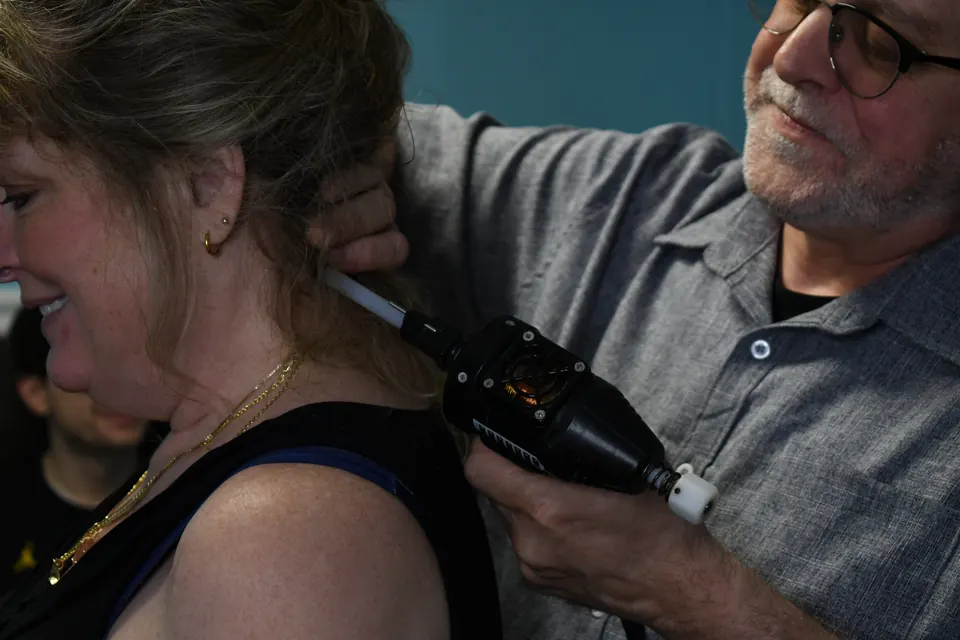
From there, care uses Koren Specific Technique (KST) and Talsky Tonal Chiropractic (TTC): gentle, nervous system focused contacts at the areas the trauma affected most. There's no cracking, twisting, or forceful manipulation involved, which matters for a neck that's already had enough force applied to it for one lifetime. Every visit is adjusted based on how your body responded to the last one, not a fixed script everyone gets.
What Patients Often Notice
Every recovery looks a little different, but a pattern shows up often enough that we've come to expect it. Neck pain and stiffness tend to ease first. Headaches that used to show up unannounced start spacing out. Sleep gets easier to fall into and stay in, and many people notice the brain fog lifting around the same time, along with steadier energy through the day. These changes tend to show up together because they were never separate problems, they were different expressions of the same nervous system pattern.
While You're Recovering
A few habits tend to support the process alongside care, whether your accident was last month or a few years back:
- Keep a simple log of your symptoms and when they show up. It helps your care team, and if you're dealing with an insurance claim, it gives you your own record of what actually happened.
- Sleep on your back or side with a pillow that keeps your neck level, rather than curled forward or twisted to one side.
- Move gently and often. Short, easy walks and slow neck rotations within a comfortable range keep the area from stiffening further.
- Avoid sitting still for long stretches, whether at a desk or in a car. Long stillness tends to let the guarding pattern settle in deeper.
- Give yourself permission to rest when your body is asking for it, especially in the days right after a crash.
Next Steps
Whether your accident was two weeks ago or three years ago, it is not too late to have your nervous system looked at properly. You can read more about our approach on the whiplash and auto injury page, or grab our free guide on what is actually happening in the body after a crash and why it lingers for so many people. Our approach is explained in more detail on our techniques page as well. When you are ready, you can book directly with our doctors, or call the office at (248) 616-0900 and we will walk you through what to expect.