
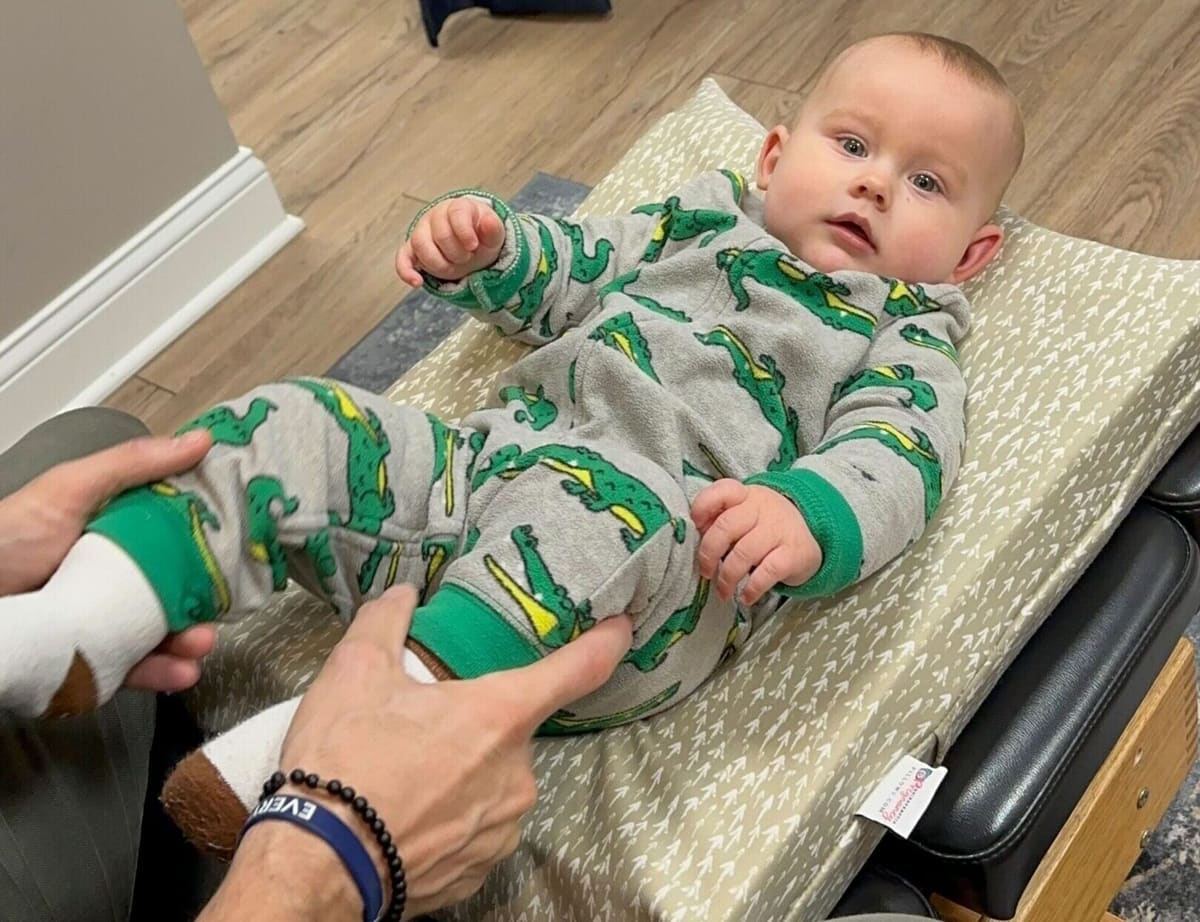
You already know your baby has a head tilt. Maybe you spotted it yourself, maybe a pediatrician pointed it out at a checkup. Either way, you've moved past the question of whether something is going on and landed on a different one: what actually happens at an evaluation, and how would our doctors know what to do about it. That's worth walking through, because a thorough torticollis evaluation looks well past the tight muscle everyone can see.
Starting With Your Baby's Story
Every evaluation starts with the details only you know. We ask about the pregnancy, how labor and delivery went, whether any interventions were used, and what you've noticed since. Did your baby favor one side from the very first days, or did the tilt develop gradually over weeks? Is there a preferred nursing side, a flat spot forming, more fussiness than expected, or trouble settling into sleep? None of these details are throwaway small talk. They help our doctors understand where tension is likely sitting in your baby's nervous system before we ever put hands on them.
The Hands-On Exam
From there, we move to a gentle physical exam. Our doctors check how freely your baby's head turns in each direction, feel along the muscle running from behind the ear to the collarbone for tightness or a small firm area, and assess the mobility of the upper neck and spine as a whole. We're looking for more than the muscle itself. We're checking whether the vertebrae in the upper neck are moving the way they should, since that's the region where the vagus nerve begins its path down through the body toward the heart, lungs, and digestive organs.
Why We Add INSiGHT Scanning
Alongside the hands-on exam, we use INSiGHT scanning technology to get an objective look at how your baby's nervous system is actually functioning. The scans measure heart rate variability, muscle tension patterns along the spine through surface electromyography, and thermal symmetry using infrared sensors. Together, these give us real data rather than a guess about where nervous system stress is concentrated and how significant it is. For a baby who can't tell us how they feel, that data matters. It lets us track real, measurable change visit over visit instead of relying only on how the tilt looks from the outside.
What We're Actually Looking For
A tight sternocleidomastoid muscle is rarely operating in isolation. It's usually one visible sign of a broader pattern, tension held in the upper neck that's kept the nervous system leaning toward a more alert, sympathetic-dominant state rather than the calmer, more regulated state a baby needs for good digestion, settled sleep, and steady development. Our evaluation is built to find that underlying pattern, not just measure how far the chin turns.
What Care Looks Like After the Evaluation
Once we understand what your baby's nervous system and spine are showing us, our doctors build a plan specific to your baby. No two babies get the same plan, even when the head tilt looks similar from the outside, because the underlying pattern of tension is rarely identical from one baby to the next. Using Koren Specific Technique and Talsky Tonal Chiropractic, we deliver light, nervous system focused contacts, pressure more like checking the ripeness of an avocado than anything forceful, with no cracking, popping, or twisting. Most babies tolerate their adjustments easily, and many visibly relax or even fall asleep during a session. We also give you specific, practical things to do between visits, positioning during feeds, tummy time habits, and carrying techniques, so the work continues at home.
Tracking Progress Over Time
We don't just adjust and hope. Our doctors re-check both the physical exam findings and the INSiGHT scan data at regular intervals to see how your baby is actually responding, and we adjust the care plan based on what we find. Some families see easier head turning and calmer settling within the first handful of visits. Others, especially with a more established pattern, need steadier care over a longer stretch to fully resolve. Either way, you'll always know where your baby stands, because we're measuring it rather than guessing.
We also keep an open line with any physical therapist, pediatrician, or lactation consultant already working with your family. A torticollis pattern often touches feeding, sleep, and motor development all at once, so coordinated care tends to move faster than any single piece working alone. If your baby has an appointment for stretching or bodywork elsewhere, we're glad to compare notes so everyone is working from the same picture of what's actually going on.
- A detailed history covering pregnancy, birth, and everything you've noticed since
- A hands-on exam of the neck muscle, upper spine, and range of motion
- INSiGHT scanning for objective data on nervous system function
- A personalized plan using light, nervous system focused adjustments
- Practical guidance for reinforcing progress at home between visits
- Ongoing re-evaluation so the plan can shift as your baby responds
Where to Go From Here
If you've been sitting with the question of what actually happens at a torticollis evaluation, we hope this gives you a clearer picture. You can read more about how we support babies with torticollis, or grab our free guide for a deeper look at the nervous system side of a head tilt. When you're ready to schedule, you can book online with our doctors in Royal Oak, or call us at (248) 616-0900 with any questions beforehand.