

Flat Head Shape in Babies: What Helps Beyond a Helmet
A flat spot on your baby's head is not just about head shape. It often comes with limited neck movement, and a helmet alone will not address why that tension is there.
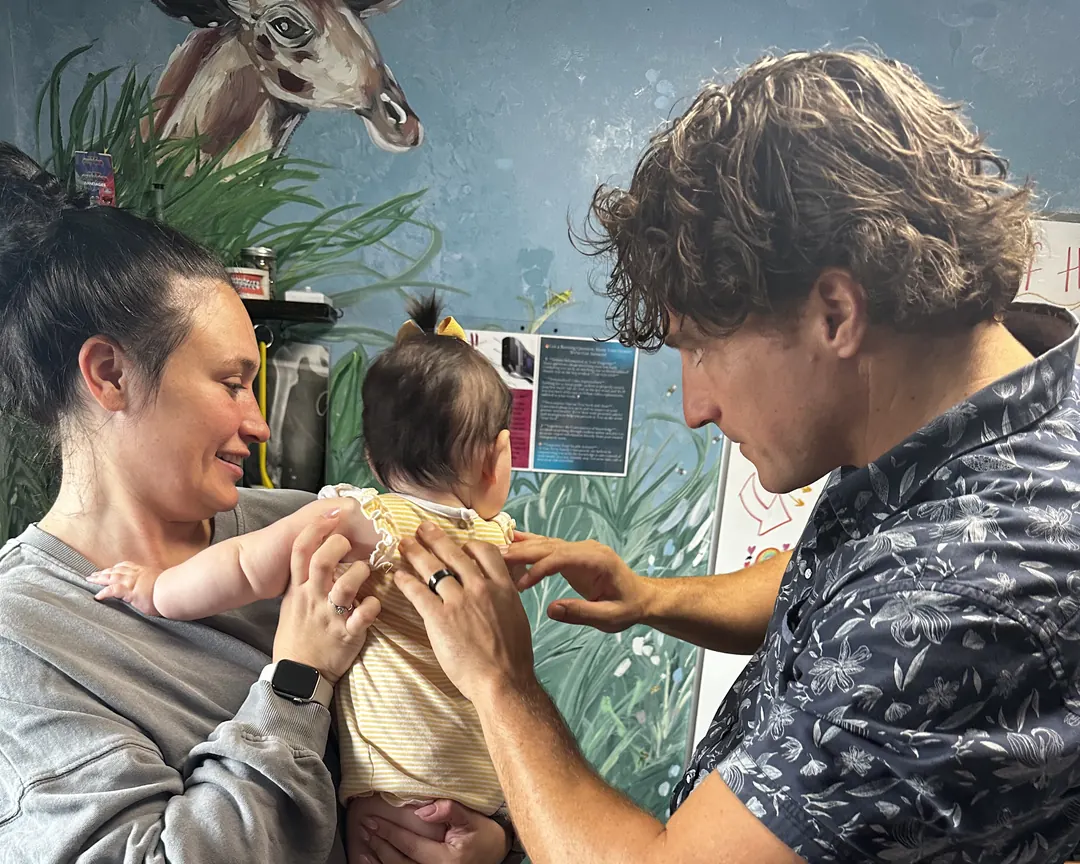
Gentle Chiropractic Care for Infant Neck Tightness
At Van Every Family Chiropractic Center, we see a fair number of babies whose heads consistently tilt to one side, unable to turn freely both ways. That is usually torticollis, one of the most common musculoskeletal conditions in infants, and it responds remarkably well to gentle chiropractic care.
Torticollis, sometimes called wry neck, happens when the neck muscles on one side are tight or shortened, pulling the head to one side while the chin points the other way. In roughly three out of four cases, it is the right side that is affected. Forceps or vacuum delivery, a breech position, a long labor, or a C-section can all put enough pressure on a newborn's neck to cause it, and tight in-utero positioning can play a role too.
Torticollis looks a little different baby to baby, but a few signs tend to repeat. The head tilts to one side and stays there, even when you try to gently straighten it, and turning toward the tight side is noticeably harder than turning the other way, so your baby may consistently favor looking in one direction. Feeding can reveal it too: nursing or bottle feeding goes smoothly on one side and is a struggle on the other. Some babies get visibly frustrated in positions that ask them to turn the harder way, a flat spot can start forming on the side they favor, and if you run a finger along the side of the neck you may feel a small lump or band of tightness where the muscle is pulling.
Stretching loosens the muscle that is guarding. Correcting the misalignment underneath it is what stops the muscle from needing to guard in the first place.
Left alone, torticollis rarely resolves on its own. The tight side keeps shortening while the other side lengthens to compensate, and a baby who cannot turn freely toward one side will keep favoring the other, which is also how a flat spot develops on the back of the head. Left long enough, it can also affect feeding on one side and how easily a baby reaches early milestones like rolling and reaching. The sooner the underlying tension is addressed, the less time the body has to build compensating patterns around it, and the easier those patterns are to unwind.
We start with a thorough evaluation, including INSiGHT neurological scanning (thermal, HRV, and sEMG) when appropriate for your baby's age, to get an objective look at where tension is sitting in the nervous system rather than guessing from the tilt alone. We also check for related issues, like a flat spot forming or difficulty feeding on one side.
Our doctors use a light, nervous-system focused approach, so the correction stays precise and controlled. Using Koren Specific Technique (KST) and Talsky Tonal Chiropractic (TTC), adjustments are made at the base of the skull and down through the shoulder muscles, wherever the tension is actually sitting, with contact so light it is closer to the pressure you would use to check a piece of fruit for ripeness, no cracking or popping. Cranial work is often part of the visit too, easing tension through the skull itself rather than the neck muscles alone. You hold your baby the entire time, and most babies settle right into it or fall asleep.
We teach parents specific positioning and gentle stretches to reinforce what happens in the office between visits, along with tummy time cues that work with your baby's progress rather than against it. Stretching on its own loosens a muscle that is guarding, but if a misalignment underneath is the reason it is guarding, the tightness tends to return. Addressing both together is usually what moves things faster.
Most babies show real improvement within four to eight visits, turning their head freely in both directions and settling into a wider range of sleep and tummy time positions. Fussiness often eases alongside it too, since a nervous system that is no longer guarding tends to mean a calmer, more comfortable baby overall.
Feeding often improves as well, since a baby who can turn both ways can nurse comfortably on either side. Many parents also notice a flat spot easing as their baby stops favoring one direction, and milestones like rolling and reaching tend to come more easily once the neck moves freely.
Torticollis in babies traces back most often to the birth process itself: a difficult delivery, forceps or vacuum use, a long labor, a breech presentation, or a C-section, and cramped in-utero positioning can play a role too. Knowing the cause does not change the approach, but it does help explain why the neck has been guarding in the first place.
Take the First Step Early evaluation makes the biggest difference with torticollis. Bring your baby in for a gentle assessment in Royal Oak.
Book OnlineYes. Our doctors use an incredibly light touch designed specifically for infants, close to the pressure you would use to check a piece of fruit for ripeness. There is no cracking or popping. Babies often fall asleep during their adjustments, and you hold your baby the entire time.
Torticollis is most often traced back to the birth process itself: a difficult delivery, forceps or vacuum use, a long labor, a breech position, or a C-section. Tight in-utero positioning can play a role too. Any of these can create enough tension in the upper cervical spine for the neck muscle on one side to shorten and start guarding.
Stretching loosens the muscle that is guarding, but it does not address why the muscle is guarding in the first place. Our doctors look for the misalignment underneath the tightness using Koren Specific Technique (KST) and Talsky Tonal Chiropractic (TTC), and correcting that is usually what stops the tightness from returning. Stretching and chiropractic care work well together.
Every baby is different, so your baby's care plan is built after a detailed history, consultation, and evaluation, which can include INSiGHT neurological scanning when appropriate for your baby's age. Most babies show real improvement within four to eight visits, and we track progress closely and adjust the plan as your baby responds.
Left alone, torticollis rarely resolves on its own. It can lead to a flat spot on the head, feeding difficulties on the tight side, and the body building compensating patterns as the tight side keeps shortening while the other side lengthens. The sooner it is addressed, the less time those patterns have to set in.
Yes, and we encourage it. We teach you specific positioning and stretches to reinforce what happens in the office between visits, along with tummy time cues that work with your baby's progress. Home care paired with adjustments is usually what moves things fastest.
A flat spot on your baby's head is not just about head shape. It often comes with limited neck movement, and a helmet alone will not address why that tension is there.
You already know your baby has a head tilt. What you may not know is what a real evaluation looks for, and why it looks past the tight muscle to the nervous system underneath it.
Your pediatrician calls it a preference and says to watch and wait. If your baby always tilts to one side, here is why the neck muscle is only part of the story.
See what Royal Oak families say in our Google reviews and patient stories, or browse everything we offer.
Our doctors put together a full article on torticollis treatment for babies that explains what's really behind it and what lasting relief looks like. Get instant access below.

Van Every Family Chiropractic Center Royal Oak, Michigan
Free on-demand webinar for parents
Looking for answers for your child?
Focus struggles. Big emotions. Restless nights. Tummy troubles. Join our doctors for a free parent webinar exploring the nervous system connection and ways to support your child.
Explore the free webinarFree · About an hour · Watch anytime

