
You've propped the pillow between your knees. You've tried the heating pad, the prenatal massage, the stretches your OB printed out at your last visit. Some of it helps, for an hour, maybe an evening. Then you roll over in bed at 2am and it's right back, that ache low in your back or the sharp catch in your hip when you try to sit up.
Somewhere along the way someone probably told you this is just part of pregnancy. Wait it out. It'll go away after the baby comes. And you've mostly believed them, because the pain is common enough that everyone seems to shrug at it the same way. But common isn't the same as something you simply have to live with for the next several months.
At Van Every Family Chiropractic Center in Royal Oak, we see this every week: moms who have done everything they were told to do and are still uncomfortable. What we've found is that the muscles doing the aching usually aren't the whole story.
What's Actually Happening in Your Body
Up to 70 percent of pregnant women deal with back pain at some point, and it rarely shows up the same way twice. Lower back pain is the most common complaint, driven by your changing posture, added weight up front, and ligaments that are looser than they used to be. Sharp pain through the pelvis or buttocks often points to the sacroiliac joint, where added mobility can throw things off balance, and that same shifting can press on a nerve and send pain down the leg as sciatica.
Some women feel a stabbing sensation low in the belly or groin as the round ligaments stretch to keep up with a growing uterus. Others notice it between the shoulder blades as the rib cage expands, or right at the front of the pelvis where the pubic bones meet, especially when walking or turning over in bed. It's common to have more than one of these show up in the same week.
Why the Same Fixes Keep Wearing Off
The heating pad helps until it cools down. The stretches ease things for an hour. The massage feels wonderful and then the pain creeps back by morning. None of that means those things are useless, but they're all working on the muscle, the output, rather than on what's telling the muscle to brace in the first place.
Your nervous system is coordinating almost everything happening in your body right now: the deepening curve in your low back, the forward tilt of your pelvis, the tension building through your mid back as your center of gravity shifts. Two women can have nearly identical hormone levels and postural changes during pregnancy, and one will have mild discomfort while the other is in real pain. The physical load isn't usually what's different. What's different is how much resilience the nervous system has to adapt to that load without overreacting.
The Nervous System Layer Behind the Pain
One way to think about it: your nervous system has something like a gas pedal and a brake pedal. The gas pedal keeps muscles tight and the body on alert. The brake pedal is what allows tissue to relax, adapt, and recover, which is exactly the mode pregnancy asks your body to live in for nine months. When the gas pedal is stuck down, from accumulated stress, poor sleep, or just the sheer physical demand of pregnancy, muscles brace longer than they need to and pain signals get louder even when the physical load hasn't changed much.
That's the piece that stretching and heat can't reach. They can loosen a tight muscle for a while, but if the nervous system is still sending the signal to brace, the tension comes right back. This isn't a sign that anything is wrong with you or your pregnancy. It's a sign the nervous system could use some support doing a genuinely enormous job.
What Care Looks Like at Van Every
We start with a thorough evaluation and INSiGHT scans, thermal imaging, heart rate variability, and surface EMG, that give our doctors an objective look at where tension has settled in your nervous system, rather than relying on guesswork. Those scans also let us track whether things are actually shifting over the course of your care, not just whether the pain has changed.
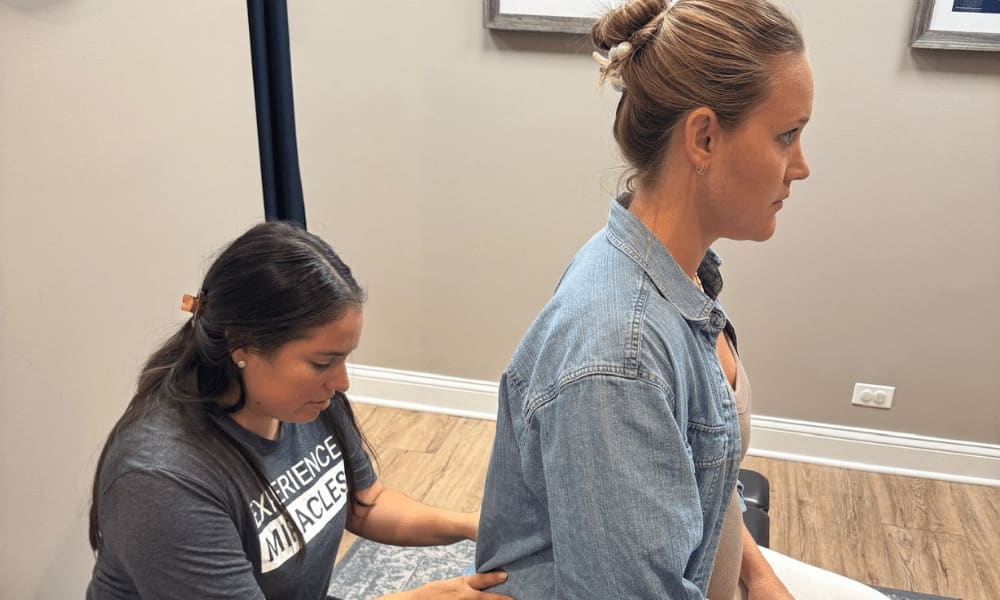
From there our doctors use gentle, nervous system-focused care built through Koren Specific Technique (KST) and Talsky Tonal Chiropractic (TTC). There's no cracking, no twisting, and you'll never be asked to lie face down. Sessions use comfortable side lying, seated, or semi reclined positioning that works with your belly at any stage of pregnancy. For moms who want extra attention on pelvic balance as their due date nears, Dr. Zach Conner is Webster certified and can incorporate that work into your visits. It doesn't turn a baby; it eases tension on the ligaments supporting the uterus and helps create space in the pelvis so your baby has more room to settle into position on their own.
What Moms Often Notice
Many moms tell us the back and pelvic pain eases noticeably within the first several visits, in spots that stretching and heat never quite reached. Sleep often improves as pelvic tension decreases, since finding a comfortable position becomes less of a nightly project. Walking, rolling over in bed, and getting up from a chair tend to feel less guarded. Some moms who receive care through their pregnancy also describe a more comfortable third trimester overall, and shorter, easier labors are something our patients report often enough that we hear about it regularly at follow up visits.
Supporting Yourself Between Visits
Care in our office is only part of the picture. A few things tend to make a real difference at home too:
- Sleep on your side with a pillow between your knees and one under your belly for extra support
- Change positions often rather than standing or sitting in one spot for long stretches
- Wear supportive, low-heeled shoes, especially later in pregnancy when balance shifts
- Keep gentle movement, like short walks, part of your routine as your body allows
- Avoid twisting through your low back when reaching or lifting; turn your whole body instead
- Notice whether pain tends to spike during stressful or exhausting stretches of your week, that pattern is worth mentioning at your next visit
Next Steps
You don't need to spend the rest of your pregnancy managing this on your own. You can read more about how we support expectant moms on our pregnancy back pain page, or grab our free guide for a deeper look at the nervous system side of pregnancy back pain. You can also learn more about how KST and TTC work on our techniques page. When you're ready, you can book online with our doctors, or call us at (248) 616-0900. We'd love to help you feel more like yourself for whatever is left of this pregnancy.
