
The words themselves do a lot of damage before a doctor even finishes the sentence. Degenerative disc disease. It sounds like a diagnosis of decline, something that only gets worse from here, a spine falling apart year by year. Then you go home, read more than you probably should have online, and start picturing a future built around pain you cannot outrun.
Here is what tends to get lost in that moment: disc degeneration is a normal part of how a spine ages, not a disease in the way the name suggests, and the stiffness and ache it causes respond well to the right kind of care.
The Pattern Worth Recognizing
Degenerative disc disease tends to show up differently from an acute injury. Instead of a sudden sharp pain, it usually shows up as stiffness that is worst first thing in the morning and eases as you move through the day, only to creep back a bit by evening after hours on your feet or sitting still. That pattern, stiff, then better, then stiff again, is a signature worth paying attention to, because it points toward a disc and joint issue rather than a muscular strain that would behave differently.
What Is Actually Happening Inside the Disc
Spinal discs act as shock absorbers between your vertebrae, and like most tissue in the body, they change with decades of use. That change is not automatically a sign that something has gone permanently wrong. Discs are more resilient, and more capable of adapting, than the word disease suggests. Degeneration describes a gradual shift in the disc's structure over time, not a countdown toward disability. Many people have real disc degeneration visible on imaging and live full, active lives with manageable symptoms, sometimes with none at all.
Why the Word Disease Sets the Wrong Expectation
Calling it a disease frames the condition as something that only progresses in one direction, which is not how most people actually experience it. Pain and stiffness from disc degeneration can improve significantly even while the degeneration itself, a natural aging process, continues in the background at its own slow pace. Those are two separate things. One is a structural change that happens over years. The other is how your nervous system and surrounding tissue are responding to that change right now, and the second one is far more responsive to care than the diagnosis name implies.
Our Approach to Disc Conditions
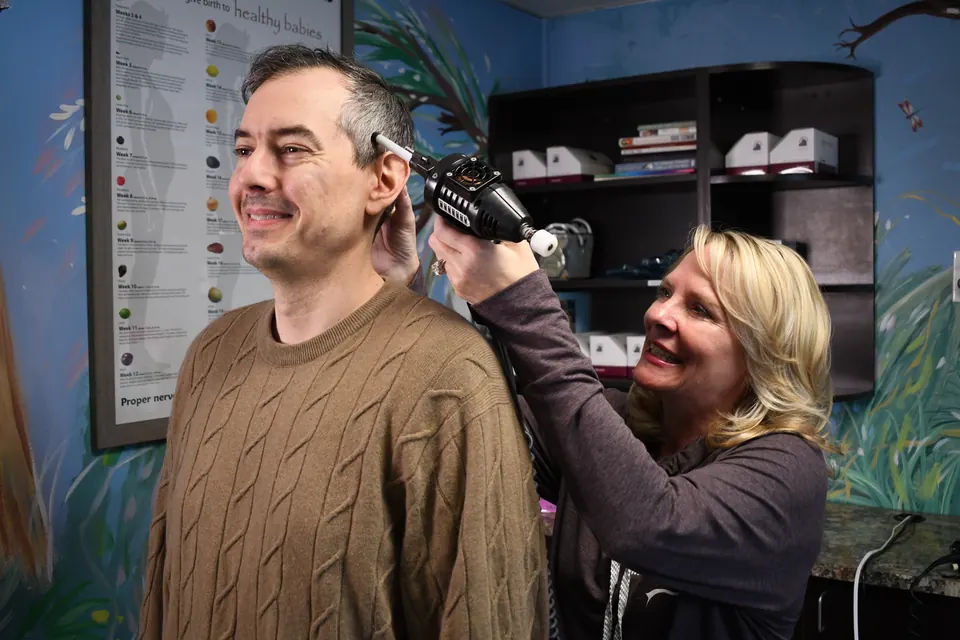
We start with a thorough exam, including orthopedic and neurological testing, INSiGHT scanning of thermal, heart rate variability, and sEMG patterns, and a review of any imaging you already have, so we understand exactly where the disc and surrounding structures are under stress before we touch your spine. Using Koren Specific Technique and Talsky Tonal Chiropractic, our doctors make light, precise, nervous system focused corrections with no cracking, popping, or twisting, adjusted seated, standing, or in whatever position keeps you most comfortable that day.
The goal is not to reverse the aging of the disc itself, which is not realistic for any form of care. It is to reduce the nervous system tension and guarding pattern that often keeps muscles held tight around a stressed disc, which is frequently a large part of what turns manageable stiffness into a daily source of pain.
What Patients Notice Over Time
Improvement with degenerative disc conditions tends to build gradually rather than arrive all at once, and a few patterns show up often enough to mention:
- Morning stiffness that eases faster and does not linger as long into the day
- Less of the achy return by evening after a full day on your feet
- Better range of motion bending, twisting, and reaching
- Improved sleep, since a nervous system that is not bracing all day tends to settle more easily at night
- More confidence moving through daily activity without bracing for a flare
Herniation Versus Degeneration
It helps to separate two things that get lumped together under the same conversation. A herniation happens when the soft inner material of a disc pushes through a tear in its outer wall, sometimes pressing on a nearby nerve and causing pain that radiates into an arm or leg. Degeneration is the slower, more gradual thinning and drying of that same disc structure over years. The two can occur together, and both respond to the same conservative, nervous system focused approach, but they are not the same process, and understanding which one is actually driving your symptoms shapes what a realistic care plan looks like.
Managing a Normal Part of Aging, Not Fighting a Disease
Reframing degenerative disc disease as a normal part of how a spine ages, rather than a disease actively working against you, changes how the whole thing feels to live with. Restoring proper spinal alignment and movement supports the disc and surrounding joints, helps manage the symptoms that actually affect your day, and can slow how quickly the underlying pattern advances, even though the aging process itself continues at its own pace regardless of the care you receive.
If a degenerative disc diagnosis has left you bracing for a future you have not actually reached yet, our doctors in Royal Oak would like to show you what a realistic, manageable path looks like. Learn more about our approach to disc herniation and degenerative disc conditions, or get our free guide on what the research actually shows. You can book online, or call us at (248) 616-0900 to talk through your imaging or history first.
