
You heard herniation and your stomach dropped. Maybe the word that stuck was surgery, even though nobody said you needed one yet. You've had the MRI, the referral to orthopedics, maybe a round of physical therapy and an epidural steroid injection that helped for a few weeks before the pain crept back in. You're doing everything you were told to do, and the leg pain still shows up the second you sit through a full workday.
A diagnosis tells you what's there. It doesn't tell you what's possible. Most disc herniations respond well to conservative care, and the research on how much the body can do on its own is more encouraging than most patients ever hear.
How a Disc Herniation Actually Shows Up
Symptoms vary a lot depending on where the disc is and how it's pressing. A herniation in the low back often sends pain, tingling, or numbness down one leg along the path of the sciatic nerve, while a disc in the neck sends similar sensations into the shoulder and arm. Many people also feel a dull, local ache right at the level of the disc that gets worse with sitting, bending, or even a hard cough. If the compression is significant enough, an arm or leg can start to feel noticeably weaker, which is worth mentioning to your doctor. Degenerative disc disease tends to announce itself differently, usually as stiffness that's worst first thing in the morning and eases once you've been moving for a while.
What's Happening Inside the Disc
Your spinal discs work as shock absorbers between the vertebrae, and unlike most tissue in the body, they don't have their own direct blood supply. They get their nutrition through fluid exchange, which depends on the disc being alternately compressed and released as you move throughout the day. A bulging disc has pushed past its normal boundary but the outer wall is still intact. A herniation means the inner material has pushed through a tear in that wall, which is what presses on a nearby nerve and creates the radiating symptoms. Neither one is a life sentence. Discs are more resilient, and more capable of recovering on their own, than most people are ever told.
Why the Pressure Doesn't Let Up
The disc itself is only part of the story. When your nervous system is stuck in a stress response, the muscles running alongside your spine stay in sustained contraction, almost like a gas pedal that's stuck partway down. That ongoing muscle tension keeps adding compression right where the disc needs the opposite, a chance to decompress so fluid can move in and out and the body's own repair process can do its work. More tension means more compression, and more compression means more symptoms, which is why the pain can flare again even after a procedure or a round of physical therapy technically "worked."
Why NSAIDs and Injections Only Get You Partway
None of this means the usual approaches are wrong. NSAIDs reduce inflammation for a while, an epidural steroid injection can numb an irritated nerve root for weeks or months, and physical therapy strengthens the muscles supporting the spine. Those approaches have real value, and plenty of people get real relief from them. But if the muscles around the disc are still bracing because the nervous system hasn't settled down, the underlying compression doesn't fully change, so the pain has room to come back once the injection wears off or the therapy course ends. A 2025 systematic review in Frontiers in Medicine found that roughly three quarters of herniated discs showed spontaneous reabsorption of the disc material with conservative care alone, which suggests the body's own capacity here is often underestimated.
What Care Looks Like at Van Every
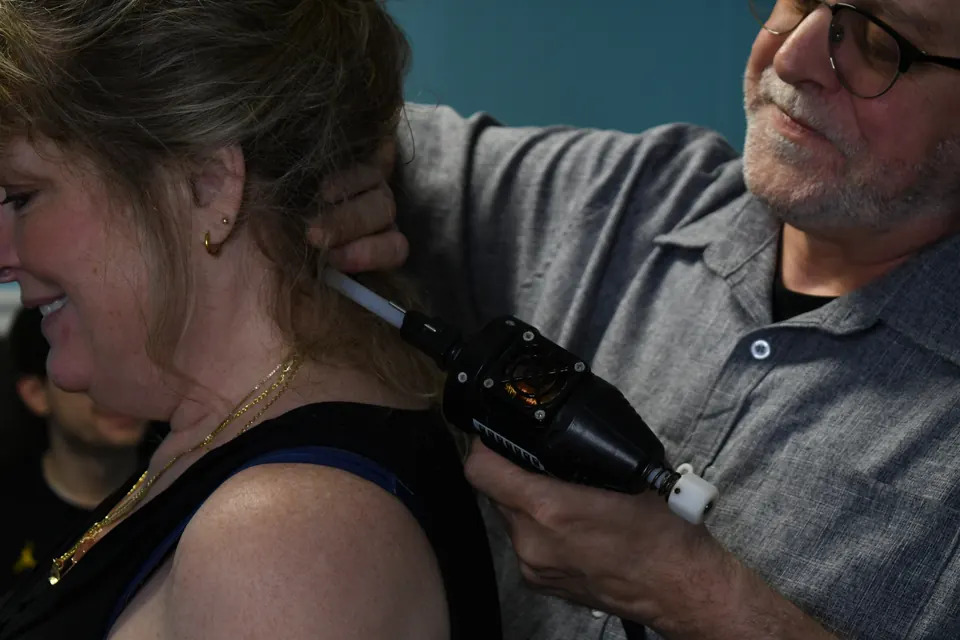
We start with a thorough exam, including orthopedic and neurological testing, a review of any imaging you already have, and INSiGHT scanning to objectively measure how your nervous system is functioning around the affected area. From there, our doctors use Koren Specific Technique (KST) and Talsky Tonal Chiropractic (TTC) to deliver light, nervous system-focused contacts, with no cracking, popping, or twisting. KST in particular lets us adjust you seated or standing, in whatever position actually reproduces your symptoms, rather than only in one position that happens to be convenient. That precision matters with a disc problem, since a forceful adjustment can add stress exactly where you can't afford it right now.
What Patients Often Notice
Every case is different, and we won't hand you a timeline before we've actually seen your scans and history. That said, patients frequently notice the radiating arm or leg pain easing before the local back or neck pain fully resolves, followed by better range of motion, less morning stiffness, and improved sleep. Many people return to normal activity and lean less on pain medication without ever needing a surgical consult, though we will always give you an honest read on your case and refer you out if surgery genuinely is the right call.
A Few Habits Worth Building In
- Change position every 20 to 30 minutes rather than sitting or standing through a long stretch
- Take short walks through the day instead of one long walk, since movement helps the disc's fluid exchange
- Notice which sleep position eases your symptoms most and stick with it while you're recovering
- Avoid a single heavy lift or twist first thing in the morning, when discs carry more fluid and less give
- Keep a simple note of what activities help or aggravate things, it makes your visits more useful
If You're Weighing Your Options
If a disc problem has you sitting with a surgery consult you're not sure about, our disc herniation page goes deeper into how we evaluate and support these cases, and our free guide walks through the nervous system side of disc pressure in more detail. You can book online before you commit to anything bigger, or call our Royal Oak office at (248) 616-0900 with questions. Book the evaluation first, and decide about anything bigger once you actually know what your case needs.
