
POTS is a condition where your heart rate climbs when you stand because the autonomic nervous system isn't regulating smoothly. Dr. Zach Conner at Van Every Family Chiropractic Center, a POTS chiropractor in Royal Oak, explained why the heart races and why he sees POTS as a nervous system story, not a heart problem.
What is POTS and why does your heart race when you stand?
POTS stands for postural orthostatic tachycardia syndrome. When you stand, gravity pulls blood down into your legs and belly, and with POTS the blood vessels don't squeeze the way they should, so less blood makes its way back up to your heart and brain.
Dr. Zach said officially it is diagnosed when your heart rate climbs 30 or more beats a minute (40 or more for teenagers) within 10 minutes of standing up, without your blood pressure dropping, and it has been going on for at least three months. Your body senses the shortfall and releases a surge of adrenaline. As he put it, "the racing heart isn't the problem itself. It's your heart trying to cover a regulation system that isn't keeping up."
He described what people feel: dizzy, foggy, headachy and exhausted from less blood reaching the brain, plus a pounding heart, shakiness, sweating, a tight chest and trouble sleeping from the adrenaline surge. Because the same nervous system runs digestion and temperature, nausea, bloating and feeling too hot or too cold show up too. It is usually worse with exercise, in heat, when you're sick, or around your cycle. Doctors describe a few types, including neuropathic, hyperadrenergic and low blood volume, and many people have a mix.
Is POTS just anxiety?
No. Dr. Zach said that when anxiety shows up with POTS, it's usually because of what POTS put you through, not the cause of it.
He opened by telling people who have been told it's just anxiety that "your body's not broken. It's stuck protecting you and it's waiting on permission to let go." He shared that research shows "people with POTS are no more anxious than the general population." In the largest survey of people with POTS, "it took a median of about two years and around seven doctors to get a diagnosis." Three out of four were told it was something else first. That is a long time to feel like nobody believes you.
Why does the nervous system get stuck on the gas pedal?
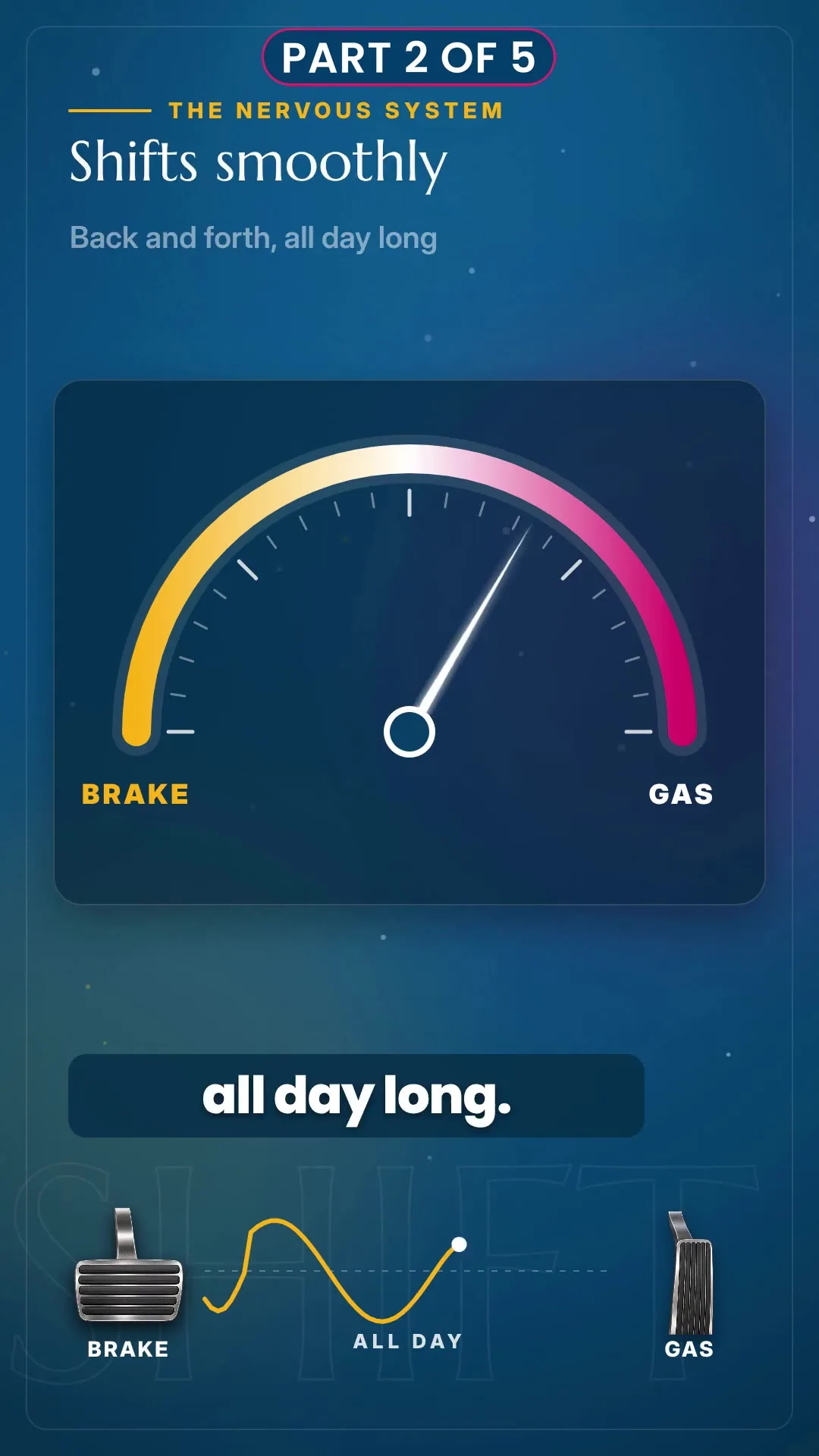
Dr. Zach explained it with a car: your nervous system has a gas pedal (fight or flight) and a brake pedal (rest, digest and recovery). With POTS, the gas pedal is pinned down, so the system can't shift smoothly and hits the alarm when you simply stand up.
He said the overwhelm behind this can be physical, like a fall, a car accident, a concussion, a surgery or a hard birth. It can be chemical, like an illness, an infection or a toxin. It can be emotional, like stress, grief or a really hard season of life. "Bracing is actually a really smart response. Your body is protecting you."
That tension starts around the brain and spinal cord, which are anchored at the top of the neck and skull and at the base of the spine, like guitar strings under tension. He said your brain also reads signals from the joints and tissues of your spine, especially your neck, to know how upright you are. When those areas hold old tension patterns, the signal gets distorted. "It's not a weak heart. It's a nervous system reacting to the wrong information." You can learn more about the fight or flight response and the vagus nerve, the main cable he described that runs from the brainstem down alongside the neck to the heart and gut.
Can posture be part of the picture?
Dr. Zach said you can often see it in someone's posture: head forward, shoulders rounded, upper back tight. He sees teenagers with the posture of someone three times their age.
He compared the head to a bowling ball on a stick: every inch it drifts forward, the load on the neck and upper back multiplies, and the nervous system works overtime all day just to hold you up. The upper back is where the fight or flight nerves branch out. "Telling them to sit up straight doesn't work for long because it's not a willpower problem." He called it a tension in the body that is still holding.
Looking for a POTS chiropractor in Royal Oak?
Van Every Family Chiropractic Center is at 4203 Rochester Rd in Royal Oak, and Dr. Zach looks at POTS through the nervous system. Our POTS and dysautonomia page has more, and you can read about Dr. Zach Conner and the rest of our team.
All three of our doctors, Dr. Anna Saylor, Dr. John Johr and Dr. Zach Conner, do all of our techniques and see pregnant patients, babies, children and adults. Families come to our Royal Oak office from Troy, Ferndale, Berkley and Clawson, and you can see more on our service areas page. This was Part 1 of 2. To talk about your own situation, call or text (248) 616-0900 or book online.
Frequently asked questions
What does POTS stand for?
POTS stands for postural orthostatic tachycardia syndrome. Postural and orthostatic mean changing position and being upright, tachycardia means a racing heart, and syndrome means a group of symptoms that show up together. Dr. Zach explained that it is a regulation issue in the autonomic nervous system, the part that runs everything automatically.
How is POTS diagnosed?
Officially, it is diagnosed when your heart rate climbs 30 or more beats a minute, or 40 or more for teenagers, within 10 minutes of standing, without a blood pressure drop, for at least three months. Doctors usually check with a tilt table test or by having you lie down, then stand for 10 minutes, after ruling out other causes.
Why does my heart race when I stand up?
Gravity pulls blood down into your legs and belly when you stand. With POTS, the blood vessels don't squeeze as they should, so less blood returns to your heart and brain. Your body senses that and releases adrenaline, and your heart speeds up to cover the difference. Dr. Zach said the racing heart is not the problem itself.
How does Van Every in Royal Oak look at POTS?
Dr. Zach looks at POTS as a nervous system pattern, not just a heart problem. He explained that overwhelm can leave the body bracing, and that tension around the brain, spinal cord and neck can distort the signals your brain uses when you stand. Call or text (248) 616-0900 to talk with our Royal Oak office.