
The clicking every time you open your mouth. The dull ache around your ear by the end of the day. The night guard your dentist made you, sitting in its case, protecting your teeth but not doing much else. If jaw pain has become part of your routine, you already know it rarely stays polite and contained to just the jaw.
Maybe you have had the bite splint fitted, tried the jaw exercises, taken the muscle relaxers, or even looked into Botox for the clenching. Some of it helped, for a while. Then a stressful week hit, or you woke up sore for no obvious reason, and the whole cycle started again.
Here is something that surprises a lot of our patients: your jaw and your upper neck share the same nerve supply. That single fact changes where it makes sense to look for lasting relief.
How TMJ Pain Shows Up
TMJ dysfunction rarely announces itself the same way twice. Some people notice a distinct click or pop with every open and close, while others feel more of a grinding sensation deep in the joint. The jaw can ache steadily around the ear and face, or briefly lock before releasing. Headaches that concentrate at the temples are common and often get mistaken for ordinary tension headaches. Grinding or clenching at night, pain when chewing anything tough, ringing or fullness in the ears, and a stiff, sore neck that flares up right alongside the jaw round out the picture for most patients.
What Tends to Set It Off
TMJ pain shows up for a lot of different reasons: waking up sore with no clear cause, discomfort after eating something tough like pizza crust or steak, an old bump to the head, a whiplash injury, or a long dental appointment that held your mouth open for an hour or more. Teeth grinding, ongoing stress, and a forward head posture from hours at a desk all add up in a similar way. When we evaluate a jaw problem, we look at the joint together with the neck and shoulders, since in our experience they rarely act independently of each other.
The Jaw-Neck Connection
The trigeminal nerve is the largest cranial nerve in the body, and it is the main nerve controlling your jaw, the muscles that clench, the joint that clicks, the sensation across your face and temples. Its processing center in the brainstem sits right next to the upper cervical spinal cord, overlapping with sensory input from the top three vertebrae in your neck. When the upper neck is carrying sustained tension, think of the nervous system's gas pedal stuck partway down with the brake pedal struggling to engage, the trigeminal system tends to run hot right along with it. Jaw muscles hold more resting tension, and clenching becomes something closer to automatic. That is not a jaw decision. It is a nervous system pattern showing up in the jaw.
Why a Night Guard Alone Does Not Always Solve It
Night guards, bite splints, and jaw exercises are legitimate tools, and plenty of people get real, if partial, relief from them. What they tend to address is the output, the grinding itself, without changing the upstream signal telling the jaw to clench in the first place. The guard protects your teeth. It does not necessarily change what is happening further up the chain. Researchers estimate that roughly one in eight adults deals with TMJ symptoms at any given time, and women are affected nearly twice as often as men, a gap that has been linked to differences in baseline nervous system tone.
What Care Looks Like at Van Every
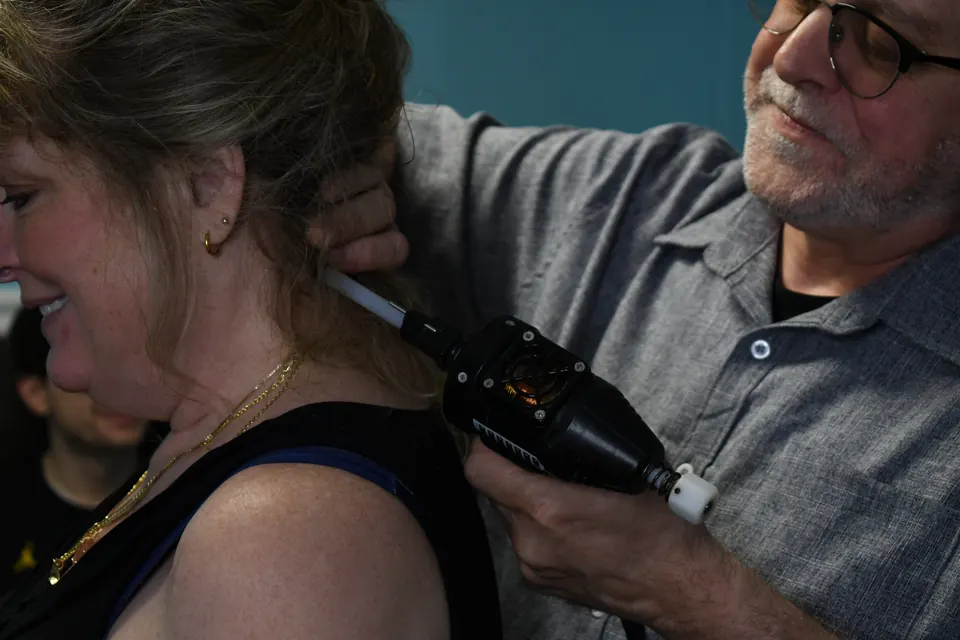
We start with a thorough evaluation, including INSiGHT scanning (thermal, heart rate variability, and sEMG) to see objectively where tension has been sitting from old injuries, clenching habits, or accumulated stress. We evaluate the joint itself along with your cervical alignment and head posture. Using Koren Specific Technique (KST) and Talsky Tonal Chiropractic (TTC), our doctors apply light, nervous system-focused contacts at the upper cervical spine and, when useful, right at the jaw, with no cracking or twisting anywhere in the process. Because a jaw that stays tight on one side often tracks back to a neck or shoulder that is tight on the same side, we tend to look at both together rather than the jaw in isolation.
Working Alongside Your Dentist
If you grind your teeth at night, a night guard from your dentist is still a smart first step, since a jaw that never gets a break stays sore no matter what else changes. The guard addresses the grinding directly, while our care works on the upstream spinal and nervous system factors contributing to the pattern. We are glad to coordinate directly with your dentist so both approaches support each other.
What Patients Often Notice
Less clicking and popping tends to come first for a lot of patients, followed by an easier time opening the mouth fully and less pain when chewing. Many notice fewer temple headaches, an easier time falling and staying asleep, and a neck that finally feels like it is loosening up too, since the two were connected the whole time.
Habits That Support a Calmer Jaw
A few things patients often find useful between visits:
- Notice how you hold your phone or laptop; a forward head position adds real load to the jaw and upper neck
- Give your jaw a break from gum, ice, and other chewy or hard foods during a flare
- Pay attention to when clenching gets worse, it often tracks closely with a stressful stretch at work or home
- Keep your sleep position in mind; stomach sleeping tends to load the jaw and neck more than side or back sleeping
- Ask your dentist about a night guard if grinding is part of your pattern
Taking the Next Step
You can learn more on our TMJ and jaw pain page or download our free guide on the jaw-neck connection. Ready to talk it through? Book online with our doctors or call us at (248) 616-0900. We are happy to look at the whole picture with you, not just the joint that hurts.
