You've been doing the tummy time. You've switched which arm you carry your baby on. You've rearranged the crib so the light comes from the other side, hoping it might tempt your baby to turn a different way. And still, every time you lay your baby down, the head turns the same direction, and the flat spot on the back of the skull hasn't gotten any smaller.
Maybe your pediatrician told you to keep watching it. Maybe helmet therapy came up. Maybe you were told it's mostly cosmetic and your baby will grow out of it. If your gut is telling you there's something more going on than a habit that will fade on its own, you're probably right, and there's a reasonable explanation for what you're seeing.
The Flat Spot Is Usually A Result, Not The Cause
Plagiocephaly, the medical term for an asymmetrical head shape, shows up in a meaningful share of infants, and it almost always has a mechanical reason behind it. If a baby can't comfortably turn their head one direction, gravity does the rest. The same spot on the skull bears weight night after night, week after week, while the other side barely gets used. Repositioning and tummy time work on the outcome. They don't do much for the reason your baby keeps choosing one side in the first place.
Most of the time, that reason traces back to tension in the upper neck, often connected to torticollis, tight positioning in the womb, or the mechanics of a difficult delivery. When turning toward one side feels effortful or uncomfortable, your baby defaults to the side that doesn't. That one-sided preference is what actually creates the flat spot over time.
How It Shows Up Beyond The Flat Spot
A flat area on the back or side of the head is usually the first thing parents notice, but it rarely stops there. One ear may sit a little more forward than the other, or one side of the forehead can look slightly more prominent, both tracing back to the same underlying asymmetry. You may notice your baby has a clear favorite side to look toward and resists turning the other way, sometimes with visible effort or fussiness when you try to encourage it. That same one-sided pattern often shows up at the breast or bottle too, nursing easily on one side and struggling on the other.
What's Happening In Your Baby's Nervous System
Think of your baby's nervous system as having a gas pedal and a brake pedal. The gas pedal is the stress response that got your baby through pregnancy and delivery. The brake pedal is what allows the body to settle, relax, and let go of tension once the stress is over. In a lot of babies with plagiocephaly, the muscles around the upper neck stay guarded because that brake pedal hasn't fully engaged yet, even though the birth process itself is long finished.
That guarding is what makes turning toward the non-preferred side feel effortful for your baby, not stubbornness and not a habit that will simply fade with more encouragement. The tension is doing exactly what it was designed to do during a stressful birth process. It just hasn't gotten the signal that it can let go. A baby's skull is highly moldable in the first several months of life, especially through around four to six months, which also happens to be the window where the fastest change is possible once that neck tension starts to ease.
Why Repositioning Alone Often Isn't Enough
Repositioning devices, alternating which side of the crib your baby faces, and encouraging tummy time all work with the same soft, moldable bone that makes early treatment so effective. What they can't do is change why your baby's head keeps returning to one position. You can reposition a baby. It's much harder to reposition a nervous system that's still holding tension from birth. That's why so many parents feel like they're doing everything right and still watching the flat spot stay the same, or slowly get worse.
Our Approach At Van Every
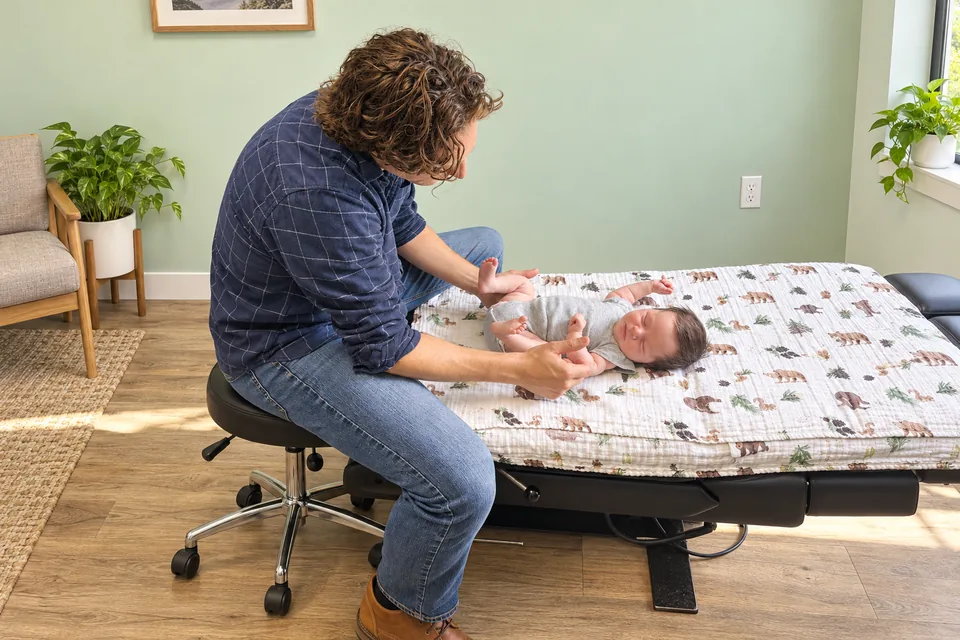
We start with a thorough evaluation of head shape, neck mobility, muscle tone, and spinal alignment, including whether torticollis or birth positioning is part of the picture. When it's age-appropriate, INSiGHT scanning, thermal imaging, heart rate variability, and muscle (sEMG) readings, gives us an objective look at where your baby's nervous system is under stress, rather than relying only on what we can see from the outside.
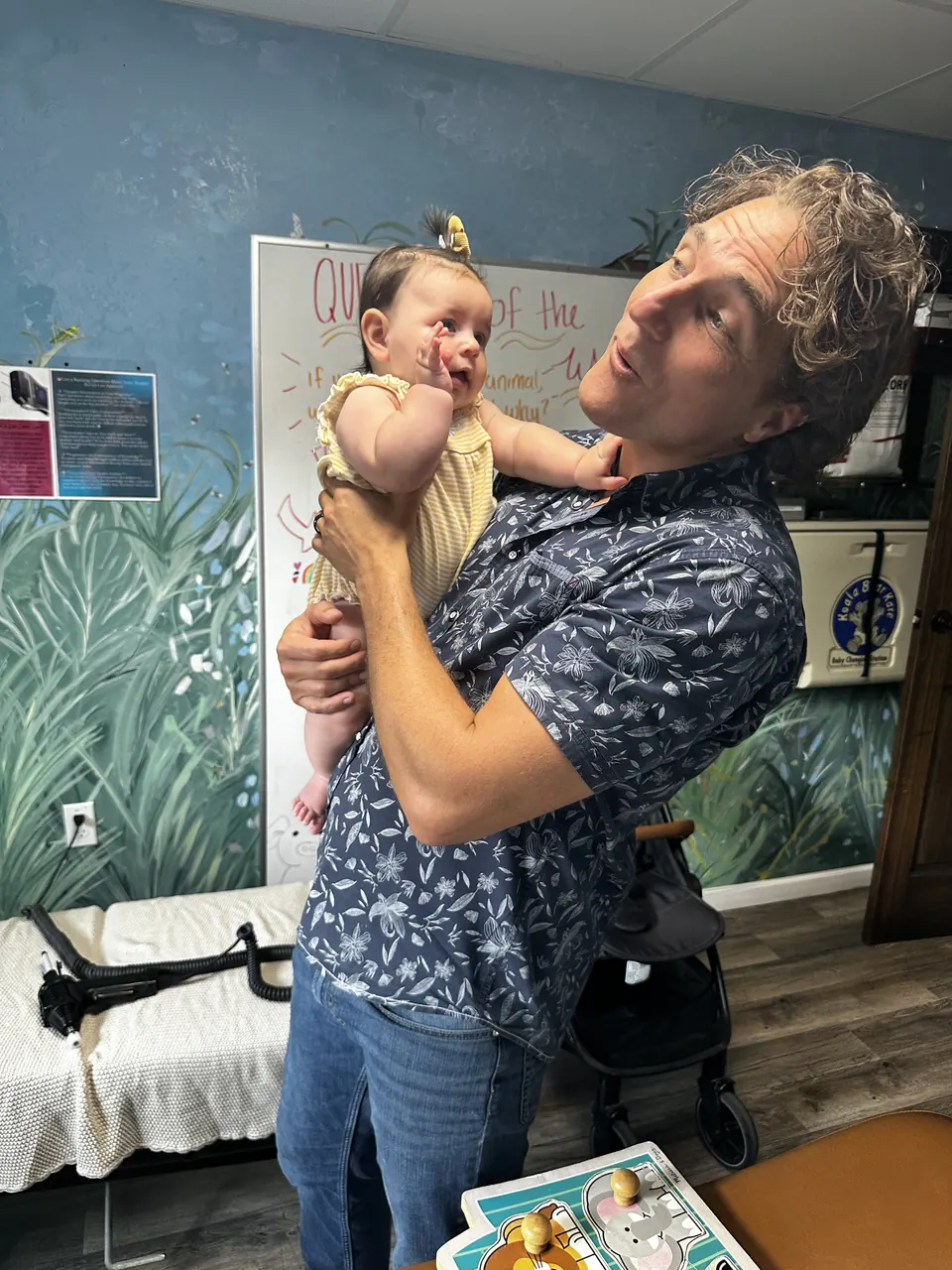
From there, our doctors use Koren Specific Technique (KST) and Talsky Tonal Chiropractic (TTC), light, nervous system-focused contacts with no cracking or twisting, to work with the upper cervical restrictions limiting head rotation. The pressure used is lighter than what you'd use to check a ripe tomato. Many babies stay relaxed through the whole visit, and some sleep right through it. Once a baby can turn freely in both directions, the skull gets the chance to round out on its own.
What Parents Often Notice
Improved rotation and a new willingness to look both ways tend to be the first changes parents see, often within the first several visits. Head shape symmetry usually follows from there as pressure redistributes more evenly, along with easier feeding on both sides and a baby who generally seems more settled. Many families notice softer signs even before the head shape itself changes, better sleep, calmer feeding, less fussiness during the day.
What You Can Do Between Visits
Care in our office works alongside what your pediatrician has already recommended. A few things that tend to help most:
- Alternating which arm you carry your baby on and which side you approach the crib from
- Limiting long stretches in car seats, swings, and bouncers where the head rests in one position
- Practicing tummy time in short, frequent stretches rather than one long session
- Alternating breast or bottle sides during feeding, even if one side is harder at first
- Noticing which direction your baby resists turning toward, and mentioning it at your next visit
When Helmet Therapy Comes Up
In moderate to severe cases, a craniofacial specialist may recommend a helmet alongside chiropractic care, and that's a conversation we're glad to have honestly with your family. The two approaches tend to work well together. Better neck mobility gives the helmet more even growth to work with, instead of fighting the same one-sided positioning that helped create the flat spot in the first place. We coordinate directly with your pediatrician or craniofacial specialist so everyone involved is working from the same information.
Getting Started
Some estimates put positional plagiocephaly in as many as 47 percent of infants to some degree, which means you're far from the only parent watching this. Babies can be evaluated within the first few weeks of life, and the earlier the underlying neck tension is addressed, the more room there usually is for natural reshaping to happen. You can learn more on our plagiocephaly page, or get the full picture in our free guide for parents. When you're ready, you can schedule your baby's evaluation with our doctors in Royal Oak, or call us at (248) 616-0900.