
Your child can tell you the make and model of every excavator that has ever rolled through the neighborhood, but cannot quite explain how the school day went. Or it is one specific episode, watched daily for months, word for word, without a single change in the routine. Clinicians call this a restricted or special interest, and it sits among the core traits used to diagnose autism.
What rarely gets explained alongside the diagnosis is why a nervous system reaches for this in the first place, or why the pull toward it seems to tighten during some stretches and ease during others.
What These Interests Actually Are
Restricted interests are a narrow, intensely absorbing topic or activity that takes over a child's attention, conversation, and daily play, well past what is typical for their age. The interest itself is usually ordinary: trains, weather patterns, elevators, a particular video game. What sets it apart is how deeply your child sinks into it, and how much distress shows up the moment access is interrupted.
Researchers generally split these patterns into two groups. One is motor driven, things like hand flapping or rocking. The other is cognitively driven, things like insistence on sameness, rigid routines, and narrow, circumscribed interests. It is that second group that tracks most closely with anxiety and overall stress load, which reframes the whole picture. The fixation is not sitting next to the anxiety by coincidence. It is what your child's nervous system is doing about the anxiety.
Common Signs Parents Recognize
Restricted interests can show up in a range of ways, and most families recognize several of these at once:
- Watching or reading the exact same thing on a loop, sometimes many times a day
- Encyclopedic recall of facts on one narrow topic
- Arranging or collecting objects in a specific order, with real distress if that order changes
- Reciting lines from shows or past conversations word for word
- Rigid routines built around the interest, like the same seat, cup, or sequence every time
- Steering nearly every conversation back to the same subject
- Fascination with a single part of an object, like wheels or spinning fans, rather than the whole thing
- A big emotional escalation whenever the interest is interrupted or unavailable
One pattern worth watching for: the pull toward the interest often gets stronger around illness, poor sleep, a schedule change, or a new school year. Parents frequently describe their child as getting more stuck during those stretches, and that timing is rarely a coincidence.
Why the Nervous System Reaches for Sameness
Picture the nervous system as running on two settings: a gas pedal geared toward alertness and quick response, and a brake, largely carried by the vagus nerve, geared toward calm, digestion, and rest. In many autistic kids, the gas pedal stays down and the brake barely engages, so the system cannot downshift easily into rest, sleep, or flexible attention on its own. When a child cannot regulate that internally, a predictable, familiar interest becomes the fastest external source of calm available.
That predictability is the whole appeal. No social ambiguity, no sensory surprises, no shifting demands. Kids who process sensory input differently often carry a heavier load to begin with, since ordinary sounds, textures, and transitions that most nervous systems tune out within seconds keep landing as new information all day long. A child carrying that load has to put attention somewhere that does not cost anything extra, so the world narrows down to one dependable thing.
Why Interrupting It Leads to a Meltdown
Shifting from one activity to another takes real regulatory work: noticing the change, deciding how to respond, stopping one behavior, and starting another, all in sequence. That is exactly the capacity a dysregulated nervous system is already short on. The meltdown that follows an interrupted interest is not defiance and it is not a choice. It is a system running out of resources partway through a shift it does not have the reserve to complete.
This also explains why consequences rarely change much here. Discipline works on choices, and this is not happening at the level of choice. No amount of consistency builds a skill the nervous system does not yet have the capacity to run.
Where This Pattern Tends to Start
Dysregulation this deep rarely begins with one moment. It usually builds gradually. Maternal stress during pregnancy can shift a baby's developing nervous system toward a more reactive baseline before birth. Birth itself, particularly when it involves interventions like a C section, forceps, vacuum extraction, or a long, stalled labor, places real physical strain on a newborn's upper neck and brainstem, exactly where the vagus nerve begins its path through the body. Early childhood then adds its own load: rounds of antibiotics, chronic ear infections, reflux, and the ordinary bumps of early life. None of this is caused by anything a parent did. It is simply how much stress a developing nervous system can accumulate before it starts looking for somewhere steady to hold on.
What Actually Helps
Support the interest while lowering the overall load at the same time. That combination goes further than any attempt to shrink the interest by itself.
- Do not remove the interest abruptly during a stressful stretch. That takes away a regulation tool without replacing it with anything
- Give real warning before transitions, using timers or a consistent countdown
- Use the interest as a bridge into language, connection, and shared attention rather than treating it as something to remove
- Take an honest look at the weekly schedule. Stacking several therapies at once can add more load than an already overwhelmed system can carry
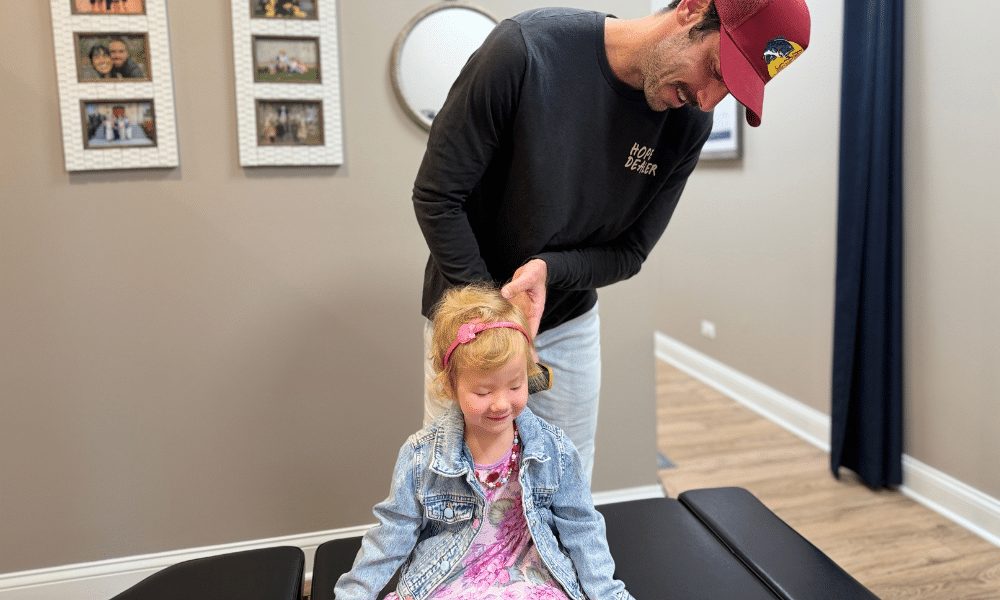
Our doctors approach a fixated or rigid pattern by looking underneath the behavior at the nervous system driving it. Using a gentle exam along with INSiGHT scanning, which measures heart rate variability, muscle tension patterns, and skin temperature, we get an objective look at where your child's nervous system is holding onto stress, often concentrated through the upper neck. From there, using Koren Specific Technique and Talsky Tonal Chiropractic, our doctors work with light, nervous system focused contacts to ease that interference. Many families notice the earliest shifts show up as steadier sleep and easier digestion, with more flexibility and a wider range of interests tending to follow as the foundation settles.
Where to Go From Here
Your child's fixations are not a flaw to correct. They are a strategy a nervous system built to find safety in a world that can feel loud, fast, and unpredictable. Our doctors in Royal Oak would welcome the chance to take a closer look at what is underneath the pattern. Learn more about our approach to autism and neurodevelopmental care, or how we support behavior in kids more broadly. You can also get our free guide, book a consultation, or call us at (248) 616-0900.