You've learned the location of every bathroom in every restaurant you like. You've turned down an invitation you actually wanted to accept because you couldn't be sure how the morning would go. Some days your stomach is fine until early afternoon, then cramping and bloating show up with no clear cause. Other days start rough and you spend the whole morning bracing for whatever comes next.
You've done the work, too. Low FODMAP for weeks at a time. Probiotics. Fiber. An antispasmodic your doctor prescribed. Maybe a colonoscopy that came back clean, which should have felt reassuring and instead felt like being told nothing is wrong while you're still living with it every day. Somewhere in there, someone told you to manage your stress, and you probably thought, I know I'm stressed. That part isn't news.
What usually goes unexplained is why stress and your gut are tied together so tightly, and what that actually means for getting relief that lasts longer than a good couple of weeks.
What IBS Actually Looks Like
IBS isn't one experience. Some people deal mainly with cramping abdominal pain that tracks closely with bowel movements. Others live with bloating that builds through the day regardless of what they ate. Bowel habits swing in both directions too, loose and urgent for some, slow and incomplete for others, and for a lot of patients an unpredictable mix of both that makes it hard to plan anything with confidence. What almost everyone with IBS has in common is that stressful stretches make it worse, even when nothing about the diet has changed.
The Gut Follows the Nervous System
Most people picture a gut brain connection running one way: food goes in, the gut sends signals up, mood follows. The direction that matters most for IBS runs the other way. Your brain sends constant instructions down through the vagus nerve that regulate digestive motility, enzyme release, and how sensitive your gut is to ordinary sensations. Digestion doesn't run on autopilot from the gut alone; it runs on instructions coming down from above. Think of your nervous system as running on two settings, an accelerator that keys the body toward alertness and a brake that allows rest, digestion, and repair. When the accelerator stays down, blood flow and nerve signal shift away from the gut, and the rhythmic coordination digestion depends on gets disrupted. That's a large part of why flares line up with stress so reliably, and why it has so little to do with willpower.
Why the Usual Approaches Only Get You Partway
None of what you've tried was wrong, exactly. Low FODMAP reduces the foods most likely to provoke symptoms. Fiber and probiotics support the gut environment. Antispasmodics quiet the muscle spasm once it starts. Each one addresses an output, a trigger, or a symptom. None of them reach the regulatory signal producing the pattern in the first place. That's a common reason IBS patients cycle through approach after approach and land on partial, temporary relief instead of something that holds. If the nervous system stays locked in a stressed pattern, the gut keeps getting the same instructions no matter how carefully the diet is managed.
What Care Looks Like at Van Every
We start with a full history: what triggers your flares, what you've already tried, and what has helped even a little. Alongside that, our doctors use INSiGHT scanning, thermal, heart rate variability, and sEMG, to get an objective look at how your nervous system is functioning, particularly the balance between that accelerator and brake we mentioned above. That gives us a picture of where the nervous system may be driving digestive dysfunction rather than guessing from symptoms alone.
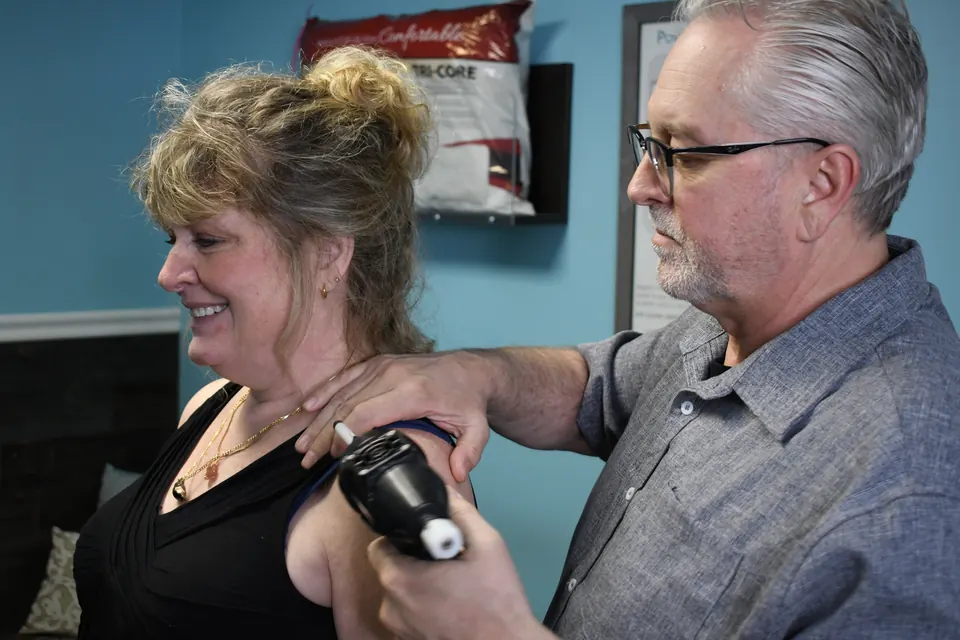
From there, our doctors use Koren Specific Technique and Talsky Tonal Chiropractic, light, nervous system focused contacts with no cracking or twisting, to work with the areas connected to vagus nerve function and autonomic balance, particularly the upper cervical spine where the vagus nerve exits and the thoracic and lumbar regions that supply nerves to the digestive tract. Many IBS patients are sensitive to touch, and this approach is built with that in mind. We also encourage you to keep your relationship with your gastroenterologist. Our role works alongside that care, focused specifically on the nervous system function underlying digestive health.
What Patients Often Notice
Every case is different, and our doctors don't predict a timeline before completing a full history and scan. That said, patients often report that bowel patterns become more regular and predictable, abdominal pain and bloating ease, and flares tied to stress become less frequent. Many describe sleeping better once nighttime discomfort settles, and a good number mention something less clinical: being able to accept an invitation, travel, or sit through a meal without mentally mapping the nearest bathroom first.
A Few Things Worth Tracking at Home
Care in our office tends to work best alongside a clear picture of your own patterns. A few habits tend to help patients and doctors alike:
- Keep a simple log of symptoms alongside sleep, stress, and meal timing, not just food, so patterns beyond diet start to show up
- Eat on a consistent schedule where possible. Irregular meal timing adds its own stress signal on top of everything else
- Notice whether flares cluster around specific stretches, a hard week at work, poor sleep, travel, and bring that pattern to your visits
- Build in short windows of real rest during the day, even five or ten minutes, rather than saving recovery for the weekend
- Share what you're trying and what's changing with your gastroenterologist along the way
Where to Go From Here
If IBS has been quietly running your schedule, restaurant choices, and travel plans for long enough, it's worth understanding the nervous system side of what you're dealing with. You can read more about our approach on the IBS condition page, or get the free guide that goes deeper into the gut brain connection through our IBS guide. Our doctors also walk through the techniques we use on our techniques page. When you're ready, call us at (248) 616-0900 or book online and talk with our doctors about what's been going on.