
Pain that moves around instead of staying in one place. Exhaustion that a full night's sleep never quite fixes. A mental fog that makes ordinary tasks feel harder than they should be. And on top of all of it, the quiet frustration of normal labs and normal imaging, and people who look at you like maybe it isn't as bad as you're describing.
It is real. You're not imagining it, and you're not exaggerating it. There's a reason behind what you're feeling, even if no one has fully explained it to you yet. That reason has a name, and understanding it changes what care for fibromyalgia actually needs to look like.
What's Actually Happening: Central Sensitization
Research increasingly points to fibromyalgia as a condition of central sensitization, meaning the nervous system itself has become hyperreactive and starts amplifying pain signals well beyond what the original input would call for. It isn't that you're overreacting to normal sensations. Your nervous system is generating an outsized response to input that wouldn't register as painful for most people, and it's doing that consistently, not occasionally.
At the spinal cord level, something called wind-up can occur, where repeated input causes the pain signal to amplify more and more with each repetition. In fibromyalgia, this amplification tends to stay switched on, meaning the pain processing centers along the spine stay sensitized even without any new injury happening. At the same time, the brain's own pain modulation, its built-in volume control, tends to be turned down. The volume is going up while the control that's supposed to bring it back down is offline. That combination is a big part of why the pain feels so persistent and so widespread.
How Fibromyalgia Shows Up
Most people describe widespread, diffuse pain that shifts in location and intensity from day to day, along with tender points that flare at the lightest pressure. Fibro fog often travels alongside it, trouble concentrating, memory lapses, and a mental cloudiness that makes even simple tasks feel heavier than they should. Sleep is frequently part of the picture too. Many people fall asleep without trouble but never reach the deep, restorative stage that actually recharges the body, so exhaustion builds no matter how many hours they spend in bed. Sensitivity to touch, light, sound, and temperature often rounds things out, the volume turned up on nearly every kind of input, not just pain.
Why Nothing Seems To Help For Long
The medications most often prescribed for fibromyalgia work on the pathways involved in the brain's pain modulation system, and for some people they genuinely help. Physical therapy can build tolerance. Massage can bring temporary relief. Trigger point injections can quiet an individual pain site for a while. Each of these addresses an output of the sensitization pattern without necessarily changing the underlying nervous system state driving it. That's a big part of why relief so often feels partial, or fades after a while. The pattern reasserts itself because nothing shifted the state maintaining it.
One line of research has found that nearly half of fibromyalgia patients show small nerve fiber changes on skin biopsy, changes that standard blood work and imaging were never designed to detect. There is something measurable happening in the nervous system. The tests you've likely already had simply weren't built to find it.
Why Care Here Looks Different
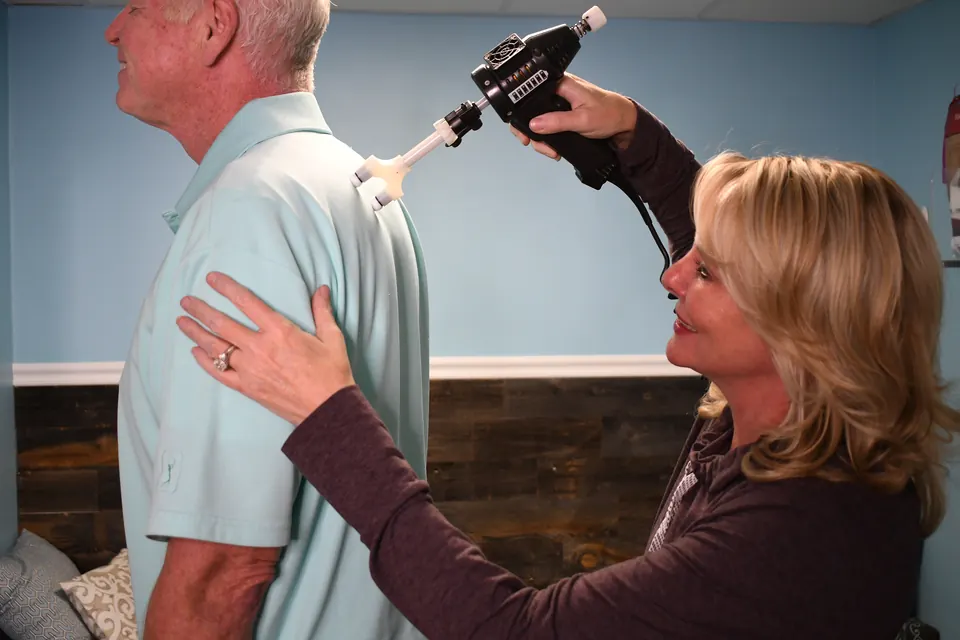
A sensitized nervous system doesn't need more input. It needs the right kind, delivered with a lot of precision and very little force. That's why our approach for fibromyalgia is built differently from a typical adjustment. Using Koren Specific Technique and Talsky Tonal Chiropractic, our doctors work with light, nervous system-focused contacts, no cracking, popping, or twisting, and pressure is adjusted to your sensitivity at every single visit rather than set to any kind of default. KST uses a gentle handheld instrument for precise, repeatable input, while TTC is hands-on and works with your body's own tone. Many patients who braced for something uncomfortable find these adjustments calming instead, sometimes the first hands-on care they've been able to tolerate in years.
We start with a thorough conversation about your symptom patterns, triggers, and sensitivity, then use our INSiGHT scans, thermal imaging, heart rate variability, and muscle (sEMG) readings, to get an objective look at where your nervous system is running hyperactive. That gives us a starting point that doesn't depend entirely on how you happen to feel that particular day. From there, our doctors work with spinal tension and upper cervical patterns affecting the nervous system, adjusting you seated or in whatever position is most comfortable, and we set expectations honestly from the start. Improvement with fibromyalgia tends to build gradually, not overnight.
What Patients Often Report
Many patients describe widespread pain becoming less intense and less constant over weeks to months, not disappearing overnight, but the volume gradually coming down. Sleep quality often improves early in the process, and a number of patients tell us this is one of the first changes they notice. Brain fog often lifts alongside the pain, since both tend to be expressions of the same underlying pattern. Flare-ups tend to become less frequent and less severe over time, and many patients describe a gradual return of capacity, more days where they can plan around their life instead of around their symptoms.
Supporting The Process At Home
Fibromyalgia care is a gradual process, and a few habits between visits tend to support it:
- Keeping a simple log of pain, sleep, and energy so patterns become easier to spot over time
- Protecting a consistent sleep and wake schedule, even on lower-symptom days
- Pacing activity instead of pushing through on good days and crashing after
- Noticing which sensory inputs, light, sound, temperature, tend to flare symptoms and adjusting your environment where you can
- Sharing new patterns or triggers with our doctors so care can adjust alongside your body
Working Alongside Your Other Care
We're glad to communicate with your rheumatologist, pain specialist, or primary care doctor as part of a broader plan for managing fibromyalgia, and we'll refer you elsewhere when that's the right next step for you.
Getting Started
An estimated 4 million adults in the US live with fibromyalgia, and many wait an average of five years or more for a diagnosis. In people with fibromyalgia, heart rate variability, a marker we measure directly with our scans, is very often significantly suppressed, which is one more piece of evidence that what you're feeling is measurable, not imagined. You can learn more on our fibromyalgia page, or get the fuller picture in our free guide. When you're ready, book online with our doctors in Royal Oak, or call us at (248) 616-0900.
