
You've added the fiber, cut back on the cheese, poured in the water, and your child is still uncomfortable, still straining, still going days between bowel movements. What you may have noticed, and what nobody quite explained to you, is that the bad stretches line up with something else entirely: a stressful week at school, a change in routine, a new worry your child cannot quite put into words. Constipation affects a large share of kids at some point, and for a good number of them, the gut is not the whole story. Something upstream is driving it.
Constipation affects up to 30 percent of children, enough that most parents eventually run into it. But when diet changes, more water, and the usual approaches only get you partway there, it is worth looking at what else might be going on underneath.
The Gut and the Brain Are Talking Constantly
There is real truth behind the old phrase about trusting your gut. The digestive tract has its own nervous system, called the enteric nervous system, made up of well over one hundred million nerve cells lining the intestines. People sometimes call it a second brain, and it stays in constant contact with the brain through what is known as the gut-brain axis. Roughly 95 percent of the body's serotonin, a chemical messenger tied to mood, sleep, and appetite, is actually made in the gut rather than the brain. When stress throws that chemical balance off, digestion is one of the first places it shows.
What Anxiety Actually Does to Digestion
When a child feels anxious or under pressure, the body shifts into a fight or flight state and releases stress chemicals like cortisol and adrenaline. That response is useful for a short burst of real danger. Held on for too long, it starts working against the gut. Blood flow moves away from digestion and toward muscles and the brain, the wave-like contractions that move waste through the intestines slow down, and stool sits longer, becomes drier, and gets harder to pass. Add in inflammation and a gut microbiome that shifts under prolonged stress, and the whole system runs less smoothly.
The pattern rarely runs in one direction only. A child who is uncomfortable, embarrassed, or scared of a painful bowel movement often starts holding it in, which only makes the next attempt harder and keeps the anxiety around bathroom time alive. Worry feeds the constipation, and the constipation feeds the worry, back and forth.
Where This Pattern Often Starts
For some kids, this loop has roots that go back further than a stressful week. A stressful pregnancy can expose a baby to elevated stress hormones before birth, shaping how the developing nervous system handles stress later on. Birth itself, particularly when it involves a C-section, forceps, or vacuum extraction, places real physical stress on a newborn's upper neck, right where the vagus nerve begins its path down toward the digestive organs. That is often part of why colic and reflux show up so early for some babies. When that tension in the upper neck goes unaddressed, the same nervous system pattern can keep resurfacing years later as constipation, since the vagus nerve is central to calm, steady digestion at any age.
Why the Usual Approaches Only Get You Partway
Fiber, hydration, and a toilet routine matter, and none of your effort so far was wrong. What those approaches cannot reach is the nerve signal telling the intestines to move in the first place. Laxatives and stool softeners can offer some short-term relief, but they come with their own downsides, cramping, dependency, and a digestive system that leans on them rather than working on its own, and they do not touch the stress pattern underneath. When the nervous system is still running the fight or flight response, gut motility stays slowed no matter how much fiber and water you add on top.
It also helps to know this is not unique to your child, and it is not a sign that something is wrong with how you are parenting. Two related conditions, irritable bowel syndrome and inflammatory bowel disease, both show a similar tie to stress and a dysregulated nervous system. Kids dealing with either one often see symptoms flare during stressful stretches and ease when things settle, more evidence that the nervous system sits underneath the gut symptom rather than the other way around.
Everyday Habits That Help Alongside Care
- Regular movement and outdoor play, which naturally supports gut motility and burns off some of that stress chemistry
- A predictable toilet routine, sitting for a few minutes after meals rather than only when your child feels the urge
- Simple, unhurried mealtimes, since a rushed or tense mealtime adds its own stress signal to a system already working hard
- Naming the worry out loud when you notice it, which can take some pressure off a child who does not yet have the words for what they are feeling
Our Approach
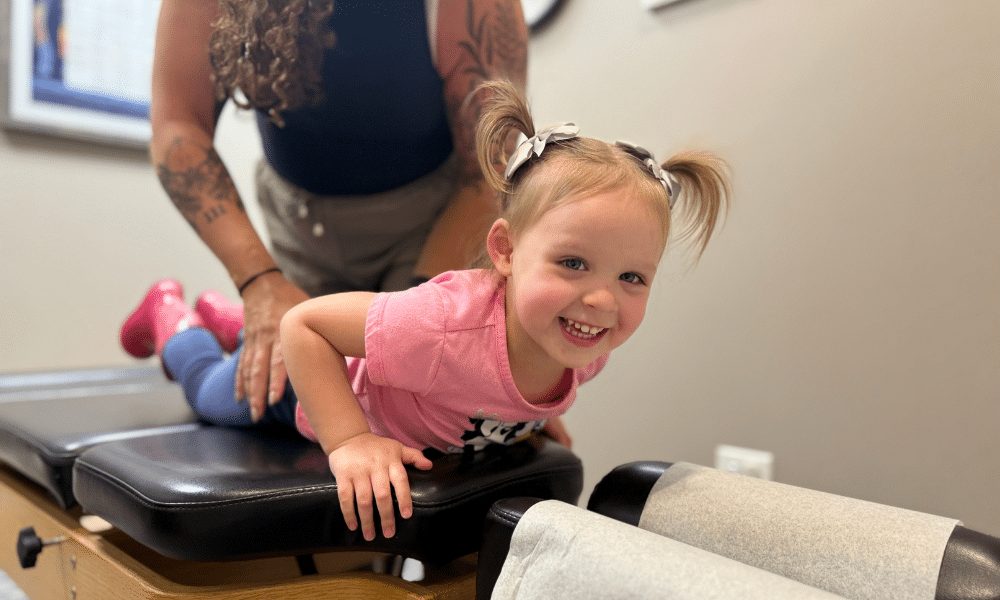
We start by hearing your child's story: the birth history, when the constipation started, what has already been tried, and where the anxiety tends to show up most. From there, our doctors examine the spine and nervous system, with a particular focus on the upper neck and the lower back and sacrum, where the nerves that control bowel motility travel. Using Koren Specific Technique (KST) and Talsky Tonal Chiropractic (TTC), we work with light, nervous system focused contacts, no cracking or twisting, and track your child's progress with INSiGHT scanning so the plan stays based on what is actually changing rather than a guess.
What Parents Often Notice
- More regular, easier bowel movements as the nervous system settles
- Less bathroom avoidance and less tension around bathroom time
- Calmer overall mood alongside the digestive change
- Steadier sleep, since a wound-up nervous system affects both digestion and rest
Where to Go From Here
If your child's constipation seems to track with stress, a hard week, a big transition, a new worry, that instinct is worth trusting. It is worth learning more about how nervous system care approaches constipation in children, and its connection to anxiety in kids. We also have a free guide on the nervous system side of childhood digestion. When you are ready, book a consultation with our doctors in Royal Oak, or call us at (248) 616-0900.